

5 Key Developments from Gaza Peace Talks in Egypt under Trump’s Plan: Ceasefire, Prisoner Exchange, and Gaza Governance. Delegations from Israel and Hamas meet in Sharm el-Sheikh as US President Donald Trump pushes for a ceasefire and hostages’ release under his 20-point Gaza peace plan. As indirect Gaza peace talks in Egypt entered a second day on Tuesday, hopes rose that an end to the devastating conflict between Israel and Hamas might finally be within reach. Delegations from both sides arrived in the Red Sea resort of Sharm el-Sheikh to negotiate under the framework of US President Donald Trump’s 20-point peace plan, which aims to secure a ceasefire, facilitate a prisoner exchange, and establish a roadmap for Gaza’s future governance.
Despite the diplomatic push, the violence on the ground has continued. Ten Palestinians were killed on Monday, including three who were seeking humanitarian aid, according to Al Jazeera sources. The latest fatalities brought the total number of Palestinians killed since Friday to 104, even as the talks began.
Israeli government spokesperson Shosh Bedrosian told reporters that the military would continue operations for “defensive purposes” and confirmed that no ceasefire was in place. “We are acting strictly for defensive reasons. The IDF will not stop operations unless there’s a verified agreement that ensures Israel’s security,” Bedrosian said.
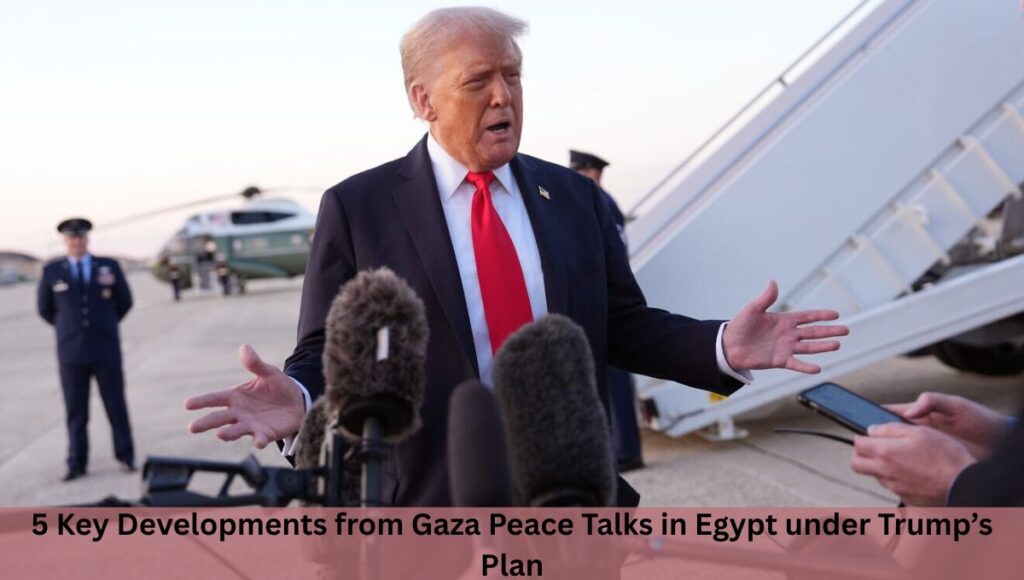
5 Key Developments from Gaza Peace Talks in Egypt under Trump’s Plan
Talks Underway in Egypt: Prisoner Exchange on the Agenda
According to Egypt’s Al-Qahera News, which is affiliated with state intelligence, the delegations in Sharm el-Sheikh are focusing on “preparing ground conditions for the release of detainees and prisoners.” Egyptian and Qatari mediators are working with both sides to create a mechanism for this exchange — a core element of Trump’s Gaza peace plan.
A Palestinian official close to the talks, cited by Reuters, confirmed that the first session concluded late Monday evening and that more discussions were scheduled for Tuesday. The source described the atmosphere as “cautiously optimistic,” with both sides under pressure to demonstrate progress.
Under the plan, Hamas would release Israeli captives in exchange for the release of Palestinian prisoners held in Israeli jails. Israeli Prime Minister Benjamin Netanyahu said over the weekend that an announcement regarding the release of the 48 captives held by Hamas — 20 of whom are believed to be alive — could be made this week.
Trump’s 20-Point Gaza Peace Framework
President Donald Trump has positioned his proposal as a “last and best chance” to end the Gaza war, which began after the October 7, 2023, Hamas attacks on Israel that killed about 1,200 people and led to a massive Israeli military campaign.
The plan’s first phase includes:
- An immediate ceasefire and cessation of hostilities.
- The release of hostages and Palestinian prisoners.
- The withdrawal of Israeli forces from Gaza.
- The deployment of an international peacekeeping force to ensure stability.
- The establishment of an interim Palestinian technocratic administration to govern Gaza.
Trump has called for the talks to “move fast”, warning that delays could result in “massive bloodshed.” On Monday, he told reporters in the Oval Office,
“I think we’re going to have a deal. Hamas has been agreeing to things that are very important. I’m pretty sure this time we’ll get a Gaza deal.”
His administration says the first phase of negotiations should conclude this week, paving the way for a framework agreement that would mark a significant diplomatic breakthrough.
Also Read: What are the key sticking points in Trump’s Gaza peace plan?
Human Toll of the Conflict
The humanitarian crisis in Gaza remains catastrophic. According to the Hamas-run health ministry, 67,160 Palestinians have been killed and 169,679 wounded since Israel launched its offensive. The majority of the enclave’s two million residents have been displaced, with entire neighbourhoods reduced to rubble.
Aid agencies have described the situation as “beyond collapse”, warning of starvation and disease. Despite Trump’s call for an end to airstrikes, Israel’s bombardment of Gaza City continued on Monday, targeting areas it said were used by Hamas for military operations.
Mahmoud Basal, a spokesman for Gaza’s civil defence, told the BBC,
“No aid trucks have been allowed into Gaza City since the offensive began four weeks ago. There are still bodies we cannot retrieve from areas under Israeli control.”
Also Read: Israel Strikes Gaza Kill 70 Despite Trump’s Urgent Plea
Phase One: Hostage Release and Ceasefire
US Secretary of State Marco Rubio outlined two phases of the Trump plan in an interview with ABC’s This Week. The first phase would see Hamas release the Israeli captives, followed by Israel’s withdrawal to the “yellow line” — its military position as of August. Once completed, full humanitarian aid would be allowed into Gaza.
Rubio added,
“Hamas should release captives as soon as they are ready, and Israel’s bombardment must end to enable that release.”
Egyptian and Qatari mediators have been tasked with overseeing this process. Officials close to the talks said the discussions are being held indirectly — Hamas delegates speaking to mediators, who then convey messages to Israeli and US representatives.
Hamas’s Response: Cautious Acceptance
In a statement released last Friday, Hamas said it agreed “in part” to Trump’s peace proposal, particularly the sections relating to the exchange of prisoners and the transfer of Gaza’s administration to a Palestinian body of independents. However, the group has not agreed to disarm or renounce its role in Gaza’s future governance — two key demands in Trump’s plan.
The Hamas statement read:
“We renew our agreement to hand over the administration of Gaza to a Palestinian national framework, based on consensus and Arab-Islamic support.”
Analysts interpreted the absence of Hamas’s traditional “red lines” — such as conditions on Israeli troop withdrawal or permanent ceasefire guarantees — as a sign that external pressure from Qatar and Egypt is shaping its position.
Israeli Politics: Netanyahu’s Balancing Act
Prime Minister Benjamin Netanyahu faces intense political pressure at home as he navigates the peace process. While publicly endorsing Trump’s initiative, he has reiterated his opposition to a Palestinian state, a stance that directly contradicts parts of the US plan.
In a video statement, Netanyahu said:
“We said we would strongly oppose a Palestinian state. It’s not written in the agreement, and that’s our position.”
His far-right coalition partners, led by National Security Minister Itamar Ben-Gvir, have threatened to quit the government if Hamas is allowed to remain in Gaza in any form.
“The central goal of the war is to ensure Hamas cannot continue to exist. We will not be part of a government that accepts Hamas’s survival,” Ben-Gvir wrote on social media.
Opposition leader Yair Lapid, however, has offered to support Netanyahu’s coalition to prevent its collapse during the talks, saying the peace process is “too important to fail due to political blackmail.”
Trump’s Frustration with Netanyahu
Behind the scenes, tensions between Trump and Netanyahu have surfaced. Axios reported that Trump scolded Netanyahu in a phone call after the Israeli leader dismissed Hamas’s partial acceptance of the peace plan as insignificant.
Trump reportedly snapped,
“I don’t know why you’re always so f***ing negative. This is a win. Take it.”
Speaking to Axios the following day, Trump confirmed the exchange, saying,
“I told him this was his chance for victory. With me, you’ve got to be fine.”
Shortly after the call, Netanyahu reportedly ordered a temporary halt to airstrikes in Gaza, following Trump’s public call for restraint.
Key Negotiators: Dermer, al-Hayya, and Kushner
Three figures are steering the Gaza peace talks in Egypt:
Ron Dermer (Israel)
A close aide to Netanyahu and Israel’s minister of strategic affairs, Dermer is known for his strong US ties and played a key role in normalizing relations with several Arab states. Born in Miami Beach, Florida, he previously served as Israel’s ambassador to Washington from 2013 to 2021.
Khalil al-Hayya (Hamas)
The senior Hamas leader, 64, narrowly survived an Israeli assassination attempt in Qatar last month. A long-time member of Hamas’s politburo, al-Hayya has endured multiple assassination attempts and lost his son in Israeli strikes. He now leads Hamas’s delegation in Sharm el-Sheikh.
Jared Kushner (United States)
Representing the US alongside special envoy Steve Witkoff, Kushner — Trump’s son-in-law — has played a pivotal role in shaping the 20-point Gaza peace plan, building on his earlier work on the Abraham Accords.
International Reactions: Cautious Optimism
The international community has largely welcomed the renewed diplomacy.
UN Secretary-General António Guterres called Trump’s proposal “an opportunity that must be seized.”
UK Prime Minister Sir Keir Starmer said London “welcomes the US initiative toward peace” and urged both sides to commit to ending the bloodshed.
Even Iran, traditionally Hamas’s key backer, has signaled tentative support for the peace plan, a shift that diplomats describe as potentially decisive.
The Palestinian Authority (PA) has also praised the US-led effort, calling it “sincere and determined,” though it remains cautious about the plan’s long-term implications.
Outstanding Challenges and Sticking Points
While optimism has grown, several major obstacles could derail the process:
- Disarmament of Hamas – The plan sets no clear timeline or enforcement mechanism.
- Israel’s right to self-defence – Israel insists it must retain the freedom to pursue Hamas even after withdrawing.
- Territorial control – Disputes persist over whether Israel will retain 25% of Gaza as a “security buffer zone.”
- Governance structure – The proposed technocratic administration has yet to be defined or agreed upon by all Palestinian factions.
Political analyst Nour Odeh, speaking from Amman, said:
“There are a lot of details that could potentially derail these negotiations. Every clause will require delicate talks.”
The Road Ahead
The second round of Gaza peace talks in Egypt is set to continue through Wednesday, with Egyptian and Qatari mediators shuttling between the delegations. Israeli and US negotiators are expected to join directly once Hamas presents its updated proposal.
US officials have said they are “cautiously hopeful” that an initial agreement on prisoner exchanges could be reached within days. If successful, the next step would be a comprehensive ceasefire and the deployment of international forces to Gaza.
President Trump said Monday that he was “pretty sure” the deal would happen, adding,
“For years and years, they’ve tried and failed. This time, we have a real shot.”
Conclusion: A Fragile Hope for Peace
The Gaza peace talks in Egypt mark the most significant diplomatic engagement since the war began nearly two years ago. Whether Trump’s 20-point plan succeeds will depend on the willingness of both Israel and Hamas to compromise on core issues — and whether the international community can guarantee compliance once a deal is reached.
For millions of Palestinians trapped in Gaza and Israelis desperate for the return of their hostages, the stakes could not be higher. As Trump wrote on his social media platform, “We are closer to peace than ever before. Everyone must move fast — time is of the essence.”
Related Posts:
- Trump’s 20-Point Gaza Peace Plan Gains Urgent Global…

- Trump’s 2025 Gaza Peace Plan Signing and Historic…

- Trump’s Breakthrough Gaza Ceasefire Deal 2025: Key Insights

- Dramatic Moments Behind Trump’s Gaza Peace Push and…

- Israel Awards Highest Honor to Trump in 2025 for…

- 5 Powerful Highlights as Trump Lands Second Nobel…
