New Delhi | October 2025 — A powerful next-generation hypersonic missile: 5 Reasons India’s Dhvani Missile Will Shake the World. India is poised to make a historic leap in missile technology with its next-generation hypersonic missile, Dhvani, developed by the Defence Research and Development Organisation (DRDO). Already renowned for the BrahMos supersonic cruise missile, India’s missile program is now preparing for a new chapter in strategic defense with Dhvani, which promises speed, agility, and lethality far beyond existing systems.
Dhvani, classified as a Hypersonic Glide Vehicle (HGV), is expected to undergo flight trials before the end of 2025, marking a milestone that positions India alongside global superpowers like the United States, Russia, and China in operational hypersonic weapons.
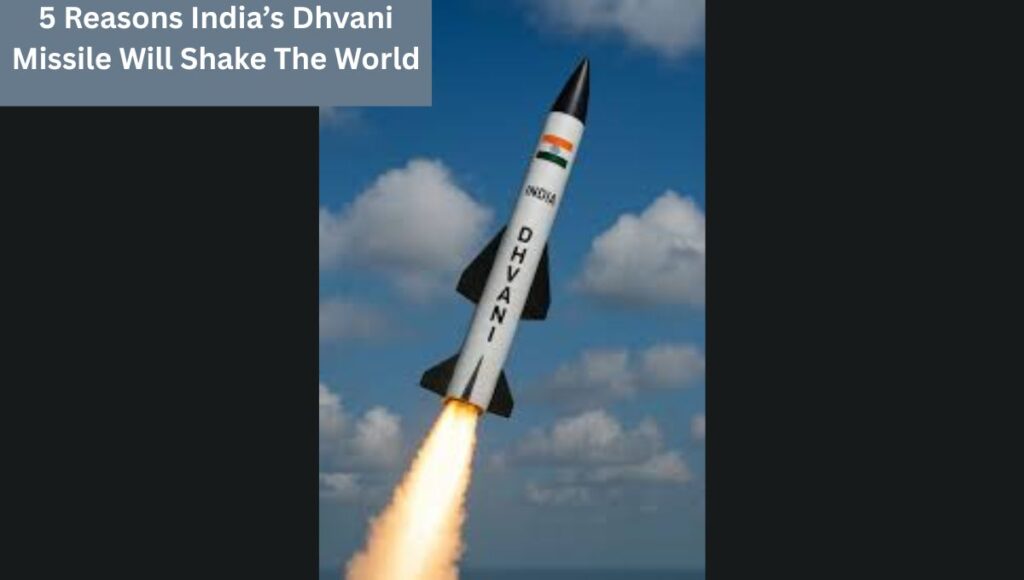
5 Reasons India’s Dhvani Missile Will Shake The World
The Dhvani Hypersonic Missile: A Gamechanger
The Dhvani missile is designed to exceed Mach 6, roughly 7,400 kilometers per hour, making it almost impossible for conventional air-defense systems to intercept. Unlike traditional cruise missiles, Dhvani combines two-stage propulsion and advanced maneuverability:
- Rocket booster launch – propels the missile to high altitude.
- Glide vehicle – separates from the booster and glides toward its target at hypersonic speed, capable of sharp mid-course maneuvers.
Experts argue that existing missile shields, including America’s THAAD and Israel’s Iron Dome, cannot counter a missile with Dhvani’s speed and evasive trajectory. This capability is expected to give India a decisive strategic advantage in both land and maritime combat scenarios.
Built on DRDO’s Hypersonic Technology Demonstrator Vehicle
Dhvani’s development leverages lessons learned from the Hypersonic Technology Demonstrator Vehicle (HSTDV). This program enabled India to master scramjet-based propulsion, a technology critical for sustained hypersonic flight.
- The scramjet combustor has run continuously for over 1,000 seconds, a benchmark unmatched globally.
- Advanced aerodynamics and thermal management systems have been tested to withstand extreme heat generated during flight at Mach 6 speeds.
- Guidance and control technologies have been refined to allow precision strikes at unpredictable trajectories.
These breakthroughs ensure that Dhvani not only surpasses BrahMos in speed but also outperforms China’s DF-26, which relies on a more predictable flight path with limited mid-course maneuverability.
Dhvani vs BrahMos and China’s DF-26
The BrahMos missile, a joint India-Russia project, is already one of the fastest supersonic cruise missiles in the world, capable of Mach 2.8–3. However, Dhvani represents a paradigm shift in missile warfare:
- Speed: Mach 6 versus BrahMos’ Mach 2.8–3.
- Trajectory: Dhvani can glide, turn sharply, and evade interception, whereas BrahMos follows a powered, predictable path.
- Range: Dhvani is expected to cover 6,000–10,000 km, extending India’s strategic strike capabilities.
- Stealth and radar evasion: Dhvani’s design reduces radar cross-section with angled surfaces and smooth contours, unlike BrahMos.
When compared to China’s DF-26, Dhvani surpasses it in agility and maneuvering potential. DF-26 is constrained by fixed flight paths and altitude limits, while Dhvani can shift course mid-flight to strike from unexpected directions. Analysts believe this makes Dhvani one of the deadliest hypersonic weapons in development today.
Technical Specifications That Make Dhvani Lethal
Blended Wing-Body Design
Dhvani measures 9 meters in length and 2.5 meters in width, featuring a blended wing-body configuration. This improves aerodynamics, reduces radar signature, and allows for stable glide at hypersonic speeds.
Advanced Thermal Protection
The missile uses ultra-high-temperature ceramic composites, capable of withstanding 2,000–3,000°C during atmospheric re-entry. These coatings are critical for maintaining structural integrity at Mach 6 speeds.
Hypersonic Maneuverability
Dhvani’s glide vehicle can execute sharp turns mid-flight, evading missile defense systems. This allows it to approach targets from unpredictable angles, a key advantage over existing hypersonic missiles.
Precision Strike Capability
Dhvani can target both land-based and maritime assets with exceptional accuracy, making it a versatile strategic asset for India’s defense forces.
DRDO’s Mission Mode Execution
India’s hypersonic program is part of a broader initiative, Operation Sindoor, aimed at achieving self-reliance in defense technology.
- DRDO and Hindustan Aeronautics Limited (HAL) are spearheading key projects, from fighter jets and radar networks to unmanned platforms.
- Dhvani represents the culmination of these efforts in missile technology, with testing scheduled for late 2025.
- Mission mode execution ensures strict adherence to timelines, technical milestones, and flight test readiness.
Why Dhvani Will Redefine India’s Strategic Posture
Defense analysts point out that pairing BrahMos and Dhvani creates a layered missile defense dilemma for adversaries:
- China and Pakistan will struggle to counter India’s next-generation missiles for at least 15 years.
- The combination enhances India’s deterrence posture, protecting borders and strengthening regional influence.
- Hypersonic glide vehicles like Dhvani elevate India into a select club of nations capable of operational hypersonic strikes.
Recent Test Milestones
In recent months, DRDO has successfully validated critical components of Dhvani:
- Aerodynamics – ensuring stability and precision at hypersonic speeds.
- Thermal management – advanced ceramic coatings withstand extreme flight temperatures.
- Guidance systems – enabling pinpoint accuracy and mid-flight course adjustments.
- Scramjet propulsion – proven for extended duration of over 1,000 seconds.
These tests are paving the way for the full-scale flight trial expected in 2025, a milestone that could solidify India’s leadership in hypersonic missile technology.
Implications for Regional Security
China
China’s DF-26 missile, deployed for years, lacks the agility and maneuverability of Dhvani. Dhvani’s ability to evade radar and alter trajectory mid-flight could give India a decisive edge in the Indo-Pacific region, potentially deterring aggression.
Pakistan
For Pakistan, Dhvani’s speed, precision, and evasion capabilities present a significant strategic challenge, making interception nearly impossible with existing air-defense systems.
Global Strategic Balance
India joining the ranks of operational hypersonic missile powers reshapes the global security architecture. With Dhvani, India demonstrates technological prowess and enhanced deterrence, signaling its ability to protect national interests against both regional and global threats.
Comparative Advantage: Dhvani Over Existing Systems
| Feature | Dhvani | BrahMos | China DF-26 |
| Speed | Mach 6 (~7,400 km/h) | Mach 2.8–3 | Mach 5–6 |
| Maneuverability | High, mid-course turns | Moderate, fixed trajectory | Limited, relatively fixed |
| Range | 6,000–10,000 km | 400–500 km | 4,000 km |
| Radar Evasion | Yes, stealth optimized | Limited | Limited |
| Interception Risk | Extremely low | Low | Medium |
Conclusion: Dhvani as a Strategic Gamechanger
The Dhvani hypersonic missile represents a leap in India’s strategic capabilities, combining speed, agility, and precision to surpass existing systems like BrahMos and China’s DF-26.
- Testing in 2025 will mark India’s entry into elite hypersonic missile powers.
- The missile will strengthen India’s defense posture in the Indo-Pacific and beyond.
- Dhvani’s success could reshape regional deterrence, ensuring India’s technological edge in missile warfare for the next decade and beyond.
As India prepares for the maiden flight, global defense analysts are watching closely. If successful, Dhvani will not only redefine India’s missile capability but also signal a new era in high-speed, high-precision hypersonic warfare.
Also Read: 1. Now at UN, Trump says he ‘ended’ India-Pak war: ‘I deserve Nobel prize’
2. Operation Sindoor: India Strikes 9 Terror Bases in Historic Tri-Services Offensive