In a striking shift of defense priorities, Pakistan Eyes German Missile Shield After BrahMos Missiles Decimate Chinese Air Defenses. Pakistan is now exploring a missile shield from Germany, after India’s BrahMos cruise missiles exposed deep vulnerabilities in Islamabad’s Chinese-supplied defense systems during the recent Operation Sindoor. The move signals growing Pakistani disillusionment with China’s HQ-9 and HQ-16 platforms and opens the door to potential deals with European defense manufacturers, notably Germany’s Diehl Defence.
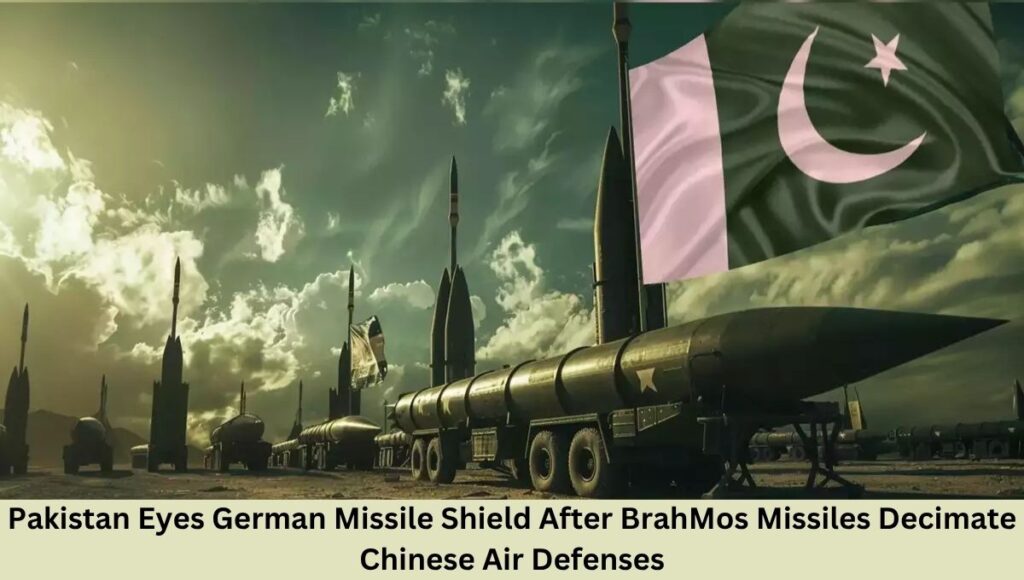
Pakistan Eyes German Missile Shield After BrahMos Missiles Decimate Chinese Air Defenses
BrahMos: The Wake-Up Call Pakistan Couldn’t Ignore
From May 7–10, 2025, India launched Operation Sindoor, a high-precision military campaign targeting terror hubs and airbases deep inside Pakistani territory and Pakistan-occupied Kashmir (PoK). The strikes were reportedly conducted using the BrahMos supersonic cruise missile, a joint Indo-Russian weapon known for its Mach 3 speed, low radar signature, and surgical precision.
While New Delhi has not officially confirmed using BrahMos, Pakistani Prime Minister Shehbaz Sharif acknowledged the strikes and admitted that 11 of the country’s 13 airbases were hit. The aftermath has left Pakistan’s military scrambling for answers.
Chinese Systems Fail Spectacularly
The biggest shock came from the complete failure of Pakistan’s Chinese-origin HQ-9 and HQ-16 missile defense systems. Designed as part of Pakistan’s multi-layered Comprehensive Layered Integrated Air Defense (CLIAD), these systems were supposed to detect and neutralize aerial threats like BrahMos.
Instead, they stood silent. Pakistani officials have privately admitted that the HQ-9B was unable to detect, let alone intercept, the fast, low-flying BrahMos missiles. The resulting humiliation has triggered a reassessment of the country’s strategic dependencies, particularly on China.
Germany’s IRIS-T SLM Emerges as a Top Contender
As Islamabad looks beyond Beijing, Germany’s IRIS-T SLM system has captured Pakistan’s attention. Developed by Diehl Defence, the IRIS-T (Infrared Imaging System Tail/Thrust Vector-Controlled – Surface-Launched Missile) is a medium-range, 360-degree air defense system that has demonstrated exceptional combat performance in Ukraine.
In 2023–24 alone, the system intercepted over 60 Russian missiles, including the P-800 Oniks, a cruise missile with similar flight characteristics to the BrahMos. Pakistani defense planners believe IRIS-T’s infrared seeker and high agility offer a better chance against supersonic threats compared to radar-guided systems like Italy’s CAMM-ER.
The Italy Option: CAMM-ER Under Consideration Too
Italy’s CAMM-ER (Common Anti-Air Modular Missile – Extended Range) is also on Pakistan’s radar. It offers flexible deployment from land, sea, or air, and has a range of 45 km. With jam-resistance and NATO standardization, it’s seen as a solid option.
However, defense analysts suggest that CAMM-ER’s slower reaction time and radar-guided mechanism may struggle against BrahMos, especially the extended-range version that can strike from up to 800 km away. Still, for a cash-strapped Pakistan, CAMM-ER’s lower cost makes it a viable secondary choice.
Indo-German Ties May Complicate Pakistan’s IRIS-T Hopes
Despite IRIS-T’s appeal, Pakistan’s attempt to buy German weaponry faces geopolitical roadblocks. Diehl Defence is currently working on multiple high-profile Indian defense projects. This includes Project 75I, a ₹70,000 crore contract to build six advanced submarines for the Indian Navy, in collaboration with Thyssenkrupp Marine Systems.
Furthermore, Diehl is partnered with Reliance Defence in India to produce Vulcano 155mm precision artillery shells, boosting India’s indigenous weapons manufacturing capabilities.
These growing Indo-German defense ties may limit Berlin’s willingness to risk diplomatic tensions with New Delhi by selling the same cutting-edge systems to Islamabad.
Pakistan’s Defense Ambitions vs Economic Realities
Even as it explores European defense systems, Pakistan’s economic crisis looms large. In its latest national budget, the Sharif government increased defense spending by 20 percent, while slashing overall expenditure by 7 percent and canceling over 1,000 billion rupees worth of development projects.
Currently, over 45% of the population lives below the poverty line, with 16% in extreme poverty. Despite this, Islamabad has secured a $1 billion loan from the IMF and $800 million from the Asian Development Bank, in part to fund its renewed military procurement efforts.
At €178–200 million per unit, the IRIS-T system is hardly cheap. Even if a few batteries are acquired, they won’t be enough to protect all key sites, raising logistical concerns about coverage gaps.
A Tactical Upgrade, Not a Strategic Solution
Military experts caution that no single system can serve as a silver bullet against BrahMos. The missile’s speed, stealth, and extended range demand a layered, multi-platform defense approach, which Pakistan currently lacks.
Even with IRIS-T, Pakistan would need to supplement it with other systems possibly newer Chinese platforms or domestic upgrades to build a viable air shield. Until then, the country remains vulnerable to another Operation Sindoor-style strike.
Conclusion: A Desperate Race for Deterrence
Pakistan’s hunt for an answer to India’s BrahMos missile is not just about hardware it’s a race against time, money, and geopolitics. Operation Sindoor shattered not only Pakistan’s air defenses but also its confidence in Chinese technology. Now, with eyes on Europe and wallets tightened by economic strain, Islamabad is walking a tightrope.
Whether Germany’s IRIS-T or Italy’s CAMM-ER becomes the backbone of Pakistan’s new missile shield, the road ahead is fraught with diplomatic dilemmas and financial hurdles. But one thing is certain: Pakistan needs more than just a new defense system it needs a strategy that works.
Also Read: 5 Reasons India’s Dhvani Missile Will Shake The World
Also Read: After Operation Sindoor, Pakistan’s Air Defenses Lie In Ruins – What Islamabad Is Doing Next
Related Posts:
- Afghanistan–Pakistan War 2025: Inside the 48-Hour Ceasefire

- 5 Reasons India’s Dhvani Missile Will Shake The World

- Pakistan–Afghanistan Border Conflict 2025: Ceasefire…

- 5 Key Shifts in Bangladesh–Pakistan Relations as…

- 7 Stunning Strikes: Iran Claims Destruction of US…

- Pakistan–Afghanistan Conflict: 10 Civilians Killed…