

Paris | October 6, 2025 — After less than a month, France’s PM Resigns: 5 Days of Political Turmoil and rattled financial markets. French Prime Minister Sebastien Lecornu resigned on Monday, hours after unveiling his new cabinet, sending shockwaves through Paris and amplifying a political crisis that has gripped the country since snap elections in 2024. Lecornu, a close ally of President Emmanuel Macron, had been in office for less than four weeks, making him the shortest-serving French prime minister in the Fifth Republic.
The abrupt departure underscores the challenges Macron faces in governing a deeply divided National Assembly, where no single party commands an absolute majority.
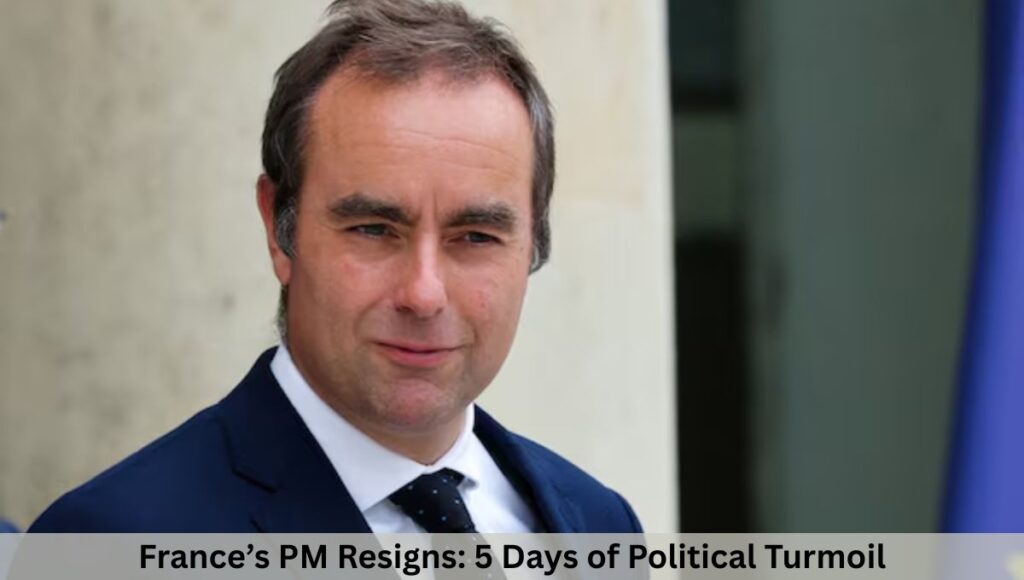
France’s PM Resigns: 5 Days of Political Turmoil
A Cabinet That Sparked Backlash
Lecornu’s government, unveiled on Sunday, largely retained ministers from previous administrations, drawing immediate criticism from across the political spectrum.
- Bruno Retailleau, Interior Minister and leader of the Republicans, criticized the cabinet for failing to reflect promised reforms.
- Jordan Bardella, leader of the far-right National Rally, condemned Macron for controlling appointments, leaving Lecornu with limited authority.
- Arthur Delaporte, Socialist Party spokesperson, labeled the cabinet a continuation of “Macronism” plunging France into chaos.
Of Lecornu’s 15 ministers, 10 belonged to Macron’s party, leaving no representation from left-wing or far-right parliamentary blocs. Critics argued that this reinforced the perception of a government disconnected from the electorate.
Key Cabinet Appointments
Despite backlash, several high-profile appointments were made:
- Bruno Le Maire – Former Finance Minister, appointed Defence Minister
- Roland Lescure – Economy Minister, tasked with delivering the 2026 austerity budget
- Bruno Retailleau – Interior Minister
- Jean-Noël Barrot – Foreign Minister
- Gérald Darmanin – Justice Minister
Lecornu’s cabinet was intended to navigate France through a politically hostile parliament and implement fiscal reforms, but the rapid resignation has thrown the plan into uncertainty.
Political Paralysis in France
France has seen five prime ministers in less than two years, reflecting the turbulence of Macron’s presidency since snap elections in 2024 produced a fragmented legislature.
- No single party holds a majority, forcing Macron to rely on fragile coalitions.
- Opposition parties on both left and right have prepared no-confidence votes, while far-right leaders are demanding snap elections.
- Lecornu, a former defence minister, inherited a minority government with limited maneuverability in Parliament.
Political analysts see Lecornu’s resignation as a reflection of systemic instability. Antoine Bristielle, a French political scientist, told CNN:
“Emmanuel Macron is left with only two real options: dissolve the National Assembly or resign himself, triggering a new presidential election. It seems highly probable that he will choose the former.”
Economic Fallout and Market Reactions
The resignation immediately impacted financial markets.
- CAC-40, France’s benchmark stock index, fell nearly 2% on Monday morning, reflecting investor anxiety over political instability.
- Concerns mounted over the 2026 national budget, which was scheduled for ministerial approval Tuesday, now in limbo.
- Lecornu had aimed to implement austerity measures, reduce the national deficit, and propose a wealth tax to appease Socialists, while avoiding measures that could impact business owners.
Bruno Le Maire’s shift from finance to defense has also raised investor unease due to his prior management of France’s national deficit during the COVID-19 pandemic.
Strikes and Public Protests Intensify Pressure
The resignation comes amid widespread unrest in France.
- On October 2, unions organized nationwide strikes, with teachers, students, and public-sector workers demanding higher wages, better funding for public services, and reversal of pension reforms.
- Over 500,000 protesters participated in marches just two weeks earlier, targeting austerity measures.
- Lecornu faced the challenge of presenting a budget for 2026, while attempting to manage both parliamentary opposition and street-level protests.
The public unrest underscores the fragile legitimacy of France’s minority government, adding pressure on Macron’s administration to act decisively.
Short-Lived Leadership and Institutional Challenges
Lecornu’s tenure is remarkable for its brevity. Appointed less than a month ago, he became the fifth prime minister under Macron in two years, highlighting the instability of the presidency in a fragmented parliamentary system.
- His predecessors, Francois Bayrou and Michel Barnier, were removed over budget disputes, reflecting persistent tensions between executive ambitions and legislative authority.
- Lecornu’s promise to avoid constitutional shortcuts for budget approval left him vulnerable in a politically divided National Assembly.
Observers note that the government’s minority status and contentious cabinet choices were central to his rapid departure.
Political Reactions Across the Spectrum
Left-Wing Response
Socialist Party leaders described the cabinet as illegitimate and a continuation of Macronist chaos. Olivier Faure, Socialist Party leader, warned:
“We are witnessing an unprecedented political crisis. Macron’s group is imploding, and the new government has no legitimacy left.”
Right-Wing and Far-Right Response
- Bruno Retailleau (Republicans) criticized the cabinet as failing to bring meaningful change.
- Jordan Bardella (National Rally) called for snap elections or Macron’s resignation, blaming the president for centralizing cabinet appointments.
Implications for Macron and the French Government
Macron now faces two major options:
- Dissolve the National Assembly and call fresh elections, risking further political uncertainty.
- Attempt to appoint another prime minister and rebuild coalition support, a challenging prospect given fractured parliamentary blocs.
The political deadlock coincides with France’s record-high public debt, the third highest in the EU, and ongoing economic pressure from rising deficits, exacerbating concerns about stability.
Key Challenges Ahead
- Passing the 2026 Budget – Delayed due to the resignation, increasing pressure on the next prime minister.
- Managing Public Unrest – Strikes and protests demand responsive government action on social and economic policies.
- Securing Parliamentary Support – Macron must negotiate across ideological divides to prevent further gridlock.
- Investor Confidence – Stock market drops highlight the economic cost of political instability.
Historical Context of Frequent PM Changes
Since the beginning of the Fifth Republic, France has experienced relatively stable governance, but the current period under Macron has seen a surge in short-lived administrations, driven by:
- Snap elections producing divided legislatures
- Coalition governments struggling to implement reforms
- Public dissatisfaction with austerity measures and economic policy
Lecornu’s resignation, hours after cabinet formation, may be remembered as a symbol of modern political fragility in France.
Also Read: What’s Next For France As Macron’s Revolving Door Of PMs Spins Again?
Conclusion: A Government in Limbo
The resignation of Sebastien Lecornu has amplified France’s political crisis, revealing the complexities of governing without a majority in Parliament.
- Macron faces immediate pressure to stabilize the government or call new elections.
- Investors and the public alike are watching the unfolding situation closely, with economic uncertainty compounding political instability.
- Lecornu’s short-lived leadership highlights both the fragility of minority governments and the challenges of navigating competing political, social, and economic pressures.
As France grapples with protests, financial volatility, and parliamentary division, the next steps taken by Macron will likely determine whether the country finds stability or descends further into uncertainty.
Related Posts:
- Macron Reappoints Lecornu as PM 2025 – Triggers…

- 5 Shocking Developments in Macron’s Political Crisis

- France’s Political Crisis 2025: Macron’s Next Move

- France in Turmoil as ‘Block Everything’ Protests…

- 7 Big Takeaways: Macron’s High-Stakes China Visit…

- French PM François Bayrou Ousted in Confidence Vote,…
