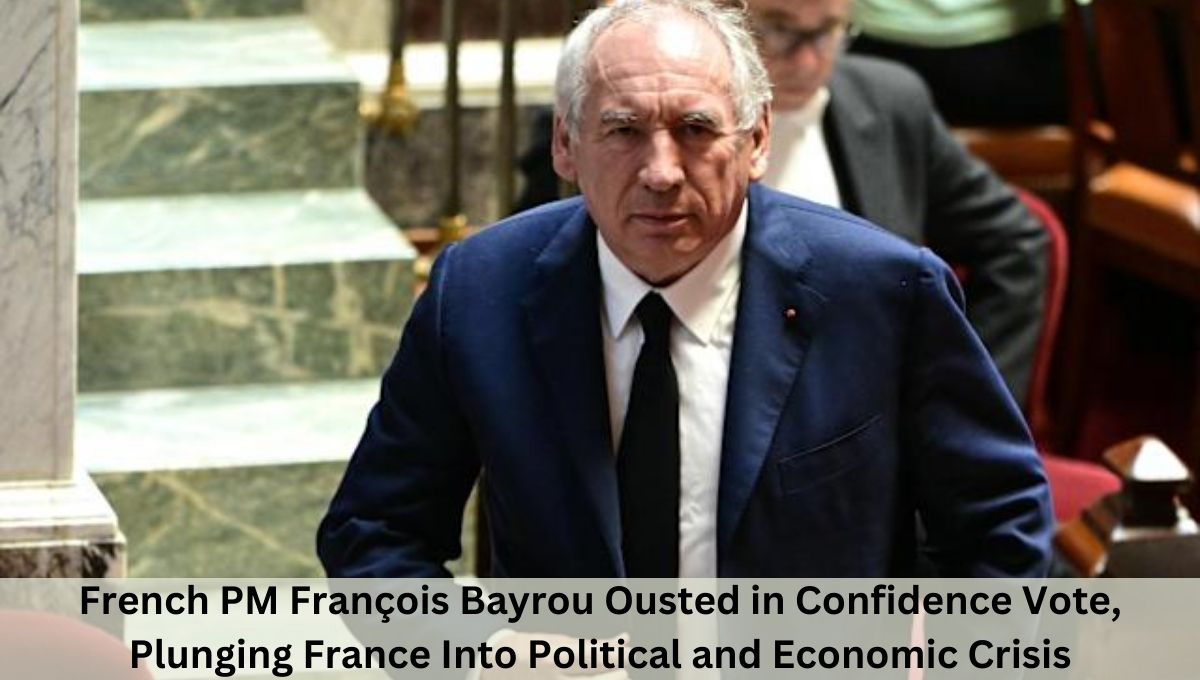
After just nine months in office, French PM François Bayrou Ousted in Confidence Vote, Plunging France Into Political and Economic Crisis. France has been plunged into a fresh political storm after Prime Minister François Bayrou lost a confidence vote in Parliament on Monday, forcing his government to collapse after just nine months in office. The stunning defeat deepens a crisis at the heart of Europe’s second-largest economy, raising questions about President Emmanuel Macron’s leadership, France’s fiscal future, and the stability of the country’s parliamentary democracy.
French PM François Bayrou Ousted in Confidence Vote, Plunging France Into Political and Economic Crisis
The Confidence Vote That Toppled Bayrou
On Monday, lawmakers in the National Assembly France’s lower house of Parliament voted 364 to 194 to declare no confidence in Bayrou’s government. The vote centered on Bayrou’s controversial €44 billion ($52 billion) austerity budget plan, which sought to reduce France’s ballooning public debt.
Bayrou, a 74-year-old veteran of French politics, had dramatically called the confidence vote himself, betting that lawmakers would rally behind his fiscal credibility. Instead, his gamble backfired spectacularly, uniting opposition forces from both the far left and far right in a resounding rejection.
“You have the power to bring down the government, but you do not have the power to erase reality,” Bayrou warned lawmakers in his final speech before the vote. “Reality will remain relentless: expenses will continue to rise, and the burden of debt, already unbearable, will grow heavier and more costly.”
Despite his plea, the Assembly voted decisively to topple his administration, making Bayrou the first prime minister in modern French history to be ousted by a confidence vote. He is expected to formally present his resignation to Macron on Tuesday.
Macron’s Dilemma: A Fifth Prime Minister in Two Years
Bayrou’s downfall leaves President Macron facing one of the toughest moments of his presidency. Since 2022, France has seen four prime ministers come and go, reflecting a fractured political system where no single party commands a majority in Parliament.
Macron now faces three unenviable choices:
- Appoint another prime minister — risking yet another repeat of Bayrou’s fate if the new premier cannot command parliamentary support.
- Call snap elections — a gamble that could backfire by strengthening the far-right National Rally (RN) led by Marine Le Pen or the far-left bloc under Jean-Luc Mélenchon.
- Stay the course until 2027 — resisting calls to resign and trying to manage with a caretaker government while passing only minimal legislation.
Political analyst Hugo Drochon of the University of Nottingham told Al Jazeera:
“Macron doesn’t have many good choices. In fact, most of his choices are bad ones. Whoever he appoints will face the same fractured Parliament. Without a consensus, the risk is simply more paralysis.”
Why Bayrou Fell: The Budget Battle
The immediate trigger for Bayrou’s collapse was his austerity budget aimed at slashing France’s deficit, which has ballooned to 5.8% of GDP, nearly double the European Union’s 3% ceiling. France’s national debt now stands at 114% of GDP, among the highest in the eurozone.
Bayrou’s plan called for:
- €44 billion in spending cuts in 2025
- Freezing most welfare programs
- Eliminating two public holidays to boost productivity
- Targeting a debt-to-GDP reduction to 117.2% by 2029
Opposition leaders blasted the plan as unfair and socially damaging, with far-right leader Jordan Bardella declaring:
“We will never vote in favour of a government whose decisions are making the French suffer.”
Even some conservative lawmakers traditionally aligned with Bayrou defected, condemning the cuts as excessive.
A Crisis Rooted in Macron’s 2024 Election Gamble
The roots of this crisis stretch back to Macron’s snap parliamentary elections in June 2024, a bold gamble meant to shore up support for the political center. Instead, French voters flocked to the extremes.
The election produced a hung parliament split into three blocs:
- A left alliance won the most seats but fell short of a majority.
- The far-right National Rally won the largest share of votes but also lacked a majority.
- Macron’s centrist coalition lost seats but remained a crucial third bloc.
The fragmented result left France virtually ungovernable, with every major policy from pensions to welfare to climate action stuck in gridlock.
Bayrou’s ouster now marks the second prime minister Macron has lost in a year after Michel Barnier’s short-lived premiership collapsed in late 2024.
Macron’s Shrinking Popularity
If Macron hoped Bayrou’s ouster might be seen as Parliament’s failure, polls suggest otherwise. Public confidence in the president has plummeted to 15%, according to a Verian Group survey for Le Figaro Magazine, down six points since July.
Other polls by Ifop and Elabe show that 56–69% of French voters want new elections, even as Macron has consistently refused to step down before his mandate ends in 2027.
Political economist Stefano Palombarini noted:
“There’s a general political malaise and dissatisfaction specifically with Macron. Both Barnier and Bayrou failed. If Macron tries another centrist compromise, he risks losing even more credibility.”
Historical Parallels: France’s Return to 1958?
The instability has drawn comparisons to 1958, when France’s Fourth Republic collapsed under the weight of weak coalition governments and political paralysis, prompting Charles de Gaulle to establish the more stable Fifth Republic.
Today, with France seeing five prime ministers in less than two years, some warn the system may again be under strain.
Kathryn Kleppinger, professor of French studies at George Washington University, told Bloomberg:
“I fear we’re going to be dealing with more of the same. The blocs are irreconcilable. Which party can one even recruit from? That’s the dilemma Macron faces.”
The Economic Stakes: Debt, Deficit, and Investor Confidence
France’s debt crisis is not just political it is also financial. With the deficit at €169 billion ($198bn) and growing by €5,000 every second, according to Bayrou, investors are watching closely.
The spread between French 10-year government bonds and German bunds a key measure of risk in the eurozone has widened, signaling nervousness.
Fitch Ratings is due to update its assessment of France’s creditworthiness later this week. Analysts warn that failure to pass a credible budget could threaten France’s standing in global markets.
Michael Nizard of Edmond de Rothschild Asset Management wrote:
“Whichever outcome of the current political crisis, the probability of a significant public finances reform will remain low. Financial markets might settle for a scenario where the deficit doesn’t deteriorate further but they’re not expecting miracles.”
Social Unrest Brewing
Beyond Parliament, France’s streets are once again becoming a pressure point.
- A left-wing movement known as “Block Everything” is calling for nationwide demonstrations this week.
- Union-led hospital and rail strikes are planned for September 18.
- The unrest recalls the “gilets jaunes” (yellow vest) protests of 2018 and 2023, when Macron’s domestic policies triggered mass anger.
Analysts warn Macron cannot afford another cycle of social upheaval, particularly with inflation and energy costs still straining households.
Marine Le Pen and the 2027 Election Shadow
For Macron, the crisis is also reshaping the battlefield ahead of the 2027 presidential election. With Macron barred from seeking a third term, the far right smells opportunity.
National Rally leader Marine Le Pen, despite her legal troubles, has urged Macron to call snap legislative elections, declaring:
“This moment marks the end of the agony of a phantom government. Elections are not an option but an obligation.”
Le Pen was recently convicted in a fake jobs scandal and handed a four-year prison sentence (two suspended) and a five-year political ban, but her appeal will be heard well before the 2027 race potentially reviving her presidential ambitions.
What Happens Next?
President Macron now has days perhaps weeks to decide on a new prime minister. Under France’s constitution, there is no deadline, but the longer the vacuum persists, the greater the risk of political and economic instability.
Potential scenarios include:
- Appointing a technocratic premier — a neutral figure focused on fiscal management rather than politics.
- Reaching across the aisle to form a coalition with moderate Socialists or Greens.
- Relying on caretaker governance until after the next budget battle, effectively putting reforms on ice.
Whatever choice Macron makes, the underlying parliamentary arithmetic remains the same: a hung Assembly where neither left, right, nor center commands enough power to govern alone.
Conclusion: A Test of Macron’s Legacy
The collapse of François Bayrou’s government after just nine months is more than another political embarrassment for Macron. It underscores the deep dysfunction at the heart of French democracy a divided Parliament, a weakened presidency, and a restless public.
With France’s debt spiraling, markets watching nervously, and social unrest looming, Macron’s next decision will shape not only his legacy but also the trajectory of the French Fifth Republic.
If he cannot restore stability, historians may one day look back at 2024–25 as the moment when France slid into a new era of political fragmentation one that could open the door to a far-right presidency in 2027.
Related Posts:
- Macron Reappoints Lecornu as PM 2025 – Triggers…

- France in Turmoil as ‘Block Everything’ Protests…

- 7 Big Takeaways: Macron’s High-Stakes China Visit…

- France’s Political Crisis 2025: Macron’s Next Move

- 5 Shocking Developments in Macron’s Political Crisis

- 7 Heartbreaking Facts About Venezuela's Earthquake Disaster