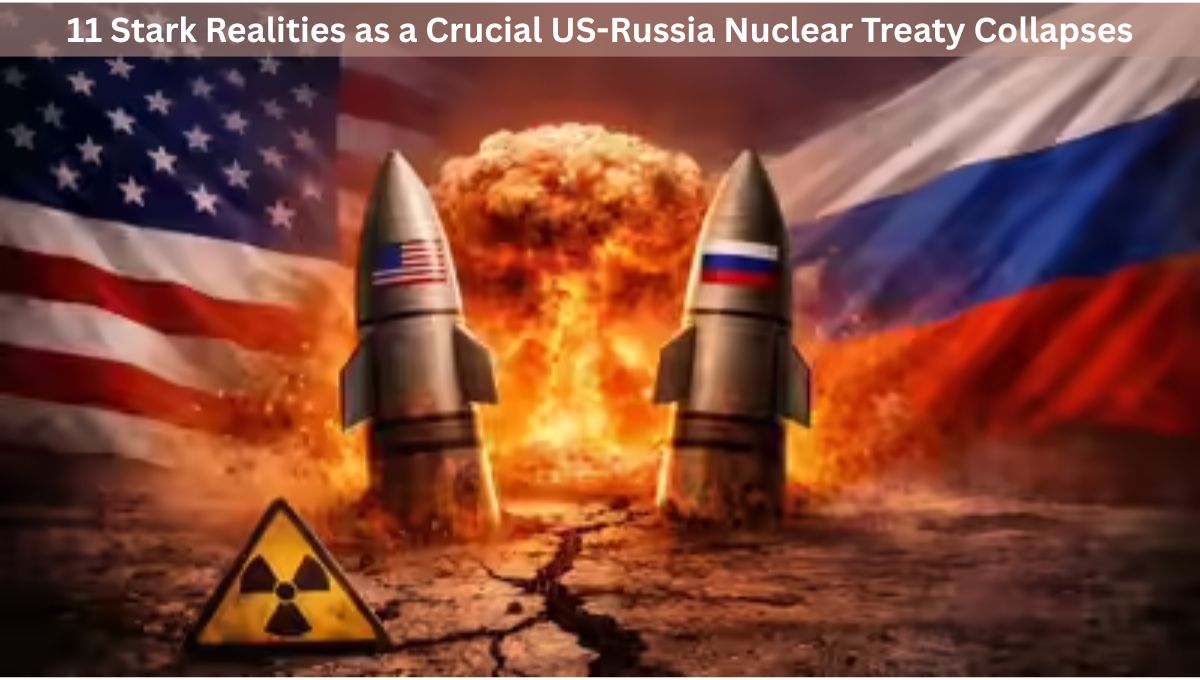
11 Stark Realities as a Crucial US-Russia Nuclear Treaty Collapses, ending all limits on nuclear arsenals. For the first time in more than half a century, the world has entered an era without any binding limits on the two largest nuclear arsenals on Earth.
The expiration of the New Strategic Arms Reduction Treaty (New START) marks not just the collapse of a single agreement, but the unraveling of an entire framework that once anchored global nuclear stability.
Signed in 2010 by then-US President Barack Obama and Russian President Dmitry Medvedev, New START capped deployed nuclear warheads at 1,550 each and imposed verification and inspection regimes that allowed both sides to monitor compliance.
For Russia in particular, the treaty carried significance far beyond numbers. It preserved Moscow’s standing as a nuclear peer to Washington—one of the last tangible remnants of Soviet-era superpower status. With the treaty’s expiration, that symbolic parity is gone.
And with it, many fear, goes a crucial guardrail preventing miscalculation, arms racing, and nuclear escalation at a moment of extraordinary global instability.
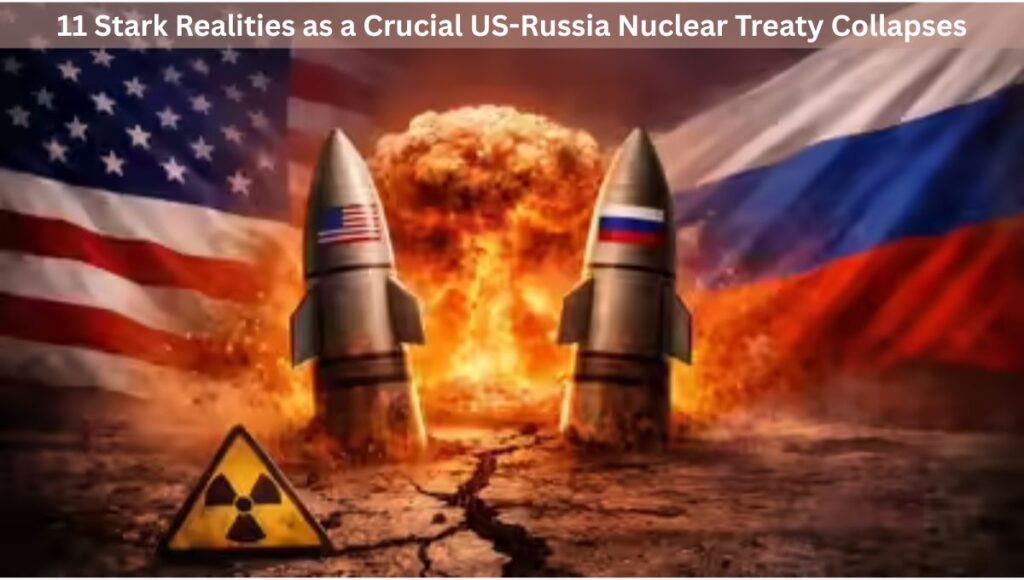
11 Stark Realities as a Crucial US-Russia Nuclear Treaty Collapses
1. Why New START Mattered More Than Any Other Treaty
The Last Pillar of US-Russia Arms Control
New START was the final surviving agreement in a long lineage of Cold War and post-Cold War arms control treaties, stretching back to SALT I in 1972.
As other accords collapsed—the Anti-Ballistic Missile Treaty in 2001, the Intermediate-Range Nuclear Forces Treaty in 2019—New START remained the sole framework limiting strategic nuclear weapons.
Its importance lay not only in numerical caps, but in predictability. Through data exchanges, notifications, and inspections, both sides could assess the other’s capabilities without resorting to worst-case assumptions.
With its demise, that predictability disappears.
2. Russia’s Nuclear Status: The Last Claim to Superpower Equality
A Superpower in Name, Not Capacity
Since the collapse of the Soviet Union in 1991, Russia’s global influence has steadily diminished.
Its economy, technological base, and conventional military power no longer match those of the United States.
Yet one arena remained where Moscow could credibly claim equality:
nuclear weapons.
New START institutionalized that parity. At summits, Russian leaders could sit across from US presidents as equals, negotiating the fate of the world’s most destructive weapons.
Without the treaty, Russia faces a harsh reality:
it lacks the economic and industrial capacity to compete in an unconstrained nuclear buildup with the United States.
3. Why Moscow Is Alarmed While Washington Shrugs
Contrasting Reactions to Expiry
The Trump administration has treated the treaty’s expiration with notable indifference.
President Donald Trump dismissed the issue bluntly, saying:
“If it expires, it expires. We’ll do a better agreement.”
In Moscow, the tone has been starkly different. Russian officials have issued repeated warnings, emphasizing the risks of instability and escalation.
Dmitry Medvedev cautioned that the lapse of New START would move the symbolic Doomsday Clock closer to midnight.
The disparity reflects underlying power realities. The United States can afford a new arms competition. Russia cannot.
4. The Economic Gap That Undermines Russia’s Leverage
An Arms Race Moscow Cannot Win
The Soviet Union once matched American military expansion step for step. Modern Russia cannot.
The United States has vastly greater:
- Defense spending
- Advanced manufacturing capacity
- Technological depth
An unconstrained environment allows Washington to expand or modernize at a scale Moscow struggles to match.
This imbalance strips Russia of the leverage that arms control once provided—ironically making treaties more valuable to Moscow than to Washington.
5. Inspections, Trust, and the Ukraine War
How Verification Broke Down
One of Washington’s central complaints was Russia’s refusal to allow on-site inspections, which Moscow suspended in 2023.
Russian officials argued inspections were untenable while NATO openly backed Ukraine and sought Russia’s defeat.
This collapse of verification mechanisms hollowed out the treaty well before its formal expiration, eroding trust on both sides and making renewal politically difficult.
6. The Risk of an Unconstrained Nuclear Future
What Happens Without Limits
With New START gone:
- Both sides may increase deployed warheads
- Missiles can be “uploaded” with additional warheads
- Transparency vanishes
Experts warn that even modest increases could trigger reciprocal moves, creating a self-reinforcing cycle driven by fear rather than strategy.
7. China’s Role: The Complication That Killed Extension
Washington’s Trilateral Demand
The Trump administration has insisted that any future arms control framework must include China, whose nuclear arsenal is growing rapidly.
China currently possesses far fewer warheads than the US or Russia, and Beijing has rejected demands to join talks, calling them “neither fair nor reasonable.”
This impasse has left the US unwilling to extend bilateral limits—and Russia unable to secure relief without US participation.
8. UN and Global Alarm Over a ‘Grave Moment’
Warnings from the World’s Highest Offices
UN Secretary-General António Guterres described the treaty’s expiration as a “grave moment for international peace and security,” warning that the risk of nuclear weapon use is now the highest in decades.
Pope Leo XIV echoed the concern, urging leaders to abandon fear and distrust in favor of shared responsibility.
The message from global institutions is clear:
the collapse of nuclear arms control endangers everyone, not just Washington and Moscow.
9. Threats to the Nuclear Non-Proliferation Treaty (NPT)
A Chain Reaction Risk
The NPT rests on a bargain:
non-nuclear states refrain from acquiring weapons, while nuclear powers pursue disarmament in good faith.
The end of New START weakens that bargain. If the largest nuclear powers expand their arsenals, other countries may question why they should continue to restrain themselves—raising the risk of wider nuclear proliferation.
10. Missile Defense and the ‘Golden Dome’ Effect
Why Defense Can Fuel Offense
Trump’s proposed “Golden Dome” missile defense system has alarmed both Russia and China. Missile defense systems often provoke adversaries to build more offensive weapons to overwhelm them.
This dynamic—defense triggering offense—could accelerate arms competition faster than treaties ever constrained it.
11. A Symbolic End to an Era
More Than Just a Treaty
The expiration of New START is not merely a legal milestone.
It represents the end of an era in which:
- The US accepted limits on its nuclear dominance
- Russia could claim parity through diplomacy rather than power
- Arms control served as a stabilizing force
What replaces that system remains uncertain.
Conclusion: A More Dangerous World Without Guardrails
The collapse of the New START treaty exposes uncomfortable truths. Russia’s claim to superpower status rests increasingly on symbolism rather than substance.
The United States, confident in its strength, shows little urgency in preserving constraints it no longer sees as necessary.
Between them lies a world facing rising geopolitical tensions, technological disruption, and eroding trust.
Arms control once functioned as a brake on humanity’s worst impulses. With that brake gone, the global security system now relies on restraint, judgment, and luck—an uneasy foundation for an age of nuclear weapons.
Whether Washington and Moscow return to the negotiating table, or drift further into strategic competition, will shape not just their rivalry, but the safety of generations to come.
Also Read: 20-Point Breakthrough: Trump-Led Peace Plan That Could End the Russia-Ukraine War
Also Read: New START Treaty Expiration Threatens Global Nuclear Stability
Related Posts:
- Trump vs. Medvedev: Nuclear Brinkmanship Returns in…
- Barack and Michelle Obama Break Silence on Divorce…

- Trump Ends 33-Year Pause: U.S. to Resume Nuclear…

- Trump Ends 33-Year Pause on US Nuclear Testing
- 5 Explosive Global Implications of Trump’s Nuclear…

- Russia Hints at Missile Deployment After INF Treaty…