Sparks global fears as Russia Hints at Missile Deployment After INF Treaty Exit: Is a New Arms Race Beginning? In a major shift with Cold War echoes, Russia has ended its self-imposed moratorium on intermediate-range missiles, raising alarms across the globe about a potential new nuclear arms race. The announcement follows rising military and geopolitical tensions with the United States, as both nations ramp up their nuclear posturing and strategic deployments.
Just days after US President Donald Trump deployed two nuclear submarines to regions near Russia, the Kremlin declared it no longer considers itself constrained by the 1987 Intermediate-Range Nuclear Forces (INF) Treaty, a key arms control agreement that once stabilized the global nuclear order. Now, Russia is openly hinting at deploying previously banned nuclear-capable missiles, while accusing the US and NATO of provoking the breakdown.
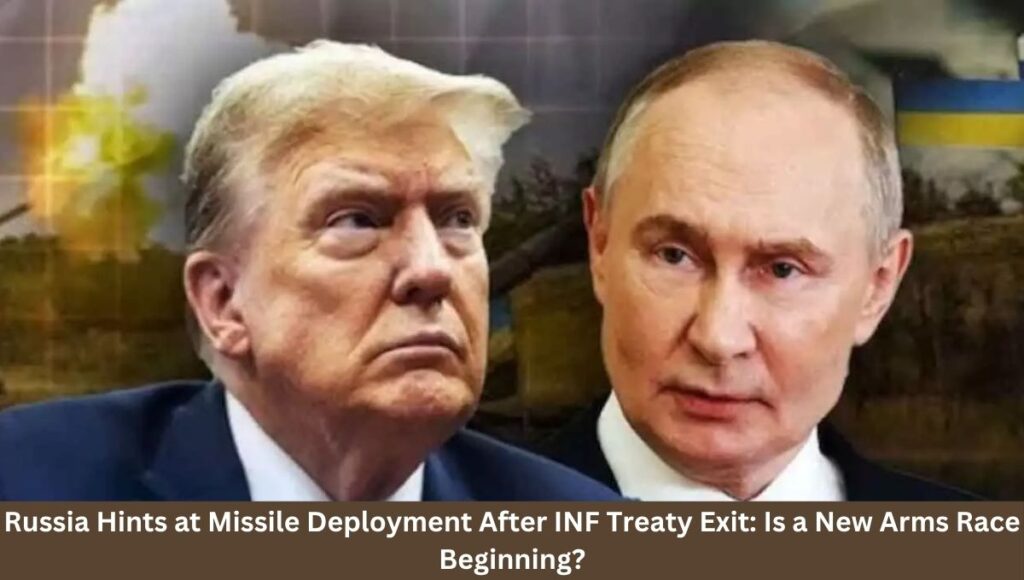
Russia Hints at Missile Deployment After INF Treaty Exit: Is a New Arms Race Beginning?
The End of the INF Treaty: What Changed in 2025?
The INF Treaty, signed by Ronald Reagan and Mikhail Gorbachev in 1987, banned all ground-launched missiles with ranges between 500 and 5,500 kilometers (311 to 3,418 miles).
It led to the destruction of nearly 2,700 missiles and was seen as a cornerstone of nuclear arms control during the Cold War.
But in 2019, during Trump’s first term, the United States withdrew from the INF Treaty, accusing Russia of violating its terms.
Moscow denied the allegations but pledged not to deploy INF-range missiles unless the US did so first.
Fast forward to 2025, and Russia says that Western actions, including missile deployments in Europe and Asia, have invalidated the conditions for its continued restraint.
“There are no longer any restrictions in Russia in this regard,” Kremlin spokesperson Dmitry Peskov told reporters. “Russia is entitled, if necessary, to take appropriate measures.”
What Prompted Russia’s Decision Now?
The timing of Russia’s formal withdrawal appears to be linked to several developments in US military posture:
- Deployment of American land-based missile systems to countries like Denmark, the Philippines, and Australia for exercises.
- Trump’s repositioning of two nuclear submarines “in the region” amid tensions with Moscow.
- A growing sense in Russia that NATO’s expansion and missile deployments threaten its national security.
“The United States and its allies have not only outlined plans to deploy INF-class missiles, but have also made significant progress in doing so,” said Russia’s Foreign Ministry.
In short, Russia argues that it is merely responding to an aggressive buildup by the West.
Trump’s Ultimatum and Submarine Deployment
Earlier this month, President Trump imposed harsh sanctions on Russia and threatened penalties on countries including India and China that continue to purchase Russian oil.
He also issued a dramatic August 8 deadline for Russian President Vladimir Putin to agree to a ceasefire in Ukraine, warning of further actions if the demand is ignored.
To add to the pressure, Trump publicly revealed the deployment of two nuclear submarines to “appropriate regions” in response to inflammatory remarks by Russian officials.
This highly visible show of force is being interpreted as nuclear brinkmanship and Moscow has responded in kind.
Medvedev Warns the West: “Expect Further Steps”
Dmitry Medvedev, former Russian president and now deputy head of the country’s Security Council, issued a chilling warning following the end of the INF moratorium.
“This is a new reality all our opponents will have to reckon with. Expect further steps,” Medvedev wrote on social media.
He directly blamed NATO’s “anti-Russian policy” for Moscow’s latest actions and emphasized that Russia would not hesitate to escalate if necessary.
Medvedev has become one of Russia’s most hawkish voices and has frequently traded verbal blows with President Trump online.
Who Is at Risk from New Missile Deployments?
With the end of the INF Treaty, Russia is now legally able to deploy medium- and short-range nuclear missiles, which could be stationed anywhere potentially without public notice.
Immediate Threat Zones:
- Europe: NATO states like Poland, Germany, and the Baltics are within range of Russia’s potential missile sites.
- Asia-Pacific: US missile deployments in the Philippines, Guam, Japan, and Australia have raised alarms in Moscow.
“Russia will not announce where it stations these missiles,” said Peskov, suggesting a return to Cold War-era secrecy and suspicion.
India Caught in the Crossfire: Sanctions Over Oil
India, which has significantly increased its imports of Russian oil since the war in Ukraine began, is now facing US sanctions under Trump’s expanded economic pressure campaign.
A 25% tariff has been placed on Indian exports, and further penalties targeting India’s defense and energy cooperation with Russia have been hinted at.
New Delhi has responded strongly:
“These measures are unjustified and unreasonable,” said India’s Ministry of External Affairs.
“India will take all necessary steps to protect its economic security and national interest.”
External Affairs Minister S. Jaishankar criticized the hypocrisy of Western countries, noting that both the US and EU continue to import certain Russian commodities while penalizing India for doing so.
Top Buyers of Russian Energy: India, China, and Turkey
As Western countries pulled back from Russian energy after the Ukraine war, Asia became Moscow’s biggest market.
According to recent reports:
- China has imported ~$219.5 billion in Russian oil, gas, and coal.
- India follows with ~$133.4 billion.
- Turkey imported ~$90.3 billion worth.
India’s oil imports from Russia jumped from under 1% to over 35–40%, making it a key energy ally of Moscow and a target of US disapproval.
Cold War Echoes: Are We Seeing a Nuclear Arms Race Reborn?
The unraveling of the INF Treaty, along with the deployment of nuclear-capable missiles and submarines, is fueling fears of a new Cold War.
“We are entering an arms race without the safety nets that existed in the past,” warned a European diplomat.
With no active arms control treaties between the US and Russia, both powers are now free to expand their arsenals and deploy missiles across multiple continents.
What makes this situation more volatile is the absence of trusted communication channels. During the Cold War, Washington and Moscow maintained hotline systems to avoid miscalculations. Today, that infrastructure is weakened or nonexistent.
Can Putin Ignore the August 8 Deadline?
With Trump’s ceasefire deadline looming, analysts are watching closely for signs of compliance or defiance from the Kremlin.
President Putin recently suggested that some progress has been made in peace talks with Ukraine but emphasized that Russia maintains the momentum on the battlefield.
Should Putin reject the ceasefire or fail to respond, the White House may ramp up sanctions, increase military deployments, or take further steps prompting even more aggressive Russian countermeasures.
Is Diplomacy Dead?
The INF Treaty’s demise is a symbol of the broader collapse in US-Russia diplomacy.
In December, Foreign Minister Sergei Lavrov warned that Russia’s INF moratorium was “practically no longer viable.”
He pointed to the US’s ongoing deployments of land-based missiles in Europe and Asia as a breach of trust.
“The United States arrogantly ignored warnings from Russia and China,” Lavrov said.
With arms control frameworks in tatters and both sides doubling down on military strength, opportunities for peaceful resolution are diminishing.
What Lies Ahead: Strategic Realignment and Global Uncertainty
The breakdown of the INF Treaty has sparked realignments in global alliances:
- China has deepened its military cooperation with Russia.
- India is asserting its sovereignty by resisting Western pressure.
- Europe is bracing for renewed security threats with limited diplomatic leverage.
In this new landscape, nuclear weapons, regional rivalries, and shifting energy dependencies form a volatile mix one that could spiral out of control in the absence of diplomacy.
Conclusion: A Dangerous New Era Begins
The INF Treaty’s collapse marks the end of an era one defined by arms control, dialogue, and mutual restraint. What comes next is less predictable, more dangerous, and full of uncertainty.
As Russia hints at deploying intermediate-range missiles, the United States responds with military muscle, and global powers like India and China navigate sanctions and strategic choices, the risk of conflict rises. With nuclear weapons again front and center, and Cold War-era tensions resurging, the world must ask: Are we headed toward confrontation or can diplomacy still find a way back?
Also Read: 5 Stunning Facts about Russia’s New Missile Test
Also Read: Russia Abandons Missile Moratorium, Warns of Retaliation Over US Deployment Plans in Europe