
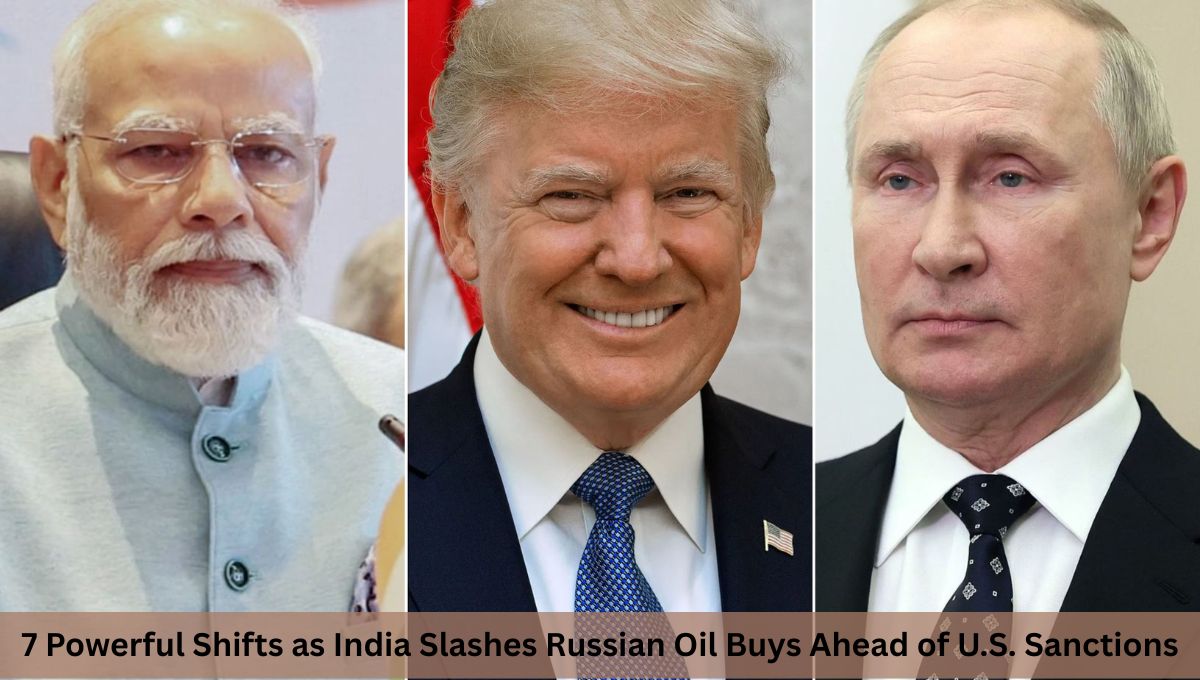
7 Powerful Shifts as India Slashes Russian Oil Buys Ahead of U.S. Sanctions — a seismic moment in global energy geopolitics. India’s oil diplomacy has hit a turning point. With just weeks before tough new U.S. sanctions on Russian energy giants Rosneft and Lukoil take effect, New Delhi is pulling back on cheap Russian oil purchases that once powered its post-pandemic recovery. This shift — driven by global politics and economic pragmatism — threatens to reshape Asia’s oil market, rattle fuel prices at home, and redefine India’s balancing act between Washington and Moscow.
7 Powerful Shifts as India Slashes Russian Oil Buys Ahead of U.S. Sanctions
A Deadline That Could Upend Energy Flows
The U.S. Treasury’s fresh sanctions on Rosneft and Lukoil, effective November 21, have sent shockwaves through energy markets. These measures threaten heavy fines, blacklisting, or trade bans for any company doing business with the sanctioned firms beyond the deadline.
For India — the world’s third-largest oil importer — the timing couldn’t be worse. Over the past three years, Russian crude had become a lifeline. Since Moscow’s 2022 invasion of Ukraine, Indian refiners had quietly turned into Russia’s biggest buyers, lured by deep discounts that saved billions in foreign exchange.
Now, that era of bargain barrels is abruptly closing.
From Record Imports to Rapid Retreat
According to Kpler, a maritime tracking firm, India’s October 2025 imports of Russian oil rose slightly — up 2.5% year-on-year. But the calm was deceptive. Analysts expect a precipitous decline in December as refiners scramble to comply with the new sanctions.
“Most major players will slash or cease direct buys to dodge penalties,” — said Sumit Ratoliya, Lead Analyst at Kpler. He forecasts a steep fall in Russian crude volumes, possibly easing only by early 2026 through middlemen and rerouted “shadow fleet” shipments.
Who’s Pulling Out — and Who’s Staying Put
Multiple refiners have already begun retreating.
- Reliance Industries Ltd, which operates the world’s largest refining complex in Jamnagar, is reportedly ending direct Russian crude purchases.
- Mangalore Refinery and Petrochemicals Ltd (MRPL) and HPCL-Mittal Energy Ltd (HMEL) have confirmed they’ll stop imports from Rosneft and Lukoil.
Together, these three handle over half of India’s 1.8 million barrels per day of Russian crude imports.
Yet one major player is staying put: Nayara Energy’s Vadinar refinery. Partially owned by Rosneft — and already under EU sanctions — Nayara is expected to continue sourcing Russian crude despite tightening U.S. restrictions.
Trump’s Pressure Campaign and Modi’s Dilemma
In August, U.S. President Donald Trump imposed a 25% penalty tariff on Indian firms purchasing Russian oil — on top of a reciprocal 25% duty — bringing total levies to 50% since August 27.
Speaking at the White House on October 22, Trump declared:
“Oil buying isn’t instant to halt, but India will zero it out by year-end. I’ve talked it through with Prime Minister Modi.”
While Washington claims victory, Indian officials remain silent. The White House has not specified when — or if — the tariffs might be rolled back.
For Prime Minister Narendra Modi, this is a delicate balancing act: protecting India’s energy security while preserving its diplomatic independence.
China Follows Suit — Asian Markets Split
India isn’t alone in pulling back. Last month, Chinese state oil majors — including PetroChina, Sinopec, CNOOC, and Zhenhua Oil — suspended purchases of seaborne Russian oil following similar U.S. sanctions. This marks a rare parallel move by Asia’s two largest oil importers, dividing the region’s crude market.
Trade sources say non-sanctioned Russian entities now fetch a premium, while oil tied to Rosneft or Lukoil sells at steep discounts — up to $4 below Brent for December arrivals, the widest gap in a year. With both Indian and Chinese refiners scaling back, Russia faces unsold barrels and mounting pressure on its already strained budget.
Also Read: China’s exports to Russia plunge record 22% in October
A Painful Transition for Indian Consumers
The impact for Indian consumers could be sharp. Industry experts warn that refining costs may surge 10–15%, driving up petrol and diesel prices by ₹5–₹10 per litre.
“Cheaper Russian oil masked vulnerabilities; this could add 5-10 rupees per litre to petrol and diesel,”
said energy consultant Vivek Ray.
Government data shows that Russian crude accounted for 35–40% of India’s total imports last quarter. Replacing that share will be costly.
With elections looming and retail prices already near record highs, fuel inflation could become a major political flashpoint.
Diversifying the Oil Basket
To mitigate supply shocks, Indian refiners are aggressively diversifying crude sources. According to Kpler, October saw U.S. crude imports surge to 568,000 barrels per day — the highest since March 2021. Deliveries from Iraq, Saudi Arabia, West Africa, and Latin America are also rising.
“Most Indian refiners are expected to comply with U.S. sanctions,” Ratoliya said, “but Russia will still feature in India’s mix through intermediaries and longer trade routes.” That means higher freight costs and complex logistics — factors likely to erode profit margins and inflate pump prices.
The “Energy Nexus” Hypothesis
Analysts see deeper geopolitical ripples behind these trade shifts. Monique Taylor, a global economy expert at East Asia Forum, wrote:
“Discounted Russian crude has bound China more closely to Moscow and brought India into the equation, creating an emerging energy nexus that challenges U.S. sanctions and influence.”
She argues that this convergence of interests was on display during the Shanghai Cooperation Organisation (SCO) summit in Tianjin in September 2025, where Xi Jinping, Vladimir Putin, and Narendra Modi appeared together in a rare moment of unity.
The symbolism underscored how cheap Russian oil has become both an economic tool and a political statement, linking Asia’s major powers in defiance of Western pressure — even if temporarily.
The Road Ahead: Between Compliance and Continuity
As the November 21 deadline nears, India’s refiners are walking a tightrope. They must demonstrate compliance to avoid U.S. penalties, yet sustain enough supply to keep the economy running smoothly.
Energy experts say a full stop in Russian crude imports is unlikely. Instead, India may rely more heavily on “intermediary routes” — using traders and smaller firms in neutral markets like Singapore, Malaysia, or UAE to rebrand and redirect Russian barrels.
Such workarounds, however, come at a price — typically $2–$5 per barrel higher — due to freight markups and risk premiums.
Can India Absorb the Shock?
With domestic consumption soaring and GDP growth projected at 6.5%, energy remains the backbone of India’s economic story.
The government is reportedly exploring three key buffers:
- Tapping strategic oil reserves to offset short-term supply gaps.
- Negotiating long-term supply deals with Gulf and U.S. producers.
- Promoting renewable energy investments to reduce fossil fuel dependence over time.
Still, the next few months could be bumpy. “Intermediary routes may revive flows, but at higher premiums,” warned Kpler’s Ratoliya. “India’s refiners are adapting, but the adjustment won’t be painless.”
Conclusion: The High Stakes of Energy Diplomacy
As India slashes Russian oil buys under U.S. pressure, a new era of energy geopolitics is unfolding. The once-smooth trade between Moscow and New Delhi now faces sanctions, tariffs, and uncertainty.
The question isn’t just about compliance — it’s about how India navigates the world’s most combustible intersection of energy and politics. Will it succeed in protecting its economy without alienating key allies? Or will this pivot mark the end of India’s Russian oil windfall?
For now, one thing is clear:
As November 21 approaches, the stakes for India — and its 1.4 billion citizens — have never been higher.
Also Read: Marco Rubio visits India: What’s at stake with Trump-Modi ties strained?
Related Posts:
- 7 Powerful Measures: Trump Sanctions Russian Oil…

- 9 Strategic Reasons the US Allowed India to Buy…

- In 8 Moves, EU Targets China-Linked Refineries and…

- 5 Key Signals from PM Modi’s Virtual ASEAN Summit Appearance

- 7 Powerful Reasons the U.S. Is Letting Countries Buy…
- Can the EU and NATO Impose Tariffs on India and…
