

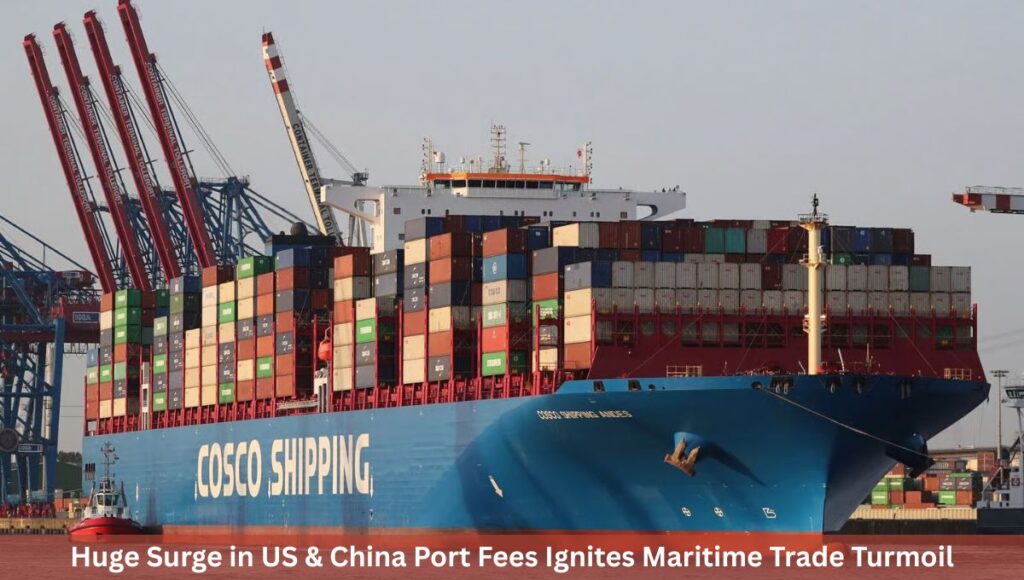
Huge Surge in US & China Port Fees Ignites Maritime Trade Turmoil – tit-for-tat port fees on each other’s vessels. The United States and China have escalated their trade dispute to the seas, each imposing port fees on the other’s vessels, deepening logistical strains across global supply chains. The move is seen as a new front in their intensifying trade war, with shipping firms bearing the brunt.
Huge Surge in US & China Port Fees Ignites Maritime Trade Turmoil
A New Front in the Trade War
Earlier this week, China began collecting special charges on U.S.-owned, -operated, -built, or -flagged vessels calling at Chinese ports. In response, the U.S. implemented corresponding fees on vessels linked to China, aiming to curtail Chinese dominance in maritime logistics.
China’s rules grant exemptions to Chinese-built ships and empty vessels entering shipyards for repairs, diluting, but not nullifying, the impact.
The charges are structured to apply at the first port of entry per voyage, or for the first five voyages per year, mirroring the U.S. design.
Analysts warn that the reciprocal design could trigger a spiral of maritime taxation, distorting freight flows and forcing shipping reroutes.
Mechanics & Industry Impact
Fees, Exemptions & Enforcement
China’s policy states that vessels with significant U.S. ties — based on ownership, operation, flag, or construction — are liable. But Chinese-built ships are exempt, and ships entering for repair may also avoid charges.
The U.S. meanwhile softened some proposals amid industry pushback, adjusting rates and exemptions for certain vessels carrying LPG or ethane.
One key exemption: long-term charterers of China-operated vessels transporting U.S. LPG products are temporarily spared fees until December 10.
Who’s Most Exposed?
China’s retaliatory fees could significantly affect very large crude carriers (VLCCs) and major shipping lines. Analysts estimate 13% of crude tankers and 11% of container ships could fall within the charge zone.
COSCO, China’s flagship container line, is expected to absorb a large share of U.S. port fee costs—potentially $3.2 billion in 2026.
Other carriers like Maersk and Hapag-Lloyd have already begun shifting ships away from U.S.–China routes to evade new levies.
In a preemptive move, DHT Holdings clarified its fleet has no U.S. links, arguing it escapes the new Chinese fees.
Escalation, Retaliation & Sanctions
Beijing recently imposed sanctions on five U.S.-linked subsidiaries of Hanwha Ocean, citing their participation in a U.S. trade probe. These non-operational units were targeted more for strategic signaling than immediate disruption.
Meanwhile, China launched investigations into U.S. maritime practices and gave notice that it could tighten export controls on critical tech inputs, linking port fees to broader trade leverage. The standoff comes ahead of a possible Trump–Xi meeting, with both sides attempting a mix of confrontation and diplomatic reassurance.
Freight Rates Climb
The new fees have already reverberated through shipping markets. Freight rates on key tanker routes have surged, notably the Middle East–China route, increasing by more than 30% in short order.
Costs have mounted by over $7 per barrel in some cases, adding tens of millions in operational burden for VLCCs.
Capacity constraints and diversion of tankers may push additional pressure on secondary ports, raising congestion risks.
Strategic Motives & Risks
U.S. Goals: Loosen China’s Maritime Grip
The U.S. contends that China has used state subsidies, regulatory bias, and control over shipyards and ports to dominate global shipping. The fees are part of Washington’s strategy to reinforce U.S. maritime competitiveness.
An earlier Biden-era investigation laid the groundwork, concluding China’s practices merit countermeasures.
The port fees have drawn sharp backlash from American exporters, farmers, and shipping firms, forcing adjustments to the original plans.
China’s Payback & Strategic Depth
Beijing’s mirrored fees aim to counterbalance U.S. pressure by hitting American-linked vessels, broadening definitions of U.S. affiliation.
Exempting China-built ships is a tactical concession, preserving flexibility for future negotiation.
Combined with rare earth export controls and tech sanctions, China is deploying a multi-domain push against U.S. leverage.
Also Read: China’s Rare Earth Export Curbs: Bold New Move
Shipping Industry in Reaction Mode
Shipowners and cargo operators are scrambling for workarounds. Some U.S.-linked vessels are diverting cargo mid-route or reflagging ships to avoid triggering the new fees.
Others are reassigning trade lanes or adjusting fleet deployments to reduce exposure.
A Shanghai trade consultant captured the mood: “Trade is already fragile… we must adapt or be left behind.”
Risks to Global Trade & Shipping
- Route distortion: Ships might reroute via secondary ports, increasing transit times and costs.
- Freight inflation: Additional port charges add unpredictability to shipping contracts.
- Regional strain: Ports in Southeast Asia, South America, or Africa may see surges in cargo diversion.
- Compliance burden: Identifying vessels with partial U.S. or Chinese ties could become administratively complex.
- Policy escalation: If either side tightens or expands charges, retaliation could spiral further.
Environmental Policy Ensnared
In an unexpected twist, the trade conflict now intersects with climate policy. The U.S. threatened punitive measures against countries supporting new IMO shipping emissions rules, signaling that environmental regulation could be weaponized.
This raises a new concern: shipping is no longer a neutral conduit for trade — it’s a tool in geopolitical contests.
What to Watch Next
- Trump–Xi dialogue: Any deal or truce between top leaders could de-escalate maritime measures.
- Rate stability: Whether freight costs retract or remain elevated.
- Sanctions expansion: Will China target deeper U.S. interests or broader foreign-linked fleets?
- Legality challenges: Potential WTO or maritime legal disputes over the port levies.
- Supply chain shifts: How exporters, especially in agriculture and energy, adapt to new costs.
Final Thoughts
The rollout of tit-for-tat port fees marks a dangerous escalation in the U.S.–China trade standoff. Shipping companies — already grappling with a fragile global logistics environment — now face direct taxation as battlegrounds shift to the sea.
The new fees disrupt freight flows, strain supply chains, and amplify geopolitical risk. As global trade braces for turbulence, the high seas may prove to be one of the next major fault lines of the great power rivalry.
Also Read: Global Markets Reel as Renewed US-China Tariff Threats Ignite Widespread Sell-Off
Related Posts:
- U.S.–China Trade War 2025: 500% Tariff Threat Sparks…
- 7 Big Takeaways: Macron’s High-Stakes China Visit…

- In 8 Moves, EU Targets China-Linked Refineries and…

- China’s Rare Earth Export Curbs: Bold New Move

- 10 Powerful Reasons the US ‘Unfair Trade’ Probe on…
- 10 Big Takeaways from Trump’s 155% Tariff Warning to China
