The latest EU Sanctions Shake Up Diesel Market, Hit Indian Shipping Links. The European Union’s newest sanctions targeting Russia’s oil exports are triggering a fresh reshuffle in the global diesel market. As the bloc tightens its grip on Russian oil products, Indian refiners, UAE-linked shippers, and diesel buyers in Europe are being forced to adapt. With global diesel inventories already critically low and demand surprisingly resilient, the timing of these sanctions is intensifying volatility in fuel prices worldwide.
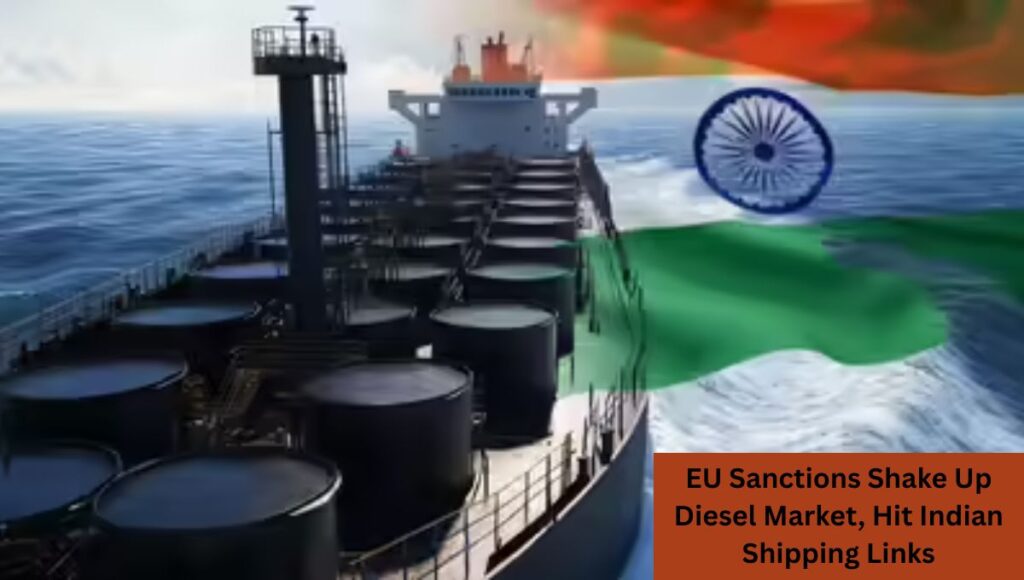
EU Sanctions Shake Up Diesel Market, Hit Indian Shipping Links
Diesel Demand Defies Trade War Fears
Despite early fears that geopolitical tensions and U.S. tariffs might dent demand, diesel consumption in major economies remains strong.
Seen as a bellwether for global economic activity, diesel fuels the logistics backbone of industry, agriculture, and transportation.
In the U.S., diesel demand has averaged 3.8 million barrels per day in 2025 nearly 5% higher than last year, according to the Energy Information Administration.
Meanwhile, India saw diesel consumption rise 2.1% year-over-year in May, and Chinese refinery runs indicate solid fuel demand through June.
This resilience defies expectations following President Donald Trump’s sweeping tariff announcements in April.
Though initially spooking markets, Trump’s walk-back on several measures and renewed trade talks helped ease fears of an economic slowdown.
Low Diesel Stocks Keep Prices Elevated
A major support for diesel prices and refining margins this year has been chronically low inventories.
Combined diesel stocks in the U.S., Europe, and Singapore are currently about 20% below the 10-year average.
Typically, refineries increase output during summer to build stocks ahead of winter.
But this year, several factors have slowed that build:
- Unplanned outages, including Israel’s 197,000 bpd Haifa refinery hit during June’s 12-day war with Iran
- The shutdown of England’s 113,000 bpd Lindsey refinery following its owner’s bankruptcy
- A shortage of heavy and medium crude grades rich in diesel yields due to U.S. sanctions on Venezuela, Canadian wildfire disruptions, and limited OPEC exports
With supply struggling to meet demand, prices have remained high despite broader market uncertainties.
EU Rolls Out 18th Sanctions Package
The situation took a dramatic turn with the European Union’s adoption of its 18th sanctions package against Russia, aiming to further curtail Moscow’s oil revenues.
Among the most impactful measures is a proposed import ban on refined petroleum products made from Russian crude.
The ban, expected to come into force in 2026, closes a significant loophole.
After the EU banned direct imports of Russian oil in 2022, countries like India, China, and Turkey increased imports of discounted Russian crude and refined it into products including diesel that were then sold to Europe.
Back in 2021, Russia accounted for about 40% of Europe’s diesel imports.
While Europe has since diversified by increasing purchases from Asia and the Middle East, the new sanctions aim to eliminate indirect sourcing of Russian-origin fuels.
Indian Refiners in the Crosshairs
Indian refineries, particularly those processing Russian crude, are among the most affected. According to Kpler, 38% of India’s crude imports in 2024 came from Russia.
That crude has helped India supply around 16% of Europe’s diesel and jet fuel imports last year.
One key player is Reliance Industries’ massive 1.2 million bpd refining complex in Jamnagar. These facilities must now pivot away from Europe, looking to new markets like Africa.
However, they will face stiff competition from Nigeria’s new 650,000 bpd Dangote refinery, further squeezing margins.
At the same time, refiners in the Gulf notably in Saudi Arabia, the UAE, and Kuwait are poised to benefit.
Since these nations are net exporters of crude, they are exempt from the EU’s new measures even if they import Russian oil, giving them a competitive edge in supplying Europe.
Maritime Fallout: Indian Captain, UAE Firm Sanctioned
In a rare move, the EU has also imposed sanctions on individuals and entities linked to the maritime transport of Russian oil.
Among them is Intershipping Services Hub Pvt Ltd, the Indian subsidiary of a UAE-based shipping company, accused of facilitating Russian crude transport.
Even more notably, the EU sanctioned Captain Abhinav Kamal, an Indian national commanding the tanker Argent, for his alleged role in aiding Russian-linked operations.
He becomes the first Indian individual targeted under EU sanctions in the context of the Ukraine conflict.
These sanctions have immediate implications:
- EU-based assets of Intershipping Services will be frozen.
- European entities are barred from doing business with the firm.
- Captain Kamal faces restrictions in EU maritime networks, likely impacting career opportunities and vessel access.
Nayara Energy Feels the Chill
India’s Nayara Energy Ltd, nearly 49.13% owned by Russia’s Rosneft, is also feeling the heat.
Bloomberg reported that shipping operators are becoming wary of dealing with Nayara, particularly at its key Vadinar port.
In one instance, the tanker Talara was scheduled to pick up diesel from Vadinar but left without loading following the EU’s latest sanctions.
Analysts suggest more such disruptions may occur as global firms steer clear of potential regulatory risks.
India Rejects Unilateral Sanctions But Can’t Ignore Impact
India maintains a long-standing position of not recognizing unilateral sanctions from blocs like the EU.
However, in practice, global market participants often comply with such measures to avoid reputational or legal fallout.
This puts Indian refiners, shippers, and port operators in a difficult position. While technically allowed to operate under Indian law, many are being sidelined by partners with EU exposure.
Global Diesel Flows Set for Another Rejig
The most likely consequence of these sanctions is a comprehensive reorganization of diesel shipping routes:
- Indian refiners will seek alternative buyers in Africa and Southeast Asia.
- Middle Eastern exporters will increase diesel shipments to Europe.
- Freight costs are expected to rise due to longer voyage routes and vessel shortages.
This market shake-up could lead to higher diesel prices at the pump in Europe.
And if President Trump follows through with his threat to impose a 100% tariff on countries that buy Russian oil unless Moscow ceases fighting in Ukraine, volatility could increase further.
Shadow Fleet, Loopholes, and Sanction Resilience
Despite the sanctions, many experts note that Russia has successfully adapted to such restrictions over the past three years.
With a “shadow fleet” of over 400 tankers and increased control over its oil logistics, Moscow continues to move crude with limited Western involvement.
The EU has tried to respond by lowering the price cap on Russian oil to $47.60 per barrel and expanding the list of banned tankers.
However, analysts argue that these efforts are largely symbolic and unlikely to derail Russia’s energy trade significantly in 2025.
The Bottom Line: Red-Hot Diesel Market Isn’t Cooling Soon
While global oil demand may soften, the combination of:
- Low global diesel inventories
- Disrupted refining capacity
- Rising freight costs
- Sanctions on major diesel suppliers
…is keeping diesel markets tight. For refiners, this means sustained strong margins. For consumers, it likely means persistently high prices. And for countries like India, it means walking a geopolitical tightrope between strategic energy needs and the growing reach of Western sanctions.
Also Read: India-Russia HMX Deal Risks U.S. Sanctions
Also Read: EU sanctions: how will the latest package of measures against Russia affect shipping?
Related Posts:
- 7 Powerful Measures: Trump Sanctions Russian Oil…

- In 8 Moves, EU Targets China-Linked Refineries and…

- 9 Strategic Reasons the US Allowed India to Buy…

- 7 Powerful Reasons the U.S. Is Letting Countries Buy…
- Xi Jinping, Lula, and Jaishankar Call for BRICS…

- 7 Powerful Shifts as India Slashes Russian Oil Buys…