In a stunning turn of events Mossad-Linked X Account Alleges Iran’s Khamenei Is ‘On Drugs’ and Sleeping All Day. In the ongoing Iran-Israel psychological warfare, a Persian-language account on X, reportedly linked to Israel’s national intelligence agency Mossad, has accused Iran’s Supreme Leader Ayatollah Ali Khamenei of being unfit to lead due to alleged drug use and excessive sleeping.
The account, known as @MossadSpokesman or “Mossad Farsi,” has raised eyebrows across the Middle East and beyond. Despite no official confirmation from Israel, intelligence experts say the information shared by the account could only come from Mossad, giving it a strong air of authenticity. The sensational claims, along with prior accurate revelations, have ignited controversy and intensified scrutiny of Iran’s leadership.
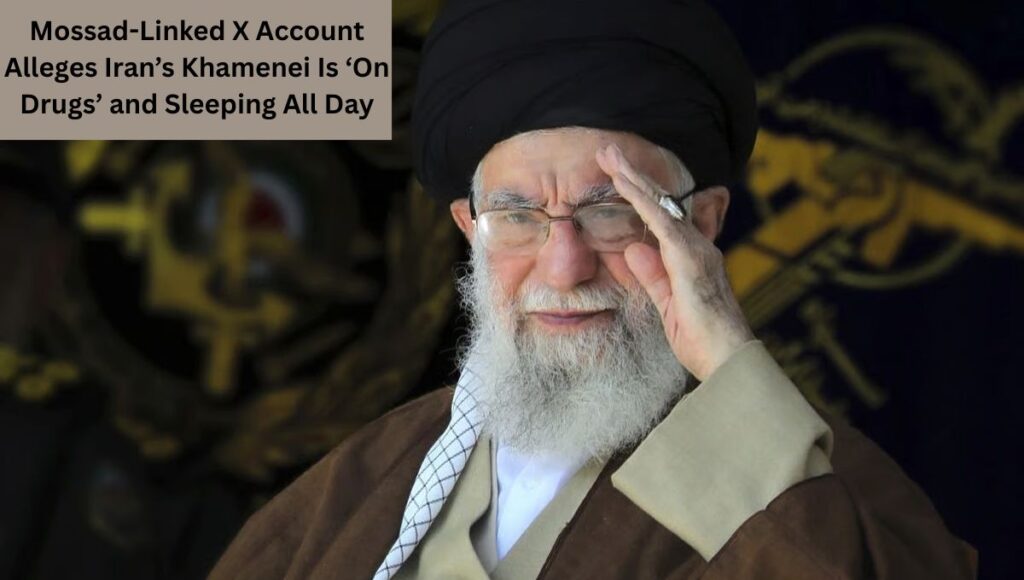
Mossad-Linked X Account Alleges Iran’s Khamenei Is ‘On Drugs’ and Sleeping All Day
The Explosive Allegation: “High on Substances”
On July 25, @MossadSpokesman posted in Persian:
“How can a leader lead when they sleep half the day and spend the other half high on substances? Water, electricity, life!”
Though the message didn’t directly name Ayatollah Ali Khamenei, its implication was unmistakable, given the account’s history of targeting Iran’s political elite.
The post, translated from Persian, struck a chord with Iranians fed up with infrastructure woes like severe water shortages and rolling blackouts summarized by the final line, “Water, electricity, life!” Within 48 hours, the post garnered over 180,000 views, sparking both outrage and speculation.
A Pattern of Provocation
This wasn’t the first such accusation by the Mossad-linked Farsi account. On July 9, it wrote:
“Consuming drugs and conversing with spirits are not desirable traits for someone leading a country.”
Again, the message fell short of naming Khamenei but left little doubt about whom it was targeting.
The account, verified with a blue checkmark, was created in June 2025 and has since built a reputation for revealing classified Iranian information.
Is the Account Really Mossad?
The Israeli government and Mossad have not officially confirmed any ties to the account. However, multiple intelligence analysts believe it is closely affiliated with Mossad.
“Some of the information it has shared could only have come from Mossad,”
said Beny Sabti, an Iran expert at Israel’s Institute for National Security Studies, in an interview with Israeli media outlet JFeed.
Furthermore, the account routinely urges Iranians to use VPNs when contacting them privately, suggesting it might be more than just a troll account it may be a tool in psychological warfare against Iran’s ruling regime.
The Commander Reveal: A Major Credibility Boost
During last month’s Israel-Iran 12-day conflict, the account correctly identified a top-secret Iranian military commander before the Iranian government publicly acknowledged the appointment.
When Tehran chose to withhold the name of the new Khatam al-Anbiya Central Headquarters chief, the Mossad Farsi account posted:
“Know that we know his actual name and are well acquainted with him… Please send us your guesses regarding his name.”
Thousands of users engaged, and the account later confirmed the identity of Ali Abdollahi Aliabadi, previously a deputy commander of the IRGC Air Force and a sanctioned figure under Mahmoud Ahmadinejad’s presidency.
“The lucky winner who successfully guessed the ‘secret’ name is Mr. Behnam. Please contact us privately to receive your prize,” the account wrote, adding to its provocative and satirical style.
Iran’s Reaction: Silence and Suspicion
So far, Iranian authorities have not publicly addressed the claims from the Mossad Farsi account.
State-affiliated media like Tasnim News reported the commander’s name only after it became public knowledge via the account.
The accusations about Khamenei’s health and drug use, however, are likely considered too sensitive or inflammatory for state-run outlets to acknowledge.
This silence could also suggest that the Iranian regime is uncertain about how to counter such digital psychological operations.
Khamenei’s Alleged Drug Use: Not a New Claim
While the drug use allegation may seem outlandish, it’s not without precedent. In 2022, Iranian academic Nour Mohamed Omara told a Turkish television channel:
“Many viewers do not know this, but Khamenei himself uses drugs. He has a special village in Balochistan, where the drugs used by the leader are produced.
This village is run by the Islamic Revolutionary Guard Corps and no one is allowed in.”
Given that Iran declares drugs as “un-Islamic” and imposes the death penalty for drug-related crimes, such accusations are especially inflammatory.
Operation Rising Lion and the Rise of Digital Warfare
The Mossad Farsi account became significantly more active during Operation Rising Lion, Israel’s campaign against Iran in June 2025.
The account’s posts during and after the conflict criticized Tehran’s secrecy, leadership, and failure to protect its citizens.
It even claimed that Mossad had assembled a team of specialist doctors offering medical help to Iranians, naming specialties like:
- Cardiology
- Diabetes
- Oncology
- Psychological support
While these claims remain unverified, they indicate a shift from pure intelligence leaking to hearts-and-minds campaigns aimed directly at the Iranian public.
A Hybrid Tool: Satire, Subversion, and Strategy
The tone of @MossadSpokesman’s posts blends satire with deadly serious intelligence. It often mocks Iran’s leadership, uses contests to crowdsource intelligence, and subtly offers support to dissidents.
By calling out “secrets” known only to insiders and challenging state narratives, the account destabilizes Tehran’s control over its narrative and perhaps even sows discord within the regime itself.
This hybrid use of open-source information, psychological tactics, and disinformation makes it a powerful tool in modern geopolitics.
Iran’s Domestic Struggles: The Bigger Picture
The Mossad Farsi account’s most viral phrase “Water, electricity, life” captures more than rhetorical flair. It taps into real public grievances inside Iran.
Years of infrastructure neglect, compounded by sanctions and economic mismanagement, have led to:
- Chronic power outages
- Water scarcity in several provinces
- Widespread unemployment and inflation
- Recurring protests in cities like Isfahan and Ahvaz
By linking Khamenei’s supposed lethargy and addiction to these hardships, the account frames him as indifferent and disconnected from the people.
Is This Digital War Escalating?
There’s growing speculation that this kind of digital warfare might escalate further. With Mossad expanding its digital footprint in Arabic, Persian, and even Turkish, more covert operations could soon surface in cyberspace.
Already, the Mossad Farsi account has demonstrated a capability for predictive intelligence, social manipulation, and morale attacks far beyond standard public relations.
Final Thoughts: Allegations Without Confirmation
Despite its explosive content, it’s important to stress that the allegations made by the Mossad-linked X account remain unverified.
There is no concrete proof that Ayatollah Khamenei uses drugs or spends excessive time sleeping.
However, the strategic use of such allegations, paired with revealed classified information, underscores how intelligence operations have evolved in the age of social media.
If Mossad truly is behind this account, it marks a new frontier in geopolitical influence campaigns where the battlefield is not just physical, but digital, emotional, and psychological.
Conclusion:
The verified Persian-language Mossad Farsi X account continues to stir the pot with provocative allegations and intelligence leaks, including claims about Ayatollah Khamenei’s drug use and sleep habits. While these remain unproven, the account’s accuracy in other revelations lends it credibility and makes it a serious player in modern intelligence warfare. As Iran grapples with both internal dissent and external pressure, digital provocations like these may shape public opinion just as powerfully as bombs or sanctions.
Also Read: Khamenei Names Successors from Bunker Amid Assassination Threats
Related Posts:
- Trump’s 20-Point Gaza Peace Plan Gains Urgent Global…

- 7 Alarming Facts About Super Typhoon Fung-wong
- Afghanistan–Pakistan War 2025: Inside the 48-Hour Ceasefire

- Israel–Hamas Ceasefire Under Strain: 4 More Hostage…

- US Strike on Venezuelan Boat Kills 6 in Fifth…

- China Hosts SCO Summit 2025 and Military Parade as…