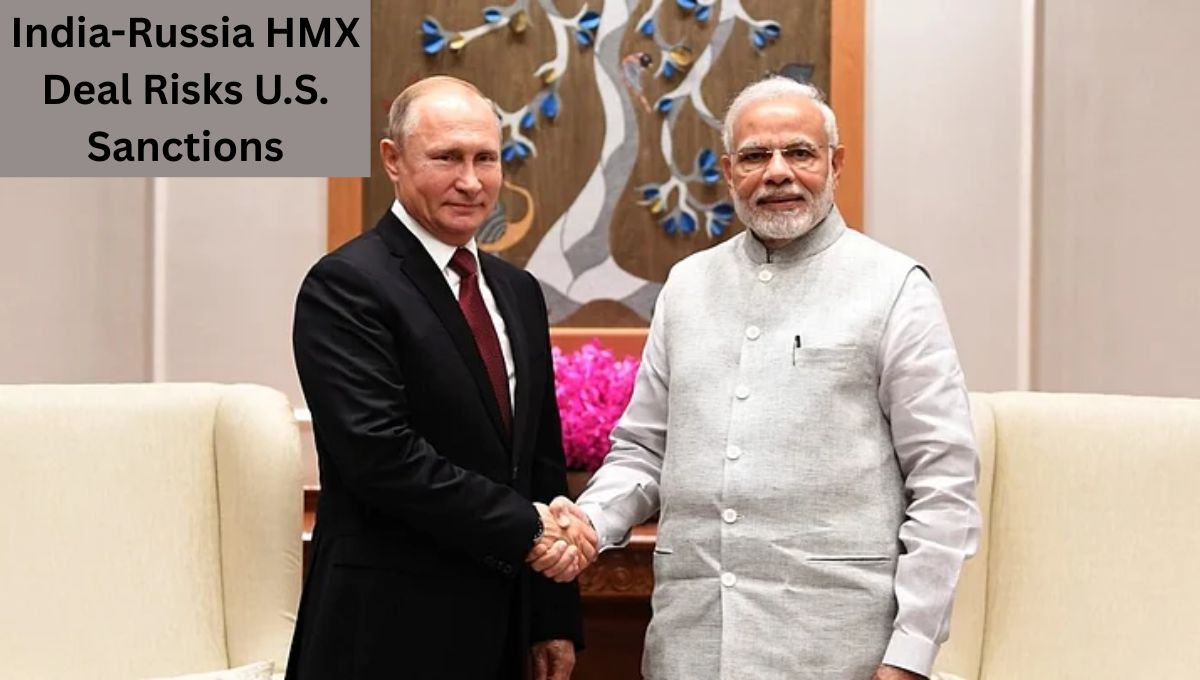
Despite U.S. sanctions warnings, India-Russia HMX Deal Risks U.S. Sanctions. In a development that has ignited diplomatic tension, Hyderabad-based Ideal Detonators Private Limited exported $1.4 million worth of HMX (octogen) explosives to two Russian entities in December 2024. According to Indian customs data obtained by Reuters, the shipments proceeded despite prior U.S. sanctions warnings aimed at isolating Russia’s military-industrial complex amid the ongoing Ukraine conflict.
The revelation could place New Delhi’s growing strategic ties with Washington under scrutiny as both sides work to counterbalance China’s influence in Asia.
India-Russia HMX Deal Risks U.S. Sanctions
What Is HMX and Why It Matters
HMX, also known as octogen, is classified as a high explosive used in military applications such as:
- Missile and torpedo warheads
- Rocket motors
- Plastic-bonded explosives
- Exploding projectiles
According to the U.S. Defense Technical Information Center, HMX is “critical for Russia’s war effort”.
Its dual-use nature allows it to be deployed in both civilian and military sectors, but its potency and sensitivity make it a prime component in modern weaponry.
Given these factors, the U.S. Treasury Department has advised banks and businesses to avoid involvement in HMX transactions potentially linked to Russia, warning of possible sanctions.
Shipment Details: Where Did the Explosives Go?
Customs data shows that Ideal Detonators shipped HMX to two companies based in Samara Oblast, Russia:
- High Technology Initiation Systems (HTIS) received a shipment valued at $405,200.
- Promsintez, a major Russian explosives manufacturer, received over $1 million worth of HMX.
Promsintez: Military Ties and Ukrainian Retaliation
Promsintez has been publicly identified by Ukraine’s SBU security service as being directly linked to Russia’s military supply chain.
The company was targeted in a Ukrainian drone strike in April 2025, believed to be a reprisal for its role in arming Russian forces.
HTIS and Its Western Connections
HTIS, while claiming to focus on mining and industrial explosives, is reportedly a subsidiary of Maxam, a Madrid-based explosives company.
Maxam is majority-owned by Rhone Capital, a New York-based private equity firm.
Maxam insists that HTIS operates independently and that it is divesting its Russian operations, although the transaction’s optics have drawn concern given the U.S. ownership links.
Ideal Detonators Responds to Scrutiny
When contacted, Ideal Detonators maintained that the HMX shipments were designated for civilian use:
“The shipment … is for industrial activity and it’s a civil explosive,” the company said via email.
This statement is technically viable under India’s export control regulations, which allow the sale of dual-use items subject to regulatory scrutiny.
However, experts question how civil-use materials ended up in the hands of firms deeply embedded in Russia’s defense infrastructure.
India’s Foreign Ministry Backs Compliance
India’s Ministry of External Affairs emphasized that all dual-use exports are:
- Conducted under a robust legal framework
- Aligned with international non-proliferation obligations
- Vetted for potential misuse
Despite these assurances, the optics of the shipment especially to defense-linked Russian firms amid wartime are raising eyebrows in Western policy circles.
U.S. Sanctions: What Are the Risks?
Although the U.S. State Department declined to comment on the specific Ideal Detonators shipment, it reiterated its broader warning:
“Any foreign company or financial institution that does business with Russia’s military-industrial base is at risk of U.S. sanctions.”
Legal experts point out that the U.S. government has wide latitude to target foreign firms, even those outside U.S. jurisdiction, if their transactions are found to materially support Russia’s military.
Private Diplomacy vs. Public Sanctions
According to Jason Prince, a sanctions expert at Akin Law Firm, the U.S. generally favors private diplomatic warnings over immediate penalties, especially when dealing with allies like India:
“The U.S. government often raises concerns privately and uses sanctions only as a last resort.”
That said, Washington may be forced to act if pressure mounts from Ukraine or domestic political actors demanding stricter enforcement.
Ukraine’s Reaction: Civilian Deaths and Foreign Supply Chains
The report coincides with a surge in Ukrainian civilian casualties. The UN Human Rights Monitoring Mission noted that 232 civilians were killed and 1,343 injured in June 2025, marking the deadliest month in over three years.
Ukraine’s Presidential Adviser Vladyslav Vlasiuk, who monitors sanctions circumvention, stated:
“While India has not typically been among the primary jurisdictions used for circumventing sanctions, we are aware that isolated cases can occur.”
Vlasiuk confirmed that Promsintez has come under Ukrainian scrutiny for collaborating with international partners, including Indian firms.
India-Russia Ties: Historic and Growing
India has historically maintained close defense ties with Russia, dating back to the Cold War era.
Despite growing U.S.-India military cooperation, New Delhi has refused to join Western sanctions against Moscow.
Instead, India has increased its imports of discounted Russian oil, now making up nearly 35% of India’s crude supply.
This economic alignment with Russia has prompted Ukrainian officials to label India a “hostile nation”, placing it alongside China, Iran, and North Korea.
Trump Administration: Changing Tone on Sanctions
The current Trump administration has reportedly slowed enforcement of Russia-related sanctions compared to the Biden era.
While some Indian entities faced sanctions during Biden’s term, the current strategy leans toward preserving strategic alliances and limiting public rebukes.
Trump’s recent tariff threats against countries importing Russian crude indicate that economic tools remain on the table, but their deployment is selective and tactical.
A Legal Grey Zone: Dual-Use Exports
Exports like octogen fall into the dual-use category, which makes them harder to police.
While civilian use is possible in sectors like:
- Mining
- Infrastructure development
…the military potential of HMX makes any transfer to defense-linked entities highly controversial.
India’s regulations permit such exports under stringent review, but international scrutiny increases when recipients are connected to Russia’s war machine.
Conclusion: A Diplomatic Litmus Test
The $1.4 million shipment of HMX explosives by Ideal Detonators to Russian defense-linked firms is more than just a trade story. It represents a litmus test for India’s foreign policy, U.S. sanctions credibility, and the integrity of wartime export controls.
As Ukraine’s civilian death toll rises and Western scrutiny intensifies, the case underscores the delicate balance India must strike between strategic autonomy and global responsibility. Whether Washington chooses quiet diplomacy or public sanctions, the situation could have lasting implications for India-U.S. relations, the enforcement of global sanctions, and the future of dual-use export governance.
Also Read: Kremlin Says Russia Has ‘Sanctions Immunity’ as Trump Slashes Ceasefire Deadline
Also Read: India’s Tryst with Secondary Sanctions