7 Critical Insights into Trump’s Mounting Frustration Over Stalled Russia-Ukraine Peace Talks, as he presses Kyiv on concessions and demands rapid action.As the Russia-Ukraine war grinds through its fourth year, diplomatic negoations have entered a tense and uncertain phase.
The United States, which has positioned itself as the primary mediator between Moscow and Kyiv, is still struggling to secure tangible progress toward a ceasefire or a broader settlement. This week, US President Donald Trump expressed unprecedented dissatisfaction with both parties, signalling that Washington’s patience is wearing thin.
Trump’s growing frustration, Ukraine’s resistance to territorial concessions, Russia’s slow-but-steady battlefield gains, and urgent warnings about global escalation have converged to create one of the most volatile diplomatic moments since the conflict began in February 2022.
Below is a comprehensive breakdown of where negotiations stand, what the new US proposals contain, the political pressures on President Volodymyr Zelenskyy, and why Trump believes the world is approaching a dangerous threshold.
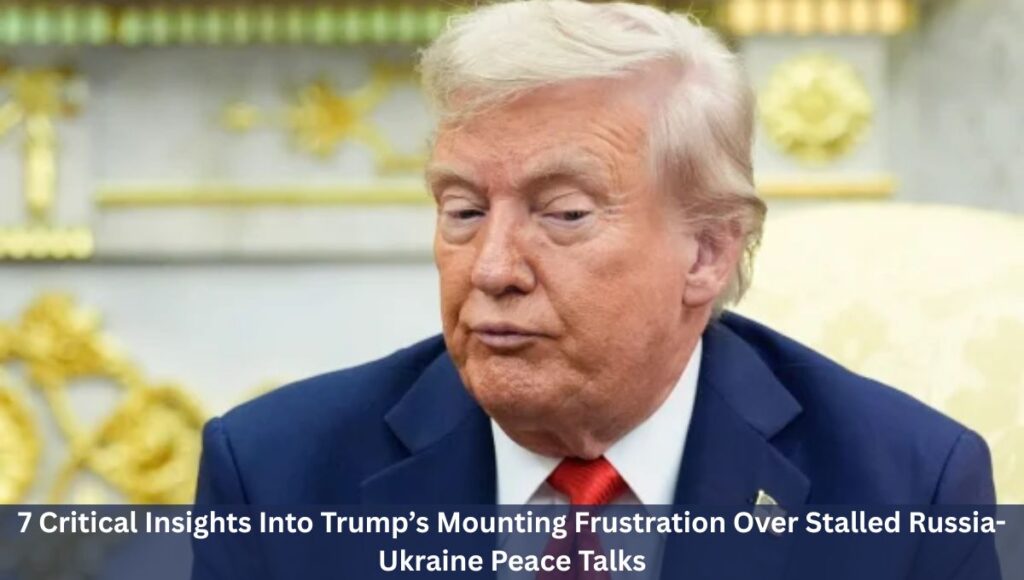
7 Critical Insights Into Trump’s Mounting Frustration Over Stalled Russia-Ukraine Peace Talks
Trump Signals Deep Frustration With Kyiv and Moscow
White House Press Secretary Karoline Leavitt used unusually stark language while briefing reporters, stating that Trump is “extremely frustrated with both sides of this war” and is now prioritising outcomes over continued diplomatic exchanges.
According to Leavitt:
- Trump wants “action, not more talk.”
- He is “sick of meetings just for the sake of meeting.”
- The President expects “tangible movement” from Moscow and Kyiv.
The shift marks a hardening of Washington’s stance after months of shuttle diplomacy led by Special Envoy Steve Witkoff and, more recently, Trump’s son-in-law Jared Kushner.
Europe Sidelined as Trump Centralises Negotiations
Trump has largely bypassed European institutions, preferring to negotiate directly:
- Witkoff’s team has been conducting real-time discussions.
- European leaders have been briefed but not included at the core of the talks.
- European governments remain wary of a deal perceived as imposing large concessions on Ukraine.
While Trump insists his diplomatic approach is the fastest route to ending the war, European officials warn that a rushed agreement could destabilize the continent’s long-term security architecture.
The US Peace Plan: Territorial Concessions at the Center of Dispute
The earlier US proposal—a 28-point document—was criticized in Kyiv for tilting too heavily toward Moscow’s demands. A revised 20-point plan has since been drafted, but the details have not been released publicly.
Ukrainian President Volodymyr Zelenskyy revealed key elements Washington continues to push:
- A Ukrainian withdrawal from parts of the Donetsk region.
- Creation of a demilitarized “free economic zone” between the two armies.
- Russian retention of positions in southern Ukraine, including territories Moscow currently occupies.
- Russian withdrawal from areas in the north where it has not formally claimed annexation.
The proposed free economic zone is meant to act as a buffer. However, Zelenskyy argues that the plan places the burden of withdrawal solely on Ukrainian forces while allowing Russia to hold vast stretches of captured land.
Zaporizhzhia Nuclear Plant a Major Sticking Point
Ukraine and the US remain divided on:
- Control and governance of the Zaporizhzhia Nuclear Power Plant, which Russia has occupied since 2022.
- The future security arrangements surrounding critical infrastructure.
Zelenskyy stressed the need for “international oversight” and stated that Ukrainian sovereignty over energy facilities is non-negotiable.
Zelenskyy Rejects Any Unilateral Withdrawal in Donetsk
Zelenskyy reiterated that Ukraine cannot, morally or constitutionally, cede territory to Russia. Under Ukrainian law, any significant territorial change requires public approval.
He emphasized two key principles:
- “I have no constitutional or moral right to give away Ukrainian land.”
- “The people of Ukraine must have the final word—whether through elections or a referendum.”
The Ukrainian president questioned why the US proposal requires Kyiv to withdraw without reciprocal Russian pullbacks.
Zelenskyy asked pointedly:
- “Why doesn’t the other side pull back the same distance?”
- “Where is the reciprocity in this agreement?”
- “Why should Ukraine be the only side to create a buffer?”
Ukraine continues to make the case that unilateral withdrawal rewards Russian aggression and sets a dangerous precedent for future security in Europe.
Russia Advances on the Battlefield as Negotiations Stall
The diplomatic stalemate is occurring alongside significant battlefield developments. Russia has been using its manpower and artillery advantages to grind forward in multiple regions.
Siversk Claim Sparks Confusion
Russia claimed this week to have captured the town of Siversk in the Donetsk region, describing it as its fastest territorial gain in more than a year. Ukraine’s eastern command immediately denied the report.
The competing claims reflect:
- Heavy fighting on the Donetsk front.
- Continued pressure on Ukrainian forces facing manpower shortages.
- Russia’s strategy of slow, attritional advances designed to improve its negotiating leverage.
Massive Human Impact
The war has exacted a devastating toll:
- Tens of thousands killed on both sides.
- Millions displaced from eastern and southern Ukraine.
- Large cities severely damaged or destroyed.
- Infrastructure—including power grids, roads, and water systems—crippled in contested regions.
Ukraine’s negotiators insist that any settlement must reflect the scale of national sacrifice and adhere to the principle of territorial integrity.
Trump Warns the Conflict Could Trigger “World War Three”
During an Oval Office briefing, Trump issued one of his starkest warnings to date, stating:
- “Things like this end up in third world wars.”
- “Everybody keeps playing games like this, you’ll end up in a third world war.”
He claimed 25,000 soldiers and civilians died in the last month alone, underscoring his demand for rapid de-escalation.
Trump also described the Ukraine conflict as something that does not directly affect the United States “unless it got out of control,” further highlighting his desire to avoid an open-ended US commitment.
The US Role: “We Are Not Involved in the War”
Trump has repeatedly insisted that:
- The US is not directly involved in combat operations in Ukraine.
- Washington’s primary role is negotiation, because “people want us there.”
- American direct military aid has been dramatically reduced during his administration.
Shift to Selling Weapons Through NATO
Trump explained that instead of sending weapons directly to Kyiv:
- The US is selling weapons at full price to NATO.
- NATO partners are then distributing (or “probably distributing,” as Trump phrased it) the weapons to Ukraine.
This system allows Washington to maintain distance from the battlefield while keeping military support flowing indirectly.
The President criticized previous US expenditures, claiming America gave “$300–350 billion” to Ukraine in the past “and got nothing in return.”
Trump Indicates Readiness to Support Ukraine’s Security Guarantees
Despite his irritation with the negotiation process, Trump acknowledged that the US would be willing to provide support for Ukraine’s long-term security as part of a peace agreement.
He stated:
- “Yeah, we would help. We would help with security.”
- Security guarantees are a “necessary factor” in finalizing any agreement.
This marks a rare point of alignment between Trump and Ukrainian negotiators, who have insisted that any territorial compromise must be accompanied by ironclad defense commitments.
But Trump Questions Zelenskyy’s Resistance
Trump expressed disappointment that Zelenskyy had not more readily accepted the US plan, saying:
- “I thought we were very close to having a deal with Russia.”
- “I thought we were very close with Ukraine… other than President Zelenskyy.”
His comments appear designed to increase pressure on Kyiv, which is already facing difficult battlefield conditions and domestic concerns about a long, grinding war.
Ukraine Submits a 20-Point Counter-Proposal
Zelenskyy confirmed that Kyiv has submitted:
- A revised 20-point peace plan to the White House.
- Detailed proposals on security guarantees.
- Suggestions for international oversight of sensitive infrastructure.
While the full document has not been published, Ukrainian officials describe it as a “fundamental” roadmap toward a sustainable and just peace.
Key elements reportedly include:
- Restoration of sovereignty over Ukraine’s internationally recognized borders.
- Demilitarization of conflict zones under international supervision.
- Security guarantees from the US and Europe.
- Protections for energy and nuclear infrastructure.
Europe Calls It a “Pivotal Moment” for the Continent
European leaders, briefed by Kyiv and Washington in a video conference, issued strong warnings about the stakes.
The UK Prime Minister’s office described the current phase as:
- “A pivotal moment for Ukraine, its people, and the security of the Euro-Atlantic region.”
European Commission President Ursula von der Leyen said the coming week will be “decisive”, stressing that any settlement must be:
- “Just and sustainable.”
- Free of “seeds of future conflict.”
- Compatible with Europe’s broader security architecture.
Europe remains concerned that the US-led proposals may lock in Russian territorial gains and weaken long-term stability.
Deadlines and Diplomatic Pressure Mount Ahead of Christmas
According to Zelenskyy, Washington hopes to have the “contours” of a deal finalized by Christmas. While there is no formal deadline, the pressure is evident:
- Battlefield developments favor Russia.
- Ukraine’s military is stretched thin.
- Trump wants a rapid end to the war.
- European leaders fear being sidelined.
However, whether Kyiv, Moscow, and Washington can converge on a mutually acceptable framework in the coming weeks remains deeply uncertain.
US Participation in Weekend Talks Still Uncertain
Leavitt noted that the US may or may not attend upcoming European-led discussions:
- “If we think there’s a good chance of signing a peace agreement, we will send someone.”
- “It’s still up in the air whether real peace can be accomplished.”
Trump added that the US does not want to “waste a lot of time” if the meeting is not likely to produce results.
Tensions Rise in Kyiv After a Double Bomb Blast
Amid mounting diplomatic pressure, Kyiv experienced a deadly double explosion in a residential area:
- One serviceman was killed.
- Four others were wounded.
- Prosecutors are investigating the incident as a suspected terror act.
The attack underscored the war’s ongoing dangers far from the front line and complicated an already tense political environment.
Conclusion: A Volatile Diplomatic Crossroads
The Russia-Ukraine conflict is entering one of its most delicate phases since 2022. With battlefield momentum tilting in Moscow’s favor, Western unity fraying, and Trump growing increasingly impatient, Kyiv faces pressure from all sides.
The next several weeks will determine whether:
- A fragile diplomatic path opens toward a ceasefire,
or - The conflict hardens into a protracted, grinding war with rising global risks.
For now, the only certainty is that negotiations are strained, fragile, and carrying enormous consequences for Europe and the wider world.
Also Read: 7 Powerful Revelations from New Ukraine Peace Talks with Putin
Also Read: Trump Warns Russia-Ukraine Conflict Risks Triggering a Third World War
Related Posts:
- 5 Powerful Highlights as Trump Lands Second Nobel…

- Trump’s 20-Point Gaza Peace Plan Gains Urgent Global…

- Trump’s 2025 Gaza Peace Plan Signing and Historic…

- Can the EU and NATO Impose Tariffs on India and…

- Dramatic Moments Behind Trump’s Gaza Peace Push and…

- Impacts of the Trump-Putin Call on Ukraine’s 2025 Strategy