
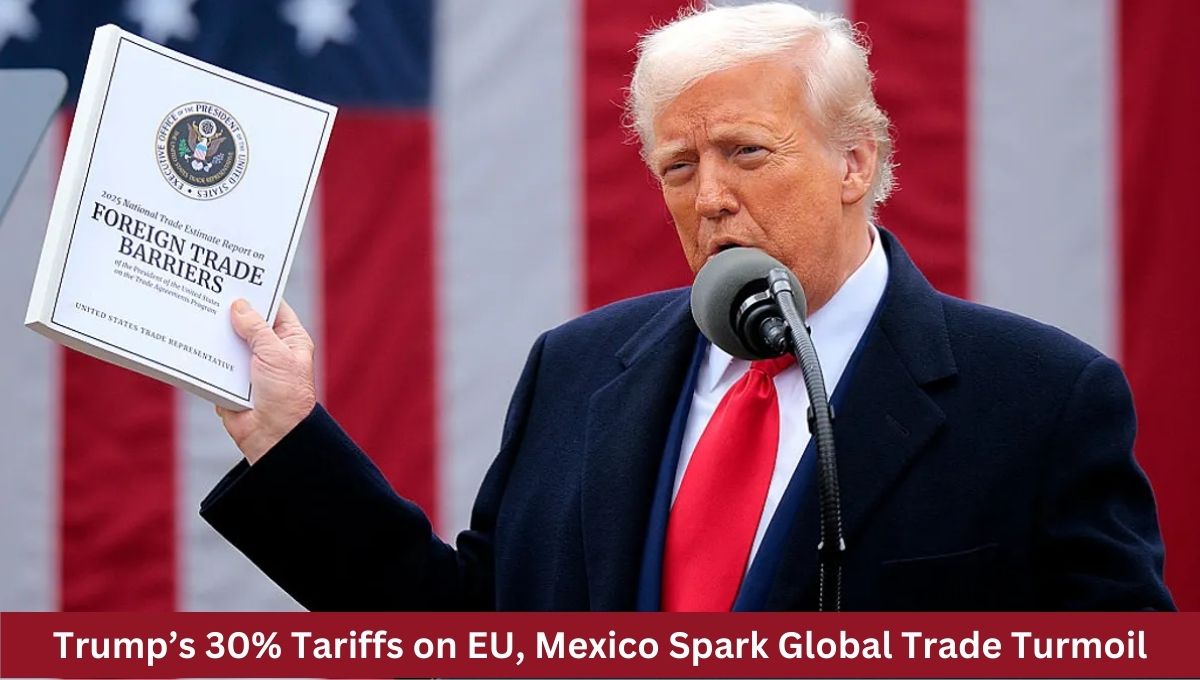
In a dramatic escalation of U.S. trade policy, Trump’s 30% Tariffs on EU, Mexico Spark Global Trade Turmoil. President Donald Trump has announced sweeping 30% tariffs on European Union and Mexican imports, effective August 1, 2025. Announced via Truth Social, the move has stunned global allies, disrupted ongoing negotiations, and triggered strong warnings of economic retaliation.
The tariffs are part of Trump’s revived strategy of protectionism, now targeting more than two dozen U.S. trade partners with duties ranging from 20% to 50%. While the White House claims this is to correct long-standing trade imbalances and protect national security, critics argue it’s a political weapon dressed as economic policy.
Trump’s 30% Tariffs on EU, Mexico Spark Global Trade Turmoil
Macron, Sánchez, and von der Leyen Slam Tariff Move
European leaders swiftly condemned Trump’s actions. French President Emmanuel Macron called on the EU to “resolutely defend European interests,” stressing that tariffs are economic weapons that fuel inflation and slow growth.
“Tariffs are taxes. They fuel inflation, create uncertainty and hinder economic growth,” Macron warned.
Spanish Prime Minister Pedro Sánchez denounced the tariffs as unjustified, emphasizing that economic openness leads to prosperity, while protectionism destroys it.
He affirmed Spain’s full support for the European Commission’s negotiating efforts.Germany adopted a more cautious tone.
Economy Minister Katherina Reiche urged pragmatism, warning that a protracted trade conflict could harm German automotive exports, which are heavily reliant on U.S. consumers.
EU Ready for Countermeasures as August 1 Deadline Looms
European Commission President Ursula von der Leyen took a firm yet diplomatic position, reiterating the EU’s openness to talks, but warning that it will not hesitate to defend its interests.
“We will take all necessary steps to safeguard EU interests, including the adoption of proportionate countermeasures if required,” she stated.
The EU is prepared to activate its Anti-Coercion Instrument, which could impose retaliatory tariffs, limit U.S. access to EU public procurement, or block imports from key American sectors like technology, energy, or pharmaceuticals.
European Council President Antonio Costa reinforced unity within the bloc, stating, “The EU remains firm, united, and ready to protect its interests.”
Mexico Rejects Tariffs as “Unfair Deal” and Upholds Sovereignty
Mexico, facing the same 30% tariff, responded with a measured but clear rejection. In a joint statement by its Economy and Foreign Affairs ministries, the government called the move an “unfair deal” and emphasized its commitment to diplomacy.
President Claudia Sheinbaum, while avoiding inflammatory language, was firm about Mexico’s non-negotiable sovereignty.
“There is something that is never negotiated, ever, and that is the sovereignty of our country,” Sheinbaum said at a public event.
Mexico has established a binational working group with the U.S. to find a resolution before August 1. With 80% of Mexico’s exports heading to the U.S., a breakdown in trade could be economically devastating.
Trump’s “90 Deals in 90 Days” Strategy Targets 24+ Nations
The tariffs are part of Trump’s campaign promise of “90 deals in 90 days,” a push to aggressively renegotiate global trade agreements.
Since his return to office, Trump has issued tariff threats to over 24 countries, including:
- Canada – 35% tariff
- Brazil – 50% tariff
- Japan and South Korea – Pending
- European Union and Mexico – 30% tariff each
The rationale varies: Trump cited a $235.6 billion trade deficit with the EU as a “national security threat.” For Mexico, the justification centers on fentanyl trafficking and migration.
In Brazil’s case, the decision was politically charged Trump expressed anger over the prosecution of former President Jair Bolsonaro.
“Our relationship has been, unfortunately, far from reciprocal,” Trump wrote in a letter to von der Leyen.
Canada and Brazil Also Caught in the Tariff Crossfire
Despite making concessions, such as suspending its digital services tax, Canada was hit with a 35% tariff. Prime Minister Mark Carney expressed shock, calling the move “unfair and unprovoked.”
Brazil, meanwhile, faces a staggering 50% tariff, despite the U.S. maintaining a $29 billion trade surplus with the country.
Analysts believe Trump’s motivations are political, with the tariff seen as retaliation for Bolsonaro’s ongoing legal troubles.
“Trump seems to use tariffs to influence foreign domestic politics as much as trade itself,” said Eswar Prasad, trade expert at Cornell University.
EU Divided on Strategy, But United Against Trump’s Demands
Within the EU, there is division on tactics but unity in rejecting Trump’s unilateralism. Germany favors a quick deal to protect its export-heavy economy, while France and Spain are demanding a balanced and reciprocal agreement.
“The EU should mobilise all instruments at its disposal,” Macron said, emphasizing the need to resist one-sided U.S. demands.
Dutch Prime Minister Dick Schoof and Italian Prime Minister Giorgia Meloni, though traditionally more Trump-aligned, warned that triggering a transatlantic trade war would be a strategic mistake.
Experts Slam Unpredictable and Risky Trade Policy
Economists and former trade officials have sharply criticized Trump’s approach, warning that it undermines international trade norms and injects volatility into global markets.
“His recent moves underscore the growing unpredictability, incoherence, and assertiveness of his trade policies,” said Wendy Cutler, former U.S. trade negotiator.
Douglas Holtz-Eakin, former director of the Congressional Budget Office, highlighted the paradox: “These are essentially letters to other countries about taxes he’s going to levy on his citizens.”
WTO Rules and the Risk of a Global Trade Breakdown
Legal experts warn that Trump’s selective tariffs may breach World Trade Organization (WTO) rules particularly the Most Favoured Nation (MFN) principle, which bars countries from charging different tariff rates for similar goods from different nations.
By bypassing diplomatic norms and issuing threats on Truth Social, Trump’s actions are being seen as a direct challenge to the multilateral trading system.
“Trump is effectively blowing up the rules of world trade,” said Jacob Funk Kirkegaard of Bruegel, a Brussels-based think tank.
Economic Fallout: Revenue for the U.S., Risk for the World
According to U.S. Treasury data, Trump’s tariff measures have generated over $100 billion in customs revenue this fiscal year.
However, the long-term impact could be severe:
- Inflation: Tariffs are expected to raise consumer prices, especially in key sectors like autos, steel, aluminum, and pharmaceuticals.
- Supply Chain Disruption: Critical goods from the EU and Mexico could face delays and cost surges.
- Investor Uncertainty: Volatile trade policy is deterring long-term investments in export-heavy industries.
“Markets haven’t panicked yet,” said financial analyst Mike Hanna. “But investors are watching this closely.”
Allies Seek Trade Diversification as Trust in U.S. Erodes
Facing an unpredictable Washington, countries are actively exploring alternative trade routes and alliances.
Canada is deepening ties with Southeast Asia, while Japan has signaled a potential rebalancing of its military and economic dependence on the U.S.
“These countries need the United States but they’re becoming increasingly unhappy and resistant to over-the-top requests,” said Matthew Goodman, Council on Foreign Relations.
This growing shift away from the U.S. could have long-term implications for America’s global economic and geopolitical influence.
Conclusion: Global Trade System at a Crossroads
As August 1 draws closer, the stakes for global trade couldn’t be higher. With talks teetering and threats mounting, the international community faces a defining moment: concede, retaliate, or reform.
Trump’s tariff strategy may deliver political points at home, but it’s straining relationships abroad and unsettling markets. The world now watches to see whether the U.S. and its allies can reach compromise or whether we are heading into a new era of economic nationalism and trade fragmentation.
For now, the global message is clear: This is no longer just about tariffs it’s about trust, sovereignty, and the future of the world economy.
Also Read: Trump Targets Sri Lanka, BRICS with Sweeping Tariffs
Also Read: US announcement of 30% tariffs on EU, Mexico sparks backlash from key trade partners
Related Posts:
- Trump’s 20-Point Gaza Peace Plan Gains Urgent Global…

- What’s Next for Donald Trump After Court Rules His…

- Trump Targets Sri Lanka, BRICS with Sweeping Tariffs
- Trump’s 2025 Gaza Peace Plan Signing and Historic…

- 10 Explosive Facts About Donald Trump’s $1 Billion…

- Can the EU and NATO Impose Tariffs on India and…
