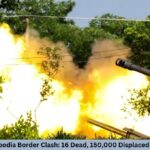
In a deadliest border conflict, Thai, Cambodian Leaders Hold Ceasefire Talks in Malaysia After Trump Threatens Trade Tariffs. Malaysia is hosting urgent peace talks between Thailand and Cambodia to de-escalate the worst border violence between the two countries in more than a decade. The negotiations, scheduled for Monday at 3 PM local time (0700 GMT), come amid heavy artillery exchanges and escalating civilian casualties along their disputed frontier.
The talks, taking place in Kuala Lumpur, are being brokered by Malaysian Prime Minister Anwar Ibrahim in his capacity as chair of the Association of Southeast Asian Nations (ASEAN). Thailand’s acting Prime Minister Phumtham Wechayachai and Cambodian Prime Minister Hun Manet are both attending in hopes of brokering a ceasefire.
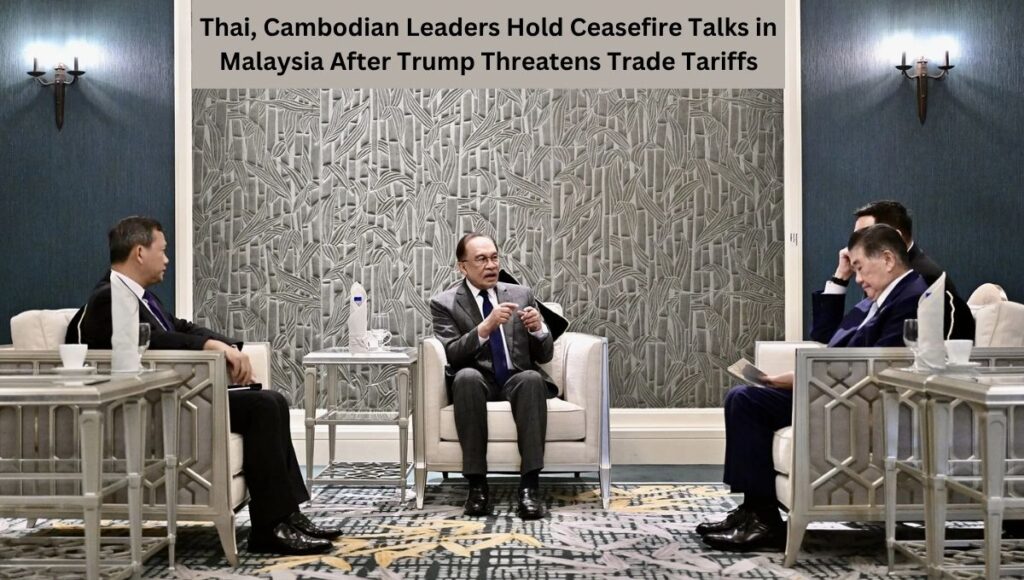
Thai, Cambodian Leaders Hold Ceasefire Talks in Malaysia After Trump Threatens Trade Tariffs
US Pressures Both Sides with Tariff Threats
The high-stakes meeting follows a dramatic intervention from US President Donald Trump, who threatened to halt ongoing trade negotiations with both nations unless they agreed to a ceasefire.
Speaking to reporters in Scotland on Sunday, Trump said he spoke directly with the leaders of both countries.
“We’re not going to make a trade deal unless you settle the war,” Trump declared. “By the time I got off the phone, I think they want to settle now.”
Trump’s tariff threat appears to have catalyzed the rapid diplomatic turnaround, prompting ASEAN to mobilize peace efforts.
Escalating Border Clashes Spark Global Concern
The conflict flared up again on July 24, with both countries accusing each other of initiating artillery strikes and ground assaults in contested regions near the Preah Vihear and Ta Moan Thom temple complexes.
The historical dispute, simmering since the 1960s, intensified after the killing of a Cambodian soldier during a May skirmish.
Since last Thursday, more than 30 people have died, including 13 civilians in Thailand and 8 in Cambodia. Both nations have reported dozens of military casualties and over 200,000 civilians have been displaced.
“We just checked in with some contacts on the border. They say they are still hearing exchanges of artillery fire,” Al Jazeera correspondent Tony Cheng reported from Surin, Thailand.
ASEAN Steps in as Malaysia Hosts Emergency Summit
Prime Minister Anwar Ibrahim took the lead in organizing the emergency meeting, underscoring ASEAN’s renewed role in regional crisis management.
Malaysia extended mediation offers over the weekend and succeeded in bringing both leaders to the negotiating table.
Acting Thai Prime Minister Phumtham Wechayachai confirmed the talks would explore bilateral agreements on troop withdrawals, non-aggression pacts, and de-escalation protocols.
“We have proposed a bilateral agreement between our foreign ministers to conclude the conditions for a ceasefire and drawing back troops and long-range weapons,” Phumtham told reporters Sunday.
US Secretary of State Marco Rubio: Diplomacy on the Ground
Adding to the American push, US Secretary of State Marco Rubio confirmed that State Department officials are already in Malaysia assisting with the peace process.
“We want this conflict to end as soon as possible. State Department officials are on the ground in Malaysia to assist these peace efforts,” Rubio said in a statement.
Rubio also held separate calls with the foreign ministers of Thailand and Cambodia, urging immediate de-escalation and pledging US support for further mediation.
Trump Leverages Trade Pressure
President Trump has used trade leverage before in Asia, notably during India-Pakistan border disputes.
His latest move involves threatening to suspend pending US-Thailand trade agreements, including proposals to lower a proposed 36% tariff on Thai exports.
“When all is done, and Peace is at hand, I look forward to concluding our Trading Agreements with both!” Trump posted on Truth Social.
According to US sources, Thailand has been offering expanded market access for American products to narrow its $46 billion trade surplus with the United States.
Blame Game Threatens Fragile Truce
Despite the peace push, Sunday saw renewed clashes, with both sides blaming each other for initiating artillery attacks.
Cambodia accused Thai forces of shelling temple complexes, while the Thai military reported rockets landing near civilian areas.
“We are reaching a deadlock where neither side is able to stand back,” said Al Jazeera’s Cheng.
Phumtham reiterated that Thailand cannot proceed with ceasefire implementation while Cambodia is “targeting its civilians” a claim Phnom Penh denies.
UN Calls for Immediate Ceasefire
UN Secretary-General Antonio Guterres expressed deep concern over the armed clashes and urged both nations to implement an immediate ceasefire.
“The Secretary-General urges both parties to halt hostilities and resolve their disputes through dialogue,” said UN spokesperson Stephane Dujarric.
Border Residents Caught in the Crossfire
Evacuation centers in border provinces of Surin and Sisaket in Thailand, as well as Oddar Meanchey and Preah Vihear in Cambodia, are now home to tens of thousands of displaced civilians.
“They came with virtually nothing, and they don’t know if they’re going to be here for days, weeks or even months,” said Tony Cheng, reporting from a shelter in Surin housing 3,000 people.
Civilians are pleading for a ceasefire. Cambodian student Sreung Nita said, “If Thailand agreed to stop fighting, both countries could live in peace.”
Thai villager Thavorn Toosawan echoed the sentiment: “It’s great that America is insisting on the ceasefire because it would bring peace.”
Preah Vihear and Longstanding Disputes
At the heart of the Thailand-Cambodia conflict lies a century-old dispute over territory near the Preah Vihear Temple, which was awarded to Cambodia by the International Court of Justice (ICJ) in 1962.
Tensions reignited in 2008 when Cambodia attempted to register the site as a UNESCO World Heritage Site, a move Thailand opposed.
Since then, repeated skirmishes have occurred, but none have reached the current level of intensity.
A Fragile Path to Peace
While Trump’s intervention has pushed both sides toward dialogue, success hinges on genuine commitment from both governments.
Cambodian Prime Minister Hun Manet welcomed US mediation and expressed hope that “this time we can finalize a peace agreement.”
Meanwhile, Thailand insists that any ceasefire must come with security guarantees and mechanisms to prevent further flare-ups.
“There is no turning back unless peace and security can be guaranteed for our civilians,” Thai Foreign Ministry spokesperson said.
Conclusion: Hope Amid Uncertainty
As peace talks begin in Malaysia, the region watches anxiously. With the US playing mediator, ASEAN stepping up, and both governments under pressure from global and domestic actors, there’s a narrow window for a diplomatic breakthrough.
The outcome could determine not only the fate of thousands of civilians but also the future of US-Thai and US-Cambodian trade relations, and ASEAN’s role in managing intra-regional crises.If a ceasefire is achieved, it will mark a significant diplomatic win for multilateralism and peace diplomacy in Southeast Asia.
Also Read: Trump Pushes for Ceasefire as Thailand-Cambodia Border War Escalates
Also Read: Thailand, Cambodia agree to ‘immediate, unconditional’ ceasefire: Malaysia
Related Posts:
- 7 Powerful Takeaways from Trump’s Thai-Cambodia Peace Deal
- Thai F-16 Jet Bombs Cambodian Targets as Deadly…

- 7 Explosive Facts as Thailand–Cambodia Airstrikes…
- 5 Key Signals from PM Modi’s Virtual ASEAN Summit Appearance
- 11 Dangerous Signals as Thailand–Cambodia Airstrikes…

- Thailand-Cambodia Border Clash: 16 Dead, 150,000…