

In a dramatic diplomatic maneuver, Trump Pushes for Ceasefire as Thailand-Cambodia Border War Escalates. U.S. President Donald Trump has directly intervened in the ongoing border conflict between Thailand and Cambodia. With rising civilian casualties and mass displacement along the border, Trump announced on Truth Social that he had spoken with both Cambodian Prime Minister Hun Manet and Thailand’s Acting Prime Minister Phumtham Wechayachai, urging an immediate ceasefire and promising to resume trade talks only if hostilities cease.
Thank you for reading this post, don't forget to subscribe!“Both Parties are looking for an immediate Ceasefire and Peace,” Trump wrote. “They are also looking to get back to the Trading Table with the United States, which we think is inappropriate to do until such time as the fighting STOPS.”
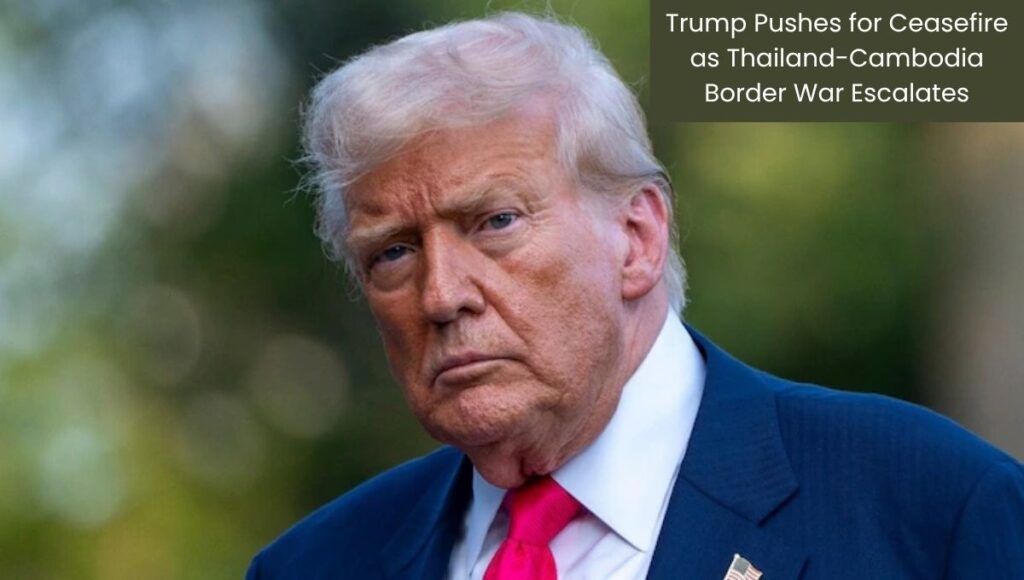
Trump Pushes for Ceasefire as Thailand-Cambodia Border War Escalates
Ceasefire Talks Gain Traction
According to the Cambodian government, the leaders have agreed in principle to initiate bilateral dialogue.
Cambodian PM Hun Manet confirmed that Cambodia’s foreign minister will coordinate with U.S. Secretary of State Marco Rubio to draft a ceasefire framework.
Thailand’s foreign ministry issued a parallel statement confirming openness to peace talks, emphasizing the need for “sincere intent” from Cambodia.
“Thailand agrees in principle to have a ceasefire in place,” a Thai official said, underlining the fragility of mutual trust.
Rising Toll: 33 Killed and Over 168,000 Displaced
The deadly clashes have resulted in at least 33 deaths and the displacement of more than 168,000 people.
Cambodian authorities reported evacuating 10,865 families approximately 37,635 people from three border provinces. On the Thai side, over 131,000 residents have fled the escalating violence.
The conflict reportedly reignited when a landmine explosion injured five Thai soldiers near the border.
Artillery and small arms fire have since been exchanged daily, with both sides accusing each other of provoking the violence.
The entire 817-kilometer stretch of border, long plagued by territorial disputes, has now become a flashpoint.
The Trade Lever: Trump’s Strategic Diplomacy
True to his transactional diplomacy style, Trump is using economic leverage to push both nations toward peace. He made it clear that no trade deals would move forward until fighting stops.
“We happen to be currently dealing on Trade with both Countries, but do not want to make any Deal, with either Country, if they are fighting,” Trump posted.
He even compared the current crisis to the India-Pakistan border conflict he claimed to have helped de-escalate during his first term.
Trump’s approach, blending economic incentives with diplomatic pressure, may offer a unique pathway toward resolving the crisis.
Historical Grievances Fuel Modern War
This conflict is far from new. The Thailand-Cambodia border has seen repeated flare-ups over the decades, particularly over ancient temple sites like Ta Moan Thom and the UNESCO-designated Preah Vihear Temple.
Although the International Court of Justice awarded Preah Vihear to Cambodia in 1962, tensions reignited in 2008 when Cambodia sought World Heritage status for the site.
This triggered military skirmishes and left dozens dead. The current conflict appears to be the most severe escalation since 2011.
Violent Weekend: New Flashpoints Emerge
Fresh fighting erupted over the weekend in Thailand’s Trat Province and Cambodia’s Pursat Province regions not previously known as conflict zones.
Reports confirmed:
- Over 30 fatalities
- More than 130,000 civilians displaced
- Dozens wounded on both sides
- Increased landmine incidents
- New battlefronts forming outside traditional hotspots
This intensification signals a dangerous expansion of the conflict, raising alarms within the international community.
Uneven Military Balance: Thailand vs. Cambodia
Thailand: U.S. Ally with Military Muscle
Thailand’s military is among the most powerful in Southeast Asia, with:
- 361,000 active-duty troops
- Swedish Gripen jets, U.S.-made F-16s and F-5s
- Cobra and Black Hawk helicopters
- Over 600 artillery systems
- 60 Chinese-made VT-4 tanks
A 2024 ranking by the Lowy Institute placed Thailand 14th in the region in military strength.
Cambodia: A Weaker Force Backed by China
In contrast, Cambodia’s armed forces remain underdeveloped:
- 120,000 active personnel
- No effective air force
- Outdated tanks and helicopters
- Dependence on Chinese military aid
Despite these limitations, Cambodia has deepened ties with China through military exercises and strategic infrastructure projects, including the Chinese-funded Ream Naval Base, which some believe could eventually host Chinese aircraft carriers.
U.S.-China Proxy Conflict?
The current Thailand-Cambodia clash is not only a regional issue but also a proxy conflict between global powers.
- Thailand: Longstanding U.S. ally, hosts joint military drills like Cobra Gold
- Cambodia: “Iron-clad” military ties with China, Beijing is top arms supplier
Trump’s sudden involvement signals growing U.S. concern over Beijing’s growing influence in Cambodia.
Washington aims to counterbalance China’s reach in Southeast Asia by leveraging trade, diplomacy, and military cooperation.
U.N. and ASEAN Step In
UN Secretary-General Antonio Guterres issued a statement urging both sides to agree to an immediate ceasefire and return to peaceful dialogue.
“I am deeply concerned about the recent armed clashes at the border between Cambodia and Thailand,” Guterres posted on X (formerly Twitter).
The UN Security Council held an emergency meeting Friday to assess the deteriorating situation.
Cambodia accused Thailand of launching cross-border military strikes, while Thailand blamed Cambodian forces for planting landmines.
Human Rights Concerns Emerge
Human Rights Watch condemned Thailand’s alleged use of cluster munitions in civilian areas. Though Thailand initially denied the allegations, a military spokesperson later admitted such weapons might be deployed “when necessary.”
Neither country is a signatory to the international Convention on Cluster Munitions.
Military Strategy: Terrain vs. Technology
Experts say Thailand holds a clear technological advantage, but Cambodia controls more favorable terrain. Carl Schuster, former U.S. Pacific Command director, noted:
“Terrain favors access from Cambodian territory to the disputed area… I think the Thais will prefer to emphasize air power and long-range firepower.”
Cambodia is reportedly using guerrilla tactics, booby traps, and landmines to slow Thai advances and protect its positions.
The Road to Ceasefire Talks
Both governments have agreed in principle to meet, but the details remain unclear. Neither side has confirmed the time, venue, or negotiation format.
Trump stated that both parties must aim for “Ceasefire, Peace, and Prosperity.”
Thai Acting PM Phumtham Wechayachai requested Trump to communicate Thailand’s readiness for talks directly to Cambodia.
Cambodia has expressed support for a multilateral ceasefire plan led by Malaysian Prime Minister Anwar Ibrahim in his capacity as ASEAN Chair.
Bilateral vs. Multilateral Peace?
While Cambodia backs ASEAN-led negotiations, Thailand has shown preference for bilateral talks. This difference in approach could stall or complicate the peace process.
Observers worry that a failed ceasefire attempt could lead to further militarization, increased Chinese or U.S. involvement, and prolonged regional instability.
Trump’s Legacy: Peace Broker or Power Broker?
Trump’s intervention, if successful, could burnish his foreign policy credentials. By halting conflict and restoring stability, he may achieve a rare diplomatic victory during his second term.
However, critics caution against over-reliance on trade threats. Gregory Poling of the Center for Strategic and International Studies warned:
“If either or both sides don’t get a trade deal after a ceasefire, they may view it as a betrayal by the U.S.”
Conclusion: A Fragile Peace Beckons
As border clashes continue, Trump’s trade-based diplomacy has opened a new window for peace. Whether this opportunity leads to lasting resolution or merely a temporary pause depends on transparent negotiations, good faith, and sustained international engagement. With 33 lives lost and over 168,000 displaced, the stakes are too high for failure. Southeast Asia and the world now watches closely.
Also Read: Thailand-Cambodia Border Clash: 16 Dead, 150,000 Displaced in Temple War
Related Posts:
- Thai F-16 Jet Bombs Cambodian Targets as Deadly…

- Deadly Border Clashes Between Thailand and Cambodia…
- 7 Powerful Takeaways from Trump’s Thai-Cambodia Peace Deal
- 5 Powerful Highlights as Trump Lands Second Nobel…

- Thailand-Cambodia Border Clash: 16 Dead, 150,000…
- 7 Explosive Developments as Cambodia Accuses…
