Surge in Deadly Border Clashes Between Thailand and Cambodia Spark Regional Crisis. The simmering Thailand-Cambodia border dispute has erupted into the deadliest clashes in over a decade, killing at least 32 people and displacing more than 150,000 civilians. What began as cultural tension around an ancient Khmer temple has spiraled into an all-out military confrontation involving artillery strikes, landmines, and fighter jets.
On July 24, violence exploded near Prasat Ta Muen Thom, an ancient temple at the center of the contested border region. What followed was a series of escalations that included the deployment of Thai F-16 jets, Cambodian rocket strikes on Thai soil, and diplomatic breakdowns with international implications.
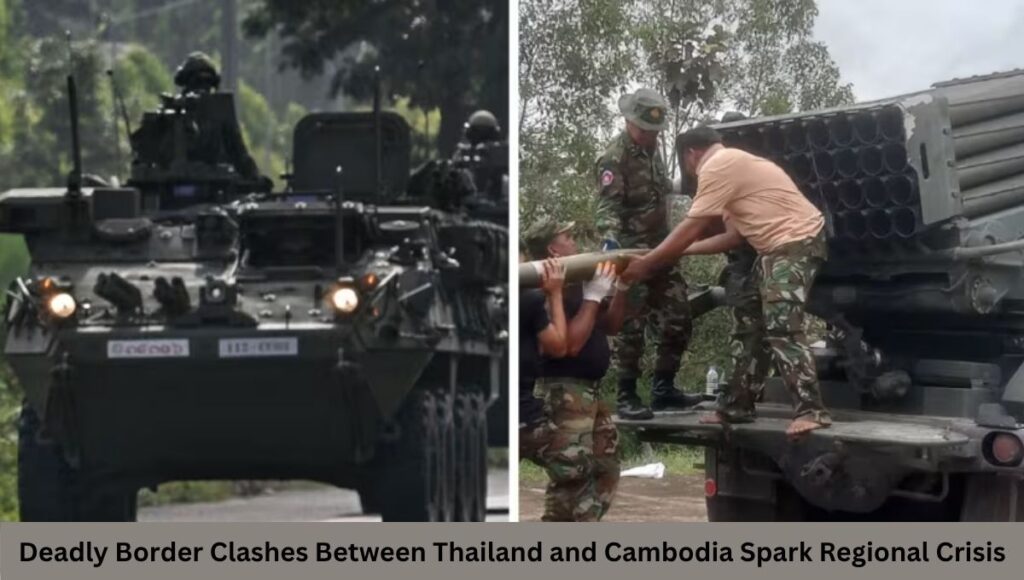
Deadly Border Clashes Between Thailand and Cambodia Spark Regional Crisis
What Sparked the Fighting?
Though tensions have flared sporadically for years, the current conflict has its roots in an incident from February 2025, when Cambodian tourists were reportedly barred by Thai authorities from singing their national anthem at Prasat Ta Muen Thom.
That symbolic insult triggered diplomatic outrage in Phnom Penh and set off a chain of retaliatory actions.
In May, a Cambodian soldier was shot dead near the disputed temple, intensifying the already fraught atmosphere.
Skirmishes continued through June and July, including landmine explosions and internet blockades, before boiling over into open warfare in late July.
A Timeline of Escalation
- February 13: Cambodian civilians escorted to the temple to sing the national anthem.
- February 17: Thailand warns Cambodia over “provocative” actions.
- May 28: Armed skirmish kills one Cambodian soldier.
- June 12–14: Cambodia announces it will cut reliance on Thai electricity.
- June 26: Thailand blocks Cambodian internet access.
- July 1–16: Landmine blasts injure Thai troops.
- July 24: Heavy fighting erupts; Thailand deploys F-16s, closes borders.
Each action and counteraction has edged both countries closer to the brink of full-scale war.
Why Is Prasat Ta Muen Thom So Important?
Located in Surin Province, Thailand, close to the Cambodian border, Prasat Ta Muen Thom is more than just a historical monument it’s a nationalist symbol for both countries.
Built during the Khmer Empire, the temple holds cultural and spiritual significance to Cambodians, while the Thai government maintains that it sits within its territory.
Because of its deep-rooted symbolism, the temple has long been a flashpoint.
Previous military standoffs occurred at similar ancient sites, including the Preah Vihear temple, which was awarded to Cambodia by the International Court of Justice (ICJ) in 1962 and again reaffirmed in 2013. However, surrounding areas remain disputed.
Civilian Toll and Displacement
The most tragic outcome of the Thailand Cambodia border conflict is the toll on civilians. Thailand’s Health Ministry has confirmed 19 Thai deaths, including an 8-year-old child, while Cambodia reports 13 fatalities.
A Cambodian rocket strike on a gas station in Sisaket Province killed six and injured ten more.
On the Thai side, 138,000 citizens have been evacuated to more than 300 shelters. Cambodia has relocated 20,000 residents from Preah Vihear province.
Hospitals near the frontlines have been cleared, and all border crossings have been closed.
The humanitarian crisis is mounting, with both countries urging civilians to evacuate affected zones as artillery fire continues.
Military Showdown: Unequal But Volatile
According to the International Institute for Strategic Studies, Thailand holds a significant edge in military capability:
Thailand:
- Defense budget: $5.7 billion
- Personnel: 360,000+
- Tanks: 400
- Artillery: 2,600
- Aircraft: F-16s, helicopters, drones
Cambodia:
- Defense budget: $1.3 billion
- Personnel: 124,300
- Tanks: 200
- Artillery: 480
Despite being outgunned, Cambodian forces have shown tactical ingenuity, leveraging drone surveillance and focused rocket attacks that have inflicted significant damage and forced Thai retaliation.
Political Turmoil in Thailand
This international crisis couldn’t have come at a worse time for Thailand, which is facing a domestic political earthquake.
Prime Minister Paetongtarn Shinawatra was suspended on July 1 following a leaked phone call with former Cambodian PM Hun Sen, in which she appeared overly deferential, calling him “uncle” and suggesting she would “arrange” accommodations for Cambodia.
Her comments were perceived by many as undermining Thai sovereignty. Mass protests erupted in Bangkok, prompting the Bhumjaithai Party to withdraw from the ruling coalition.
Former Defense Minister Phumtham Wechayachai has since stepped in as acting Prime Minister, further deepening Thailand’s leadership crisis.
Cambodia’s Position and Hun Sen’s Influence
While officially led by PM Hun Manet, Cambodia’s foreign policy is still heavily influenced by Hun Sen, who ruled the country for nearly four decades.
He has vocally accused Thailand of initiating the conflict and used the border crisis to rally domestic support.
Hun Sen also orchestrated the leak of Paetongtarn’s call, further inflaming tensions and consolidating his political narrative of Cambodia as the victim of Thai aggression.
China, the U.S., and a Widening Geopolitical Rift
As Thailand and Cambodia trade blows, China and the United States are carefully watching and maneuvering.
China, the largest trading partner of both countries, has offered to mediate and called for restraint.
Foreign Minister Wang Yi recently met with Cambodian officials and indirectly criticized U.S. tariffs in the region, framing Beijing as a stabilizing force.
Meanwhile, the U.S. has issued travel warnings and condemned violence, but its simultaneous threats of economic sanctions on both countries have undermined its credibility.
Trust in U.S. diplomacy is waning, and China’s willingness to step in could shift regional power dynamics.
ASEAN’s Delayed Response
The Association of Southeast Asian Nations (ASEAN) has yet to convene an emergency summit, even as Malaysia’s PM Anwar Ibrahim, the current chair, reached out to both parties urging peace.
This delayed response has led observers to question ASEAN’s ability to handle internal conflicts, especially those involving nationalist governments unwilling to back down.
A Dangerous Cocktail: Nationalism, History, and Pride
What makes this conflict especially combustible is the blend of nationalism and history. For both Thailand and Cambodia, these ancient temples are more than relics they are symbols of sovereignty, pride, and national identity.
In Surin Province, where many locals speak Khmer, the lines of ethnic identity blur, creating further complications.
In Cambodia, any perceived threat to sacred temple grounds is met with fierce resistance.
This volatile mix ensures that even small incidents can spark major escalations, as witnessed this July.
International Court and Legal Tangles
Though Cambodia has taken its case back to the International Court of Justice (ICJ), Thailand has rejected the court’s jurisdiction, further complicating resolution efforts.
Past rulings in favor of Cambodia, particularly concerning Preah Vihear, have left lingering resentment in Bangkok.
Unless both sides agree to binding arbitration, the legal route may prove ineffective.
What Comes Next?
Experts suggest that the situation may worsen before cooler heads prevail. With national pride on the line, and domestic political instability in Thailand, neither country wants to appear weak.
Phil Robertson, a Southeast Asia conflict analyst, warns:
“We’re unlikely to see a full invasion, but the scars will be long-lasting.”
However, international pressure is building. With fighter jets in the skies and civilians in shelters, calls for a ceasefire and diplomatic negotiations are growing louder.
Final Thoughts: A Region on the Brink
This is no longer a localized skirmish. The Thailand Cambodia border conflict is a dangerous geopolitical flashpoint with regional and international implications. What began with a song at a temple could ignite wider instability in Southeast Asia.
For peace to prevail, urgent mediation likely through ASEAN or China is essential. If left unresolved, the combination of ancient grudges, modern politics, and superpower rivalry could drag the region into deeper conflict.
Diplomacy, not devastation, must define what happens next.
Also Read: Thailand-Cambodia Border Clash: 16 Dead, 150,000 Displaced in Temple War
Also Read: The Fighting Between Thailand and Cambodia Isn’t About Territory. It’s Much More Serious
Related Posts:
- Thailand-Cambodia Border Clash: 16 Dead, 150,000…
- Thai F-16 Jet Bombs Cambodian Targets as Deadly…

- 7 Explosive Developments as Cambodia Accuses…

- 7 Powerful Takeaways from Trump’s Thai-Cambodia Peace Deal
- 11 Dangerous Signals as Thailand–Cambodia Airstrikes…

- 7 Explosive Facts as Thailand–Cambodia Airstrikes…