7 Explosive Developments as Cambodia Accuses Thailand of Defying Ceasefire After Trump’s Call. Cambodia has accused Thailand of continuing aerial bombardment inside its territory just hours after United States President Donald Trump announced that the two Southeast Asian neighbours had agreed to a ceasefire.
The allegations have cast serious doubt over the durability of the truce and underscored the fragility of peace along one of the region’s most volatile borders. According to Cambodia’s Ministry of Defence, Thai F-16 fighter jets carried out fresh airstrikes on December 13, dropping multiple bombs on targets inside Cambodia.
The claim came despite Trump’s public assertion that both Bangkok and Phnom Penh had agreed to “cease all shooting” and return to a previously negotiated peace framework with US and Malaysian support.
With fighting now reported to have entered its sixth consecutive day, civilian casualties, mass displacement, and damage to culturally significant sites have intensified concerns among regional governments and international organisations.
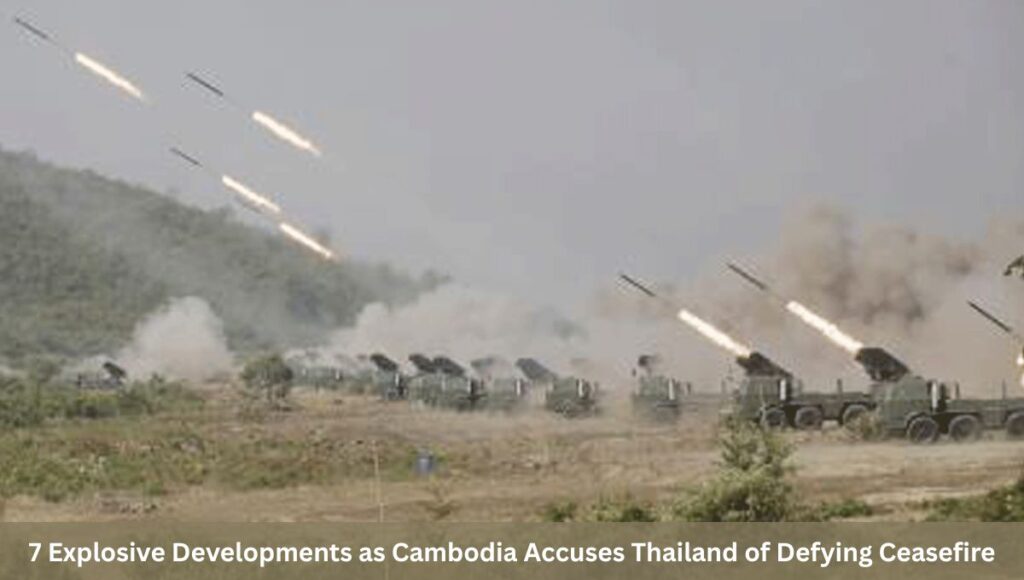
7 Explosive Developments as Cambodia Accuses Thailand of Defying Ceasefire
Cambodia Alleges Fresh Thai Airstrikes
In a statement released on social media, Cambodia’s Ministry of Defence said that two Thai F-16 fighter jets dropped seven bombs on several locations inside Cambodian territory early on Saturday.
“Thai forces have not stopped the bombing yet and are still continuing the bombing,” the ministry said, adding that the strikes included attacks on hotel buildings and bridges near the border.
Local media outlet Khmer Times, citing Cambodia’s Ministry of Information, reported that two hotels in the Thmor Da area of Pursat province were hit. The area lies close to the Thai-Cambodian border and has seen repeated clashes since the latest escalation began.
Photographs published by the outlet showed heavily damaged hotel and casino buildings, reinforcing Phnom Penh’s claims of continued air activity.
Thailand has not yet publicly responded to these specific allegations, leaving competing narratives to circulate as tensions remain high.
Trump’s Ceasefire Announcement
The accusations followed closely after President Trump announced what he described as a breakthrough ceasefire agreement. In a post on his Truth Social platform, Trump said he had spoken directly with Thai Prime Minister Anutin Charnvirakul and Cambodian Prime Minister Hun Manet.
“I had a very good conversation this morning with the Prime Minister of Thailand… and the Prime Minister of Cambodia… concerning the very unfortunate reawakening of their long-running war,” Trump wrote.
He added that both leaders had agreed to halt all shooting effective immediately and to return to an earlier peace accord reached with US involvement and the assistance of Malaysian Prime Minister Anwar Ibrahim.
Trump praised Malaysia’s role as a mediator and said the agreement would help prevent a wider regional conflict. He also suggested that both countries were eager to stabilise relations and continue trade ties with the United States.
Ceasefire Claims Under Strain
Cambodia’s assertion that Thai airstrikes continued after the ceasefire call has raised questions about command and control on the ground, as well as the extent to which political agreements are being translated into military restraint.
Observers note that previous ceasefire attempts between the two countries have often collapsed amid mutual accusations of violations. The current situation appears to follow a similar pattern, with each side blaming the other for continued hostilities.
The latest outbreak of violence began earlier this week and has already resulted in significant human and material losses, despite international efforts to de-escalate the crisis.
Rising Casualties and Mass Displacement
The fighting, which reportedly began on Monday, has so far killed at least 20 civilians and soldiers from both countries, with more than 200 people wounded. Other estimates from local and military sources suggest the death toll may be higher as clashes spread across multiple sectors.
The humanitarian impact has been severe. An estimated 600,000 people have been displaced on both sides of the 800-kilometre-long Thai-Cambodian border. Temporary shelters have been set up in several Thai provinces, while Cambodian authorities have also moved civilians away from active combat zones.
Entire communities near the disputed border areas have been emptied as artillery fire, rocket attacks, and airstrikes continue to threaten civilian life.
Dispute Over Ancient Temples at the Core
At the heart of the conflict lies a long-running territorial dispute centred on centuries-old temples along the border, most notably the Preah Vihear Temple.
The 12th-century Hindu temple, dedicated to Lord Shiva, sits atop a cliff in the Dângrêk Mountains and has been a flashpoint for decades. Although the International Court of Justice awarded sovereignty over the temple to Cambodia, surrounding land remains contested.
Periodic flare-ups have occurred over the years, but the current escalation is among the most intense in recent times, involving heavy weaponry and air power.
India Voices Concern Over Preah Vihear Damage
India has expressed strong concern over reports of damage to conservation facilities at the Preah Vihear Temple amid the ongoing clashes.
Responding to media queries, Ministry of External Affairs spokesperson Randhir Jaiswal said New Delhi was closely monitoring the situation and stressed the importance of protecting the UNESCO World Heritage Site.
“Any damage to conservation facilities is unfortunate, and is a matter of concern,” Jaiswal said, describing the temple as a symbol of shared human heritage.
India, which has been involved in preservation efforts at the site, urged both Thailand and Cambodia to take all necessary measures to safeguard the temple and related facilities. New Delhi also reiterated its call for restraint and a return to dialogue.
UNESCO Raises Alarm
UNESCO has also voiced serious concern over renewed tensions near the Preah Vihear Temple and other cultural sites along the border.
The organisation said it would continue to monitor the situation closely and stood ready to provide technical assistance and emergency protection measures once conditions allow.
Cultural heritage experts warn that sustained fighting in the area could cause irreversible damage to ancient structures that have survived for centuries.
Indian Embassy Issues Travel Advisory
In response to the deteriorating security situation, the Indian Embassy in Thailand has issued an advisory for Indian nationals and travellers.
The embassy urged travellers to check official updates from Thai authorities before visiting areas near the Thailand-Cambodia border, where tensions have escalated sharply in recent days.
Similar advisories are expected from other diplomatic missions as the conflict shows few immediate signs of resolution.
Thai Army Claims Major Battlefield Gains
While Cambodia has accused Thailand of continued airstrikes, the Thai army has released detailed statements outlining what it describes as significant military successes.
According to a situation report issued by the Second Army’s Operations Centre, the current round of clashes began on December 7, when Cambodian troops allegedly fired on a Thai patrol, wounding two soldiers.
The Thai military claims Cambodian forces subsequently launched artillery and rocket attacks across multiple provinces, prompting a response under what it described as proportionate rules of engagement.
Thirteen Active Fronts
The Second Army listed 13 main sectors of engagement across four provinces, including Ubon Ratchathani, Si Sa Ket, Surin and Buri Ram. Thai forces said they had secured or contested several key areas while facing heavy resistance involving artillery, drones and minefields.
Claimed Cambodian Losses
The Thai army estimates that Cambodian forces have suffered more than 100 fatalities since December 7, along with the destruction of tanks, rocket launchers, drones and anti-drone systems. These figures have not been independently verified.
Thailand also reported the evacuation of more than 220,000 civilians into hundreds of temporary shelters, along with special-care facilities for vulnerable groups.
How the Latest Fighting Began
The current escalation is traced to a roadside bomb explosion that killed and injured Thai soldiers. While Trump described the blast as an accident, Thailand responded with a large-scale military operation, triggering a rapid spiral of retaliatory attacks.
Since May 2025, clashes have repeatedly erupted along the border, with major flare-ups reported in July, November and December, despite earlier ceasefire agreements brokered with international involvement.
Uncertain Path to Peace
Trump has urged both governments to honour the renewed ceasefire and avoid further military action. However, Cambodia’s latest accusations suggest that the situation on the ground remains volatile and unpredictable.
Analysts say the coming days will be critical in determining whether the truce holds or collapses like previous agreements. With civilian lives at stake and priceless cultural heritage under threat, pressure is mounting on both Bangkok and Phnom Penh to step back from the brink and pursue a durable political solution.
For now, the Thailand-Cambodia border remains tense, with ceasefire promises clashing against the realities of ongoing military operations.
Also Read: 11 Dangerous Signals as Thailand–Cambodia Airstrikes Threaten Trump’s Peace Deal
Also Read: Thailand to continue military action until threats end, says prime minister
Related Posts:
- Thai F-16 Jet Bombs Cambodian Targets as Deadly…

- 7 Powerful Takeaways from Trump’s Thai-Cambodia Peace Deal
- 7 Explosive Facts as Thailand–Cambodia Airstrikes…
- 11 Dangerous Signals as Thailand–Cambodia Airstrikes…

- Thailand-Cambodia Border Clash: 16 Dead, 150,000…
- Deadly Border Clashes Between Thailand and Cambodia…