
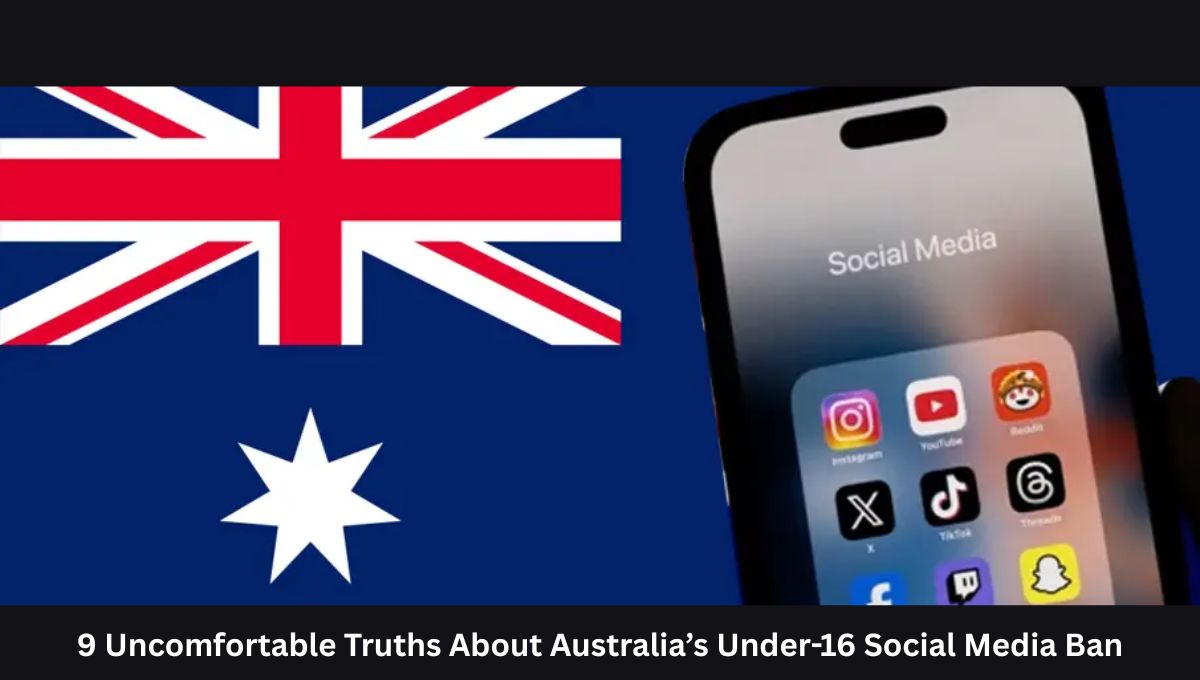
9 Uncomfortable Truths About Australia’s Under-16 Social Media Ban protecting children online. Australia’s decision to ban children under the age of 16 from major social media platforms has placed the country at the centre of an intense global conversation about how far governments should go to protect young people online.
Introduced as a landmark child-safety measure, the policy was designed to curb cyberbullying, reduce exposure to harmful content, and counter what many parents and educators describe as a growing crisis of social media addiction among teenagers.
Yet, within days of the ban coming into force, a more complicated picture emerged. Teenagers quietly returned to banned platforms, alternative apps surged in popularity, and legal challenges questioned whether the law strikes the right balance between safety, privacy, and freedom of expression.
Australia’s experiment is now being closely watched by governments across the world, including India, as a potential blueprint—or warning—for future digital regulation.
9 Uncomfortable Truths About Australia’s Under-16 Social Media Ban
Why Australia Introduced the Under-16 Social Media Ban
The Australian government justified the ban by pointing to mounting evidence linking excessive social media use to mental health problems among children and adolescents. Studies cited by policymakers have associated heavy screen time with anxiety, depression, sleep disruption, and reduced attention spans.
High-profile cases of cyberbullying and online exploitation have further fuelled public concern. Prime Minister Anthony Albanese framed the legislation as a moral obligation to protect children in an increasingly digital world.
To mark the law’s introduction, he hosted a symbolic barbecue at his Sydney residence, attended by families who had lost children to cyberbullying-related suicide and campaigners who had lobbied for tougher online safety laws.
The Sydney Harbour Bridge was illuminated in green and gold with the slogan “Let Them Be Kids,” reinforcing the emotional narrative behind the policy.
Under the law, children under 16 are prohibited from holding accounts on 10 designated platforms, including TikTok, Instagram, Snapchat, Facebook, X and YouTube. Crucially, the responsibility for enforcement rests with technology companies, which must implement age-verification systems or face penalties.
A World-First Policy With Global Implications
Australia is the first country to attempt such a sweeping, nationwide ban on social media access for minors. Other governments have experimented with age limits, parental consent requirements, and content moderation rules, but none have gone as far as a blanket prohibition for teenagers.
Supporters argue that the policy sends a strong message to technology companies that children’s safety must come before profit. Critics counter that it is a blunt instrument that underestimates teenagers’ digital literacy and overestimates the state’s ability to police the internet.
The global attention reflects a broader dilemma: how to regulate platforms that operate across borders, evolve rapidly, and shape the daily lives of billions.
Teens Return Online Almost Immediately
Within hours of the ban taking effect, teenagers began finding ways back onto restricted platforms. Fourteen-year-old cheerleader Lucy Brooks briefly lost access to Instagram, while some of her friends disappeared from Snapchat. Within a day, most were back.
Many teens created new accounts using false birthdates, a tactic that has long been common on social media. Others borrowed photos or identification details from parents and older siblings who were willing to help them bypass age checks.
Some reportedly used AI-generated images and videos designed to mimic adults, exploiting weaknesses in automated verification systems.
These workarounds closely mirror those seen in the United Kingdom after the introduction of its Online Safety Act, suggesting that determined young users often adapt faster than regulators anticipate.
Age-verification companies insist their technology can later flag suspicious accounts based on behaviour, such as posting patterns or social networks. However, whether such measures will lead to large-scale removals remains uncertain.
Social Media as Communication, News, and Identity
For many Australian teenagers, social media is not a casual pastime but a central part of daily life. It functions as a messaging system, a news source, and a space for identity formation.
In a park near Sydney Harbour, a group of 15-year-old boys admitted that none of their accounts had been shut down. One said he had entered his birth year as 2000 when signing up years earlier.
Another explained that while he could live without TikTok, losing Snapchat would be far more disruptive because it allows communication without exchanging phone numbers.
One boy said most of his news comes from Instagram, with only occasional exposure to traditional television. Another was teased by friends for admitting he sometimes reads printed newspapers, highlighting how far social media has displaced legacy media among younger audiences.
The Impact on Young Creators and Journalists
Critics of the ban warn that it risks stifling creativity and civic engagement among teenagers. Eighteen-year-old Leo Puglisi, founder of online news outlet 6 News, is one of the most vocal opponents.
Puglisi started his news channel at age 11 and now manages a team of nine school-age journalists who balance homework with reporting on national events. He argues that such opportunities would not exist if the ban had been in place earlier.
“We’re talking about 15-year-olds being banned from social media, not five-year-olds,” he said. “A teenager who can have a part-time job should be allowed to log into YouTube.”
For young people interested in journalism, activism, or creative industries, social media often provides the first and most accessible platform.
Teen Entrepreneurs Feel the Pinch
The economic impact of the ban is also being felt by teenage entrepreneurs. Lucas Lane, now 16, founded his nail-polish brand Glossy Boys at age 13 after struggling to find black nail polish in local stores. His business markets primarily through Instagram, Facebook and TikTok.
“This ban is going to impact my business and the community around it,” Lane said. “Social media is how we reach people who feel represented by what we do.”
Lane believes education, parental controls, and content restrictions would be more effective than outright bans. For many teen-led startups, social media is the only affordable route to national and global audiences.
Anxiety and Uncertainty Among Teens
Beyond access issues, the ban has generated anxiety among young users. Lucy Brooks said some of her friends are afraid to delete apps because they lack enough phone storage to download years of photos and messages.
Others worry their accounts could be frozen indefinitely, trapping personal memories in inaccessible digital vaults. The uncertainty has prompted some teens to exchange phone numbers as a backup, even if they prefer not to use them.
“It’s scary and nerve-wracking,” Lucy said. While she agrees that children should not spend excessive time on social media, she doubts a ban will work. Instead, she supports time limits of one to two hours per day.
Migration to Alternative and Fringe Apps
As mainstream platforms become harder to access, teenagers are exploring alternative apps at speed. Lemon8, Yope, Coverstar and RedNote have all surged in downloads since the ban took effect. Messaging services such as WhatsApp have also benefited as teens seek to maintain social connections.
According to app store data, Lemon8 became the most downloaded lifestyle app in Australia within days. Bahram Ismailau, chief executive of Yope, said the platform now has more than 100,000 Australian users, driven largely by word of mouth rather than marketing.
Digital experts warn this migration could expose children to platforms with fewer safeguards, less moderation, and limited regulatory oversight.
Regulatory Whack-a-Mole
The rapid rise of lesser-known apps highlights a core weakness of the ban. While major platforms face intense scrutiny, smaller or newly launched apps can emerge almost overnight.
“If a new app can start overnight, then how do we regulate that?” asked Ellese Ferdinands, a lecturer at the University of Sydney Business School. “These fringe apps don’t have the same safeguards.”
Professor Tama Leaver of Curtin University described the trend as predictable displacement. “For those that have come off, they’re looking for somewhere else to go,” he said. “They’ll regroup.”
Legal Challenges and Privacy Concerns
The ban is already facing serious legal resistance. Reddit has launched a challenge in Australia’s High Court, arguing that the law raises constitutional issues related to political communication and forces intrusive age-verification processes on all users, including adults.
The company warned that the policy creates an illogical patchwork of regulated and unregulated platforms while introducing new privacy and data security risks.
Civil liberties advocates echo these concerns, cautioning that large-scale age verification could normalise identity checks across the internet.
What This Means for India and Other Countries
Australia’s move has reignited debate in countries such as India, where social media platforms play a vital role in education, employment, and political expression—especially in rural and semi-urban areas.
India has one of the world’s largest youth populations and social media user bases. A blanket ban could push young users toward unsafe VPNs, widen the urban-rural digital divide, and limit access to learning resources increasingly delivered through platforms like YouTube and Instagram.
Experts argue that India would be better served by strict age verification at signup, robust parental control tools, and heavy penalties for platforms that expose minors to harmful content.
Control Versus Prohibition
Australia’s under-16 social media ban represents one of the boldest attempts yet to rein in the power of big tech over young lives. However, early evidence suggests it is not a silver bullet.
Teenagers remain online, alternative apps are booming, and enforcement challenges persist. While the intent—to protect children—is widely shared, the method remains deeply contested.
As governments worldwide grapple with the same dilemma, Australia’s experience underscores a central lesson: protecting children online may require smarter regulation, stronger education, and empowered parents—not just prohibition.
The coming months will determine whether Australia’s experiment evolves into a model for the world or a cautionary tale about the limits of digital bans.
Also Read: 7 Explosive Reasons Australia’s Teen Social Media Ban Could Reach the US
Also read: Reddit challenges Australia’s under-16 social media ban: Calls it ‘threat to free speech’
Related Posts:
- 7 Powerful Insights into Australia’s Bold Under-16…

- 7 Explosive Reasons Australia’s Teen Social Media…
- 7 Stunning Impacts of Australia’s Tough New Social Media Ban

- 20 Countries, 1 Bold Move: France Set to Ban Social…

- 5 Major Takeaways from the US Supreme Court's…

- Nepal Lifts Social Media Ban Amid Youth Protests,…
