In a groundbreaking move that resets the foundation of transatlantic trade, Trump Finalizes Historic $1.35 Trillion EU Trade Deal, Slashes Tariffs to 15%. President Donald Trump and European Commission President Ursula von der Leyen have finalized a sweeping $1.35 trillion trade deal between the United States and the European Union.
The high-stakes agreement imposes a uniform 15% tariff on EU exports to the U.S., while guaranteeing $750 billion in EU energy purchases and $600 billion in European investment into the U.S. economy. Announced at Trump’s Turnberry golf resort in Scotland, the deal marks a major diplomatic and economic milestone averting a trade war just days before a threatened 30% tariff deadline.
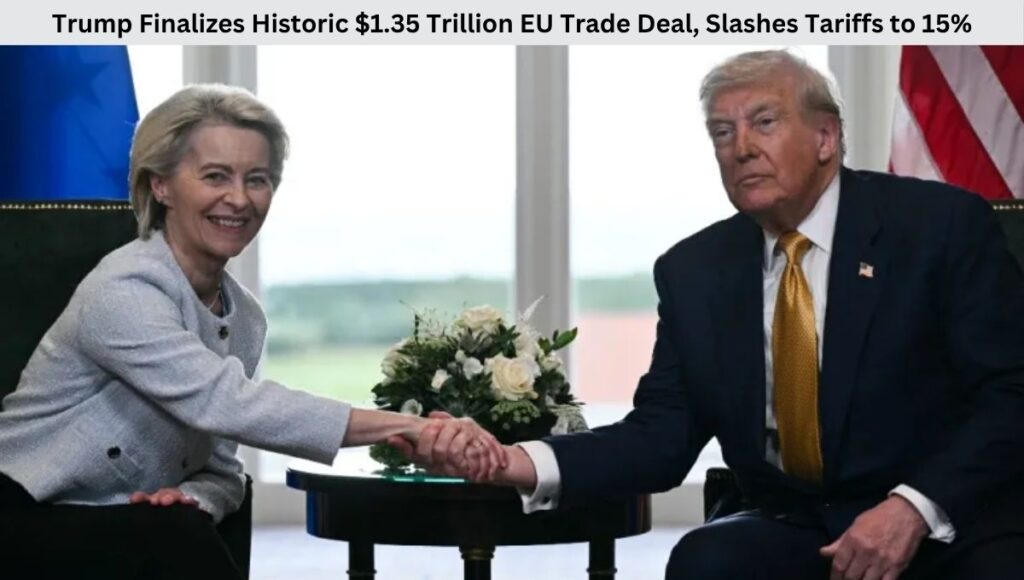
Trump Finalizes Historic $1.35 Trillion EU Trade Deal, Slashes Tariffs to 15%
Averting a Trade War: The 15% Tariff Compromise
The core of the new agreement is the 15% flat tariff imposed on all European Union exports to the U.S., covering goods like automobiles, semiconductors, pharmaceuticals, and machinery.
This replaces the previously threatened 30% across-the-board tariffs, which would have had devastating effects on both economies.
“This is probably the biggest deal ever reached in any capacity,” Trump said, adding that it is “a good deal for everybody.”
Von der Leyen echoed his sentiment, calling the deal one that “brings stability and predictability” for transatlantic trade.
$750 Billion EU Energy Commitment: A Win for U.S. Exporters
A key highlight of the agreement is the EU’s pledge to purchase $750 billion worth of American energy over the next three years. This includes liquefied natural gas (LNG), crude oil, and nuclear fuel.
“This is a massive win for U.S. energy producers and a critical step for the EU’s energy diversification strategy,” Trump noted.
Von der Leyen confirmed that the deal aligns with the EU’s broader goals of reducing reliance on Russian energy, marking a geopolitical shift as well as an economic one.
$600 Billion in EU Investment Targeted at U.S. Infrastructure and Defense
In another major economic boost, the European Union agreed to invest $600 billion in the United States, focused on sectors such as infrastructure, technology, defense, and manufacturing.
Trump highlighted that a significant portion of this investment will go toward purchasing American-made military equipment.
This will not only bolster U.S. defense industries but also create thousands of American jobs.
Von der Leyen emphasized that the deal supports economic growth on both sides of the Atlantic and helps rebuild trust after years of tariff tension.
How Europe Relented: From 30% Threat to 15% Deal
The Trump administration had made clear that without a deal, a 30% tariff would be imposed starting August 1.
In a high-pressure environment, the EU chose to compromise, resulting in a 15% tariff across all goods, with strategic carve-outs for chemicals, raw materials, and select agricultural products.
Von der Leyen defended the compromise, saying, “Fifteen percent is not to be underestimated, but it is the best we could get under the circumstances.”
Strategic Exemptions and Zero-for-Zero Clauses
Despite the tariff increase, Brussels managed to secure zero-tariff carve-outs on key goods. These include:
- Aircraft and aerospace components
- Certain semiconductors
- Generic pharmaceuticals
- Select agricultural products
- Specialty chemicals and raw materials
These exemptions were crucial to winning support from powerful industrial lobbies in Germany and France, although some, like the BDI and VCI, still expressed concerns over retained tariffs.
Detroit Automakers Raise Red Flags
One of the sectors voicing serious concern is the U.S. automotive industry, particularly Detroit automakers.
With European cars now subject to a 15% import tariff higher than prior rates the U.S. auto industry fears rising costs and competitive disadvantages, especially as it continues to face 25% tariffs on Mexican imports.
Some executives argue the deal will hurt American consumers through higher vehicle prices and supply chain disruptions.
Trump’s Trade Strategy: Pressure, Deadlines, and Face-to-Face Diplomacy
The EU deal marks the sixth major trade agreement under Trump’s watch, following deals with:
- The United Kingdom
- Japan
- Vietnam
- Indonesia
- The Philippines
In each case, Trump used tariff threats and tight deadlines to extract favorable terms, followed by direct diplomacy to close the deal.
Vice President JD Vance defended the approach, tweeting: “Tomorrow the American media will undoubtedly run headlines like ‘Donald Trump Only Got 99.9 Percent of What He Asked For.’”
Commerce Secretary: No More Grace Periods
U.S. Commerce Secretary Howard Lutnick underscored the finality of the deal: “No extensions, no more grace periods. August 1, the tariffs are set.”
This clarity has been welcomed by U.S. and EU businesses alike, who had been hedging against trade risks for months.
Market Reactions: Stocks Rally, Euro Gains
The financial markets responded with modest optimism:
- Dow futures rose 0.3%
- S&P 500 gained 0.3%
- Nasdaq increased by 0.4%
- European stocks jumped over 1%
- The euro strengthened against the U.S. dollar, pound, and yen
Oil prices also rose by 0.5%, driven by expectations of increased U.S. energy exports.
Trump’s $90 Billion Tariff Windfall
At current trade volumes, the new 15% tariff is projected to generate approximately $90 billion in annual revenue for the U.S. Treasury.
The administration has suggested that some of this will be reinvested in infrastructure and manufacturing subsidies to soften the blow of higher import prices.
EU Member State Reactions: Relief with Reservations
While German Chancellor Friedrich Merz welcomed the deal for restoring trade stability, reactions from EU member states remain mixed.
Some exporters and industrial leaders are skeptical of the long-term impact of higher tariffs and pending pharmaceutical pricing uncertainties.
EU ambassadors, who had been in Greenland for meetings, are expected to formally ratify the deal by the end of the week.
NATO and Strategic Calculations Behind the Deal
Many analysts suggest that geopolitical pressure, particularly Trump’s hints at conditional NATO support and troop withdrawals, influenced the EU’s decision to concede.
By avoiding confrontation, Brussels preserved its strategic relationship with Washington especially regarding defense coordination and Ukraine.
A Deal Framed as Victory But Is It?
While the Trump administration celebrates the agreement as a victory, some experts view it more as a managed retreat from potential disaster.
Critics point out:
- The 15% tariff is significantly higher than the pre-Trump average of 1.2%
- Much of the $600 billion in EU investment may not be “new”
- Consumer prices in the U.S. are likely to rise
- Pharmaceutical and auto sectors face major headwinds
Yet nearly all agree: the deal is far better than a full-scale trade war.
Setting the Stage for China Talks
The EU deal, along with Japan’s recent agreement, strengthens Trump’s position as he enters a new round of U.S.–China trade talks in Stockholm.
With key issues like rare earth exports and digital trade on the table, negotiators hope the EU deal adds momentum toward a potential temporary truce with Beijing.
Final Take: A Fragile But Historic Agreement
The Trump EU trade deal represents a historic reshaping of U.S.–EU economic relations, redefining trade norms through managed tariffs, massive energy deals, and strategic investment flows. It showcases Trump’s willingness to use hardball tactics, but also his capacity for rapid diplomatic resolution.
However, the long-term stability of the deal remains in question. Will European industries absorb the impact? Will U.S. consumers bear the cost? Can this model scale to China, Canada, and Mexico?
For now, the markets breathe a sigh of relief. But the world is watching what comes next.
Also Read: Trump’s 30% Tariffs on EU, Mexico Spark Global Trade Turmoil
Also Read: Why the EU’s $1.35 trillion deal with Trump is an impossible promise
Related Posts:
- Trump to Host 2026 G20 Summit at His Florida Golf…

- 5 Powerful Highlights as Trump Lands Second Nobel…

- 11 Explosive Revelations From Ted Cruz’s Leaked…

- EU Delays U.S. Tariffs, Aims for Trade Deal by August 1
- Can the EU and NATO Impose Tariffs on India and…

- Donald Trump Imposes 100% Tariff on Foreign-Made…