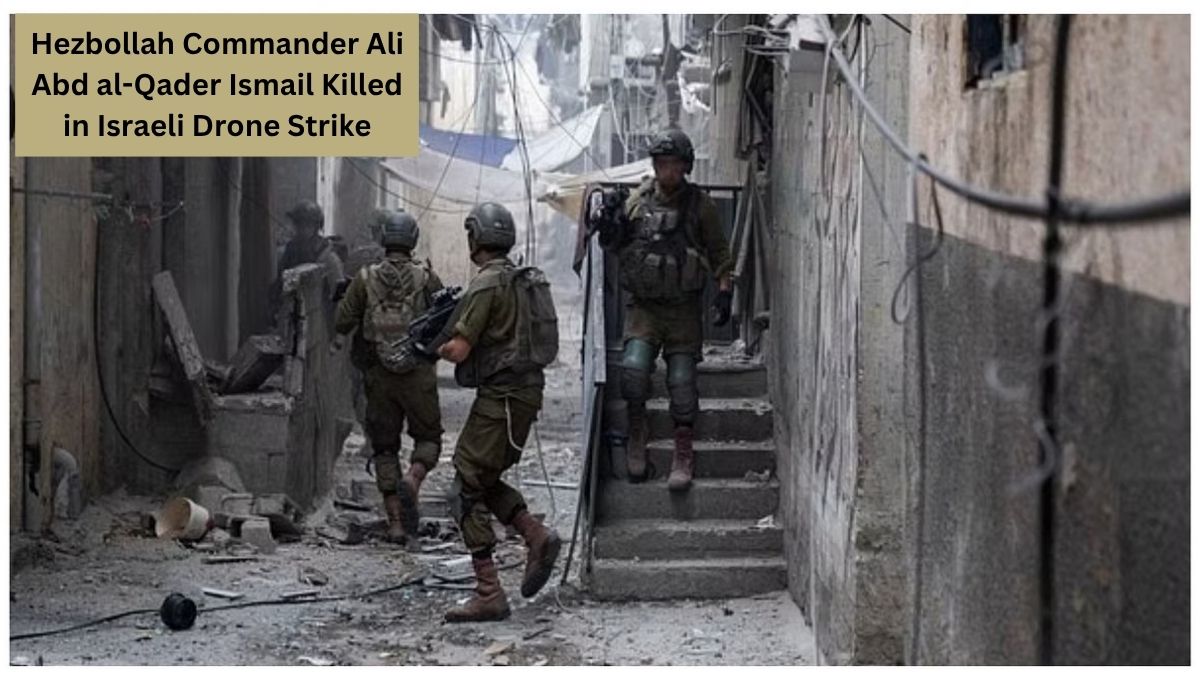
In a major development, Hezbollah Commander Ali Abd al-Qader Ismail Killed in Israeli Drone Strike. Escalating the already tense Israel-Lebanon front, the Israel Defense Forces (IDF) on Saturday confirmed the killing of senior Hezbollah commander Ali Abd al-Qader Ismail in a drone strike conducted in southern Lebanon’s Bint Jbeil sector. The targeted assassination marks a significant blow to Hezbollah amid growing cross-border hostilities.
Hezbollah Commander Ali Abd al-Qader Ismail Killed in Israeli Drone Strike
Targeted Drone Strike in Bint Jbeil
According to a statement posted by the IDF on X (formerly Twitter), Ali Abd al-Qader Ismail was involved in “efforts to rehabilitate the terrorist organization in southern Lebanon.”
The IDF described him as a senior commander operating in the Bint Jbeil sector, a volatile region along the Lebanon-Israel border.
“ELIMINATED: Ali Abd al-Qader Ismail, a senior Hezbollah commander in the Bint Jbeil sector, involved in efforts to rehabilitate the terrorist organization in southern Lebanon.
The IDF will continue to operate to remove any threat posed to the State of Israel,” the statement read.
This marks the third strike on a Hezbollah operative in the Bint Jbeil region within a week, indicating an intensifying Israeli focus on this strategic location.
Violation of Ceasefire Deal
The drone strike has drawn attention to ongoing violations of the November 2024 ceasefire agreement between Hezbollah and Israel.
The truce, which came after months of fighting post the October 7 Hamas attack, was brokered with monitoring from a five-nation panel led by the United States.
Under the agreement, Hezbollah was to withdraw north of the Litani River, about 30 kilometers from the Israeli border.
Only the Lebanese Army and UN peacekeepers were permitted to operate in the demilitarized zone. In return, Israel was to withdraw all troops from Lebanese territory.
However, Lebanon claims that Israeli forces still occupy five strategic zones, while Israel accuses Hezbollah of continuing its militant operations in violation of the truce.
Ismail’s Role in Rebuilding Hezbollah
Military sources stated that Ismail had been actively recruiting new members to rebuild Hezbollah’s capabilities in southern Lebanon.
He reportedly oversaw efforts to restore command structures and weapons stockpiles, which had been previously dismantled during the 2024 conflict.
A statement from the Israeli military emphasized that Ismail’s activities were a “blatant violation of the understandings between Israel and Lebanon,” asserting that such threats would be “eliminated without hesitation.”
Collateral Damage: Three Dead in Southern Lebanon
According to Lebanon’s Health Ministry, three individuals were killed in Israeli strikes across southern Lebanon on Saturday.
One of the strikes targeted a vehicle in Tyre district, while another hit a house in the town of Debaal, killing two people.
While Israel confirmed the death of Ali Abd al-Qader Ismail, it did not immediately comment on the Debaal strike, which the National News Agency of Lebanon said had hit a civilian residence.
Hezbollah Remains Defiant
Despite heavy losses and increased Israeli aggression, Hezbollah remains defiant, refusing to fully retreat from southern Lebanon.
Analysts suggest that the group is biding time, focusing on reorganization and relying on Iranian support to maintain its regional influence.
In the months since the ceasefire, Israel has ramped up drone surveillance and precision strikes in southern Lebanon, targeting what it calls Hezbollah’s infrastructure and recruitment hubs.
Gaza Front: Israeli Airstrikes Continue
While the Lebanon front continues to simmer, the Gaza war rages on without a clear end in sight. On Saturday, the Israeli Air Force (IAF) announced it had struck over 100 targets across the Gaza Strip in the past 24 hours.
The targets included combat tunnels, anti-tank positions, weapons storage facilities, and terrorist squads, according to the IDF.
Despite international pressure for a ceasefire, both Israeli Prime Minister Benjamin Netanyahu and U.S. President Donald Trump appeared to have abandoned negotiations with Hamas.
Netanyahu said the government is now considering “alternative options” to achieve its goals which include retrieving hostages and dismantling Hamas rule.
President Trump echoed the sentiment, warning that Hamas leaders would now be “hunted down.”
Flotilla Challenge: Pro-Palestinian Boat Approaches Gaza
Meanwhile, the Freedom Flotilla Coalition made headlines after a vessel named Handala, carrying pro-Palestinian activists and humanitarian aid, attempted to approach the Gaza coastline.
Sailing from Sicily, the vessel follows an earlier attempt by the boat Madleen to break Israel’s naval blockade.
While the IDF intercepted the first vessel, reports suggest that Handala’s mission continues, drawing criticism from Israeli officials and concern from international humanitarian observers.
U.S. Voices Strategy Shift on Gaza
U.S. Secretary of State Marco Rubio told families of former hostages in Washington that the Trump administration needs to “rethink its strategy” regarding the Gaza conflict.
“It’s necessary to come to the president with new options,” Rubio said, suggesting that the current approach may not yield desired outcomes.
This comes amid rising civilian casualties, deteriorating humanitarian conditions in Gaza, and an increasingly complex diplomatic landscape involving Egypt, Qatar, and the United Nations.
What’s Next?
With the killing of Ali Abd al-Qader Ismail, Israel has reinforced its stance that Hezbollah’s presence near the border is unacceptable, even under ceasefire terms.
However, continued Israeli strikes and mounting Lebanese casualties risk a full-scale resurgence of conflict in the north.
As the Gaza front remains locked in violent stalemate and ceasefire talks falter, the region edges closer to a multi-front war, with unpredictable consequences for Middle East stability.
Conclusion
The elimination of Hezbollah commander Ali Abd al-Qader Ismail marks a crucial escalation in Israel’s defense strategy against militant threats in southern Lebanon. It also underscores the fragility of the current ceasefire agreement, as both sides accuse each other of violations. With simultaneous crises in Gaza and Lebanon, and the growing involvement of international actors like the U.S. and Iran, the coming weeks could prove pivotal in determining whether war or diplomacy will prevail.
Also Read: Israel Threatens Top Iranian General: “12 Hours to Flee” as Shadow War Escalates
Also Read: Ex-Hamas chief Yahya Sinwar’s widow remarries in Turkey after escaping Gaza with fake passport
Related Posts:
- 12 Deadly Shockwaves as Israeli Strikes Rip Through…
- 7 Explosive Developments as Netanyahu Pushes Lebanon…

- 7 Explosive Signals as Israeli Strikes in Lebanon…
- 7 Explosive Turns: Israel Bombs Beirut as Hezbollah…
- Yemen War 2025: Israeli Strike Kills Houthi Military…

- 7 Shocking Truths About Iran-US Ceasefire as Israel…