7 Explosive Signals as Israeli Strikes in Lebanon Threaten Ceasefire, fueling regional tensions. Lebanon has sharply criticised Israel’s latest wave of airstrikes, warning that the attacks threaten fragile efforts to prevent a renewed escalation along the volatile Israel–Lebanon frontier.
Lebanese President Joseph Aoun, speaking on Tuesday, January 6, 2026, said the strikes undermine local, regional, and international initiatives aimed at stabilising the situation more than a year after a ceasefire ended a devastating cross-border war between Israel and Hezbollah.
His remarks came after Israel launched a series of strikes on southern and eastern Lebanon on Monday and early Tuesday, saying it had targeted infrastructure belonging to Hezbollah and Hamas.
The attacks included strikes on villages that had received evacuation warnings as well as later bombings carried out without advance notice.
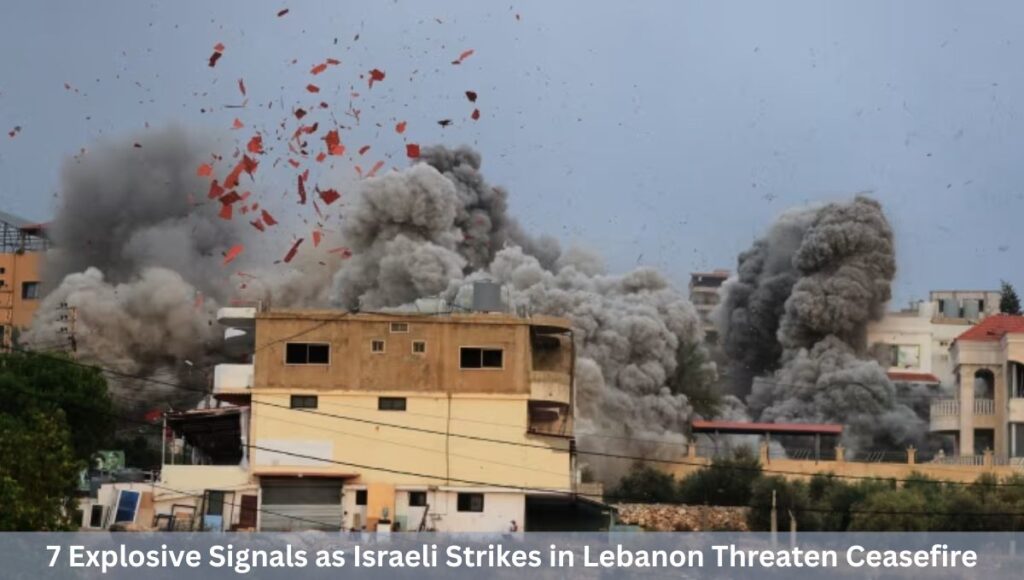
7 Explosive Signals as Israeli Strikes in Lebanon Threaten Ceasefire
President Aoun Condemns Israeli Attacks
In a strongly worded statement, President Aoun accused Israel of deliberately sabotaging diplomatic and security efforts designed to contain tensions.
“Israel’s continued attacks aim to thwart all efforts made locally, regionally and internationally to stop the ongoing Israeli escalation, despite the response shown by Lebanon to these efforts at various levels,” Aoun said.
He emphasised that Lebanon has been cooperating with ceasefire arrangements and working to extend state authority in areas long dominated by armed groups.
Aoun also renewed calls for international intervention, urging the global community to restrain Israel and allow ceasefire mechanisms to function effectively.
Details of the Latest Israeli Strikes
Israel’s air campaign began on Monday with strikes on four villages in southern Lebanon after the Israel Defense Forces (IDF) issued evacuation warnings to residents. These warnings marked the first such public alerts issued by Israel in Lebanon in 2026.
According to the IDF, the strikes targeted:
- Hezbollah facilities in Kfar Hatta and Ain al-Tinah
- Hamas-linked sites in Annan and Al-Manara
The Israeli military said these locations housed “terrorist infrastructure” threatening Israel’s security.
However, later strikes—including one in the early hours of Tuesday—were carried out without prior warning, raising alarm among Lebanese officials and civilians.
Strike on Ghazieh Near Sidon
One of the most damaging attacks occurred early Tuesday in Ghazieh, near the southern coastal city of Sidon, Lebanon’s third-largest city.
According to an AFP photographer:
- A building was destroyed
- Surrounding structures were damaged
- A fire broke out, requiring firefighters to intervene
Another strike in Sidon levelled a three-storey commercial building in an industrial district containing workshops and mechanic shops. The building was reportedly uninhabited at the time.
At least one person was transported by ambulance, and rescue teams searched the rubble, though no confirmed deaths were immediately reported from that site.
Israeli Military’s Justification
The Israeli military said its operations struck infrastructure:
“Belonging to the Hezbollah and Hamas terrorist organisations in several areas in Lebanon.”
According to the IDF, the targets included:
- Weapons storage facilities
- Military structures
- Installations located both above and below ground
Israel acknowledged that some of the sites were located in civilian areas but blamed militant groups for embedding military assets among the population.
A Ceasefire Under Strain
Despite a U.S.-brokered ceasefire signed in November 2024, Israel has carried out near-daily strikes in Lebanon.
Israel says the operations are necessary because Hezbollah continues to violate ceasefire terms by attempting to:
- Rebuild its military infrastructure
- Rearm fighters
- Maintain operational presence south of the Litani River
Lebanon, however, argues that these strikes undermine the ceasefire itself and weaken the authority of the Lebanese state.
Civilian Toll Since the Ceasefire
The human cost of the post-ceasefire violence has continued to mount.
According to AFP tallies based on Lebanese health ministry data:
- At least 350 people have been killed by Israeli fire since the ceasefire
- At least 127 of those killed were civilians, according to the United Nations
Recent incidents include:
- Two people killed in a strike on a vehicle around 10 kilometres from the Israeli border
- Two others wounded in a drone strike on a car in the village of Braikeh
UN officials have repeatedly warned that some of the attacks may amount to violations of international humanitarian law.
Targeting of Hamas and Other Palestinian Groups
While Hezbollah remains Israel’s primary focus, the IDF has increasingly targeted Hamas and other Palestinian armed groups operating in Lebanon.
Notable incidents include:
- A November strike on the Ain al-Hilweh Palestinian refugee camp in Sidon, killing 13 people
- Attacks on al-Jama’a al-Islamiyya, a Hamas ally linked to the Muslim Brotherhood
Lebanon’s National News Agency reported that a home struck in Al-Manara belonged to Sharhabil al-Sayed, a Hamas commander killed by Israel in 2024.
Analysts say Israel’s expanding list of targets increases pressure on Lebanon to confront not only Hezbollah but all armed factions operating on its territory.
Evacuations and Civilian Fear
AFP journalists on the ground described scenes of fear and displacement.
In Kfar Hatta, dozens of families fled their homes following Israeli evacuation warnings amid drone activity overhead. Ambulances and fire engines were placed on standby as residents awaited possible strikes.
Lebanese officials argue that repeated evacuations deepen humanitarian strain and risk triggering wider displacement if hostilities intensify.
Disarmament of Hezbollah Under the Spotlight
The latest strikes come at a politically sensitive moment, as Lebanon’s cabinet prepares to meet later this week to assess progress in disarming Hezbollah.
Key Points of the Disarmament Plan
- Launched under heavy U.S. pressure
- Focused initially on areas south of the Litani River
- Aimed to be completed by the end of 2025
- Part of Lebanon’s commitments under post-war arrangements
President Aoun praised the Lebanese army’s role, saying the plan to extend state authority south of the Litani has been implemented:
“With professionalism, commitment and precision.”
Israel Questions Lebanese Army’s Effectiveness
Israel remains sceptical.
Foreign Minister Gideon Saar said on Sunday that Lebanon’s disarmament efforts are “far from sufficient,” accusing Hezbollah of attempting to rearm despite the ceasefire.
Israel has retained troops at five strategic points inside Lebanon and says it will continue strikes to prevent Hezbollah from rebuilding its military capabilities.
Ceasefire Monitoring Committee Meets
The escalation comes just days before a scheduled meeting of the ceasefire monitoring committee, which includes representatives from:
- Lebanon
- Israel
- United States
- France
- United Nations (UNIFIL)
The committee is tasked with overseeing implementation of the truce, monitoring violations, and reducing the risk of renewed war.
Lebanese officials argue that continued Israeli strikes weaken the committee’s credibility and effectiveness.
UN Raises Alarm Over ‘Dangerous Conditions’
The United Nations has expressed increasing concern over the security environment.
UN spokesperson Stephane Dujarric said Israeli strikes were carried out close to UNIFIL peacekeepers stationed along the Blue Line.
UNIFIL reported:
- Three airstrikes in its areas of operation
- Fighter jet activity overhead
- Small arms fire and tank fire near UN positions
UN Undersecretary-General Jean-Pierre Lacroix, currently visiting Lebanon, said peacekeepers are operating under “increasingly difficult and dangerous conditions.”
Political and Regional Implications
Security analysts say the timing of the strikes is significant.
Beirut-based analyst Ali Rizk suggested the escalation followed high-level discussions between U.S. President Donald Trump and Israeli Prime Minister Benjamin Netanyahu.
“There had been reports that Israel got a green light to escalate against Hezbollah,” Rizk said, adding that Israel’s targeting of Hamas further pressures Lebanon politically.
A Fragile Path Ahead
More than a year after the guns fell silent, the Israel–Hezbollah ceasefire appears increasingly fragile.
Lebanon insists it is cooperating with international agreements and working to restore full state authority. Israel argues it must act unilaterally to protect its security.
With disarmament talks, UN meetings, and ongoing strikes converging, diplomats warn that any miscalculation could push the region back toward large-scale conflict.
For now, Lebanon’s leadership is urging restraint — but the airstrikes show just how narrow the margin for peace remains.
Also Read: Over 100 Killed in Israeli Airstrikes on Gaza as Humanitarian Crisis Deepens
Also Read: Israel’s continued attacks on Lebanon could derail Hezbollah disarmament
Related Posts:
- 5 Major Takeaways from the US Supreme Court's…

- Afghanistan–Pakistan War 2025: Inside the 48-Hour Ceasefire

- 7 Heartbreaking Facts About Venezuela's Earthquake Disaster
- Trump’s 20-Point Gaza Peace Plan Gains Urgent Global…

- 3 Explosive Conditions Iran Sets to End War with US…
- 7 Powerful Facts About Ayatollah Ali Khamenei’s…