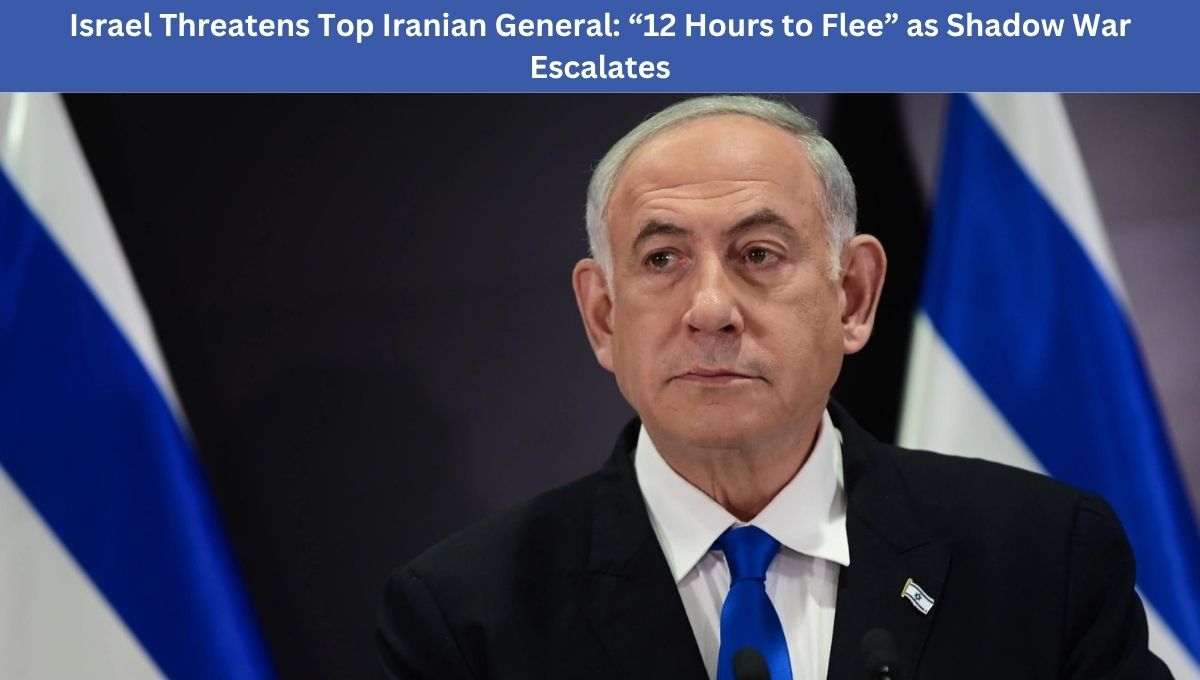
An agent from Israel Threatens Top Iranian General: “12 Hours to Flee” as Shadow War Escalates. In a chilling escalation of psychological warfare, Israeli intelligence agents threatened top Iranian generals with death if they did not publicly distance themselves from the Iranian regime.
According to a leaked audio recording obtained by The Washington Post, the agent warned a senior general in Iran’s Islamic Revolutionary Guard Corps (IRGC): “You have 12 hours to escape with your wife and child. Otherwise, you’re on our list right now.” Delivered in fluent Persian, the call was part of a wider Israeli operation aimed at destabilizing Iran’s leadership amid its ongoing military campaign, codenamed Operation Rising Lion.
Israel Threatens Top Iranian General: “12 Hours to Flee” as Shadow War Escalates
Operation Rising Lion: The Silent War Goes Loud
The leaked audio is part of what Israeli sources describe as a coordinated psychological pressure campaign targeting Iran’s second- and third-tier leadership.
It ran parallel to Israel’s kinetic military strikes on Iranian nuclear and military infrastructure, which began on June 13.
The caller, an Israeli agent, reportedly told the general: “We’re closer to you than your own neck vein. Put this in your head. May God protect you.”
The Israeli operative went on to instruct the general to record a video denouncing the regime and send it via Telegram, claiming this would prove the general had distanced himself from Iran’s ruling elite.
The general’s simple response: “How should I send it to you?”
A Network Years in the Making: Mossad Inside Iran
This wasn’t a one-off call. Reports say at least 20 Iranian officials received similar phone calls, notes delivered to their homes, or even messages passed via family members. The goal? Intimidation, deterrence, and destabilization.
Israeli operatives told targets that they were calling from “the country that just killed” top IRGC leaders Hossein Salami, Mohammad Bagheri, and Ali Shamkhani though Iran claimed Shamkhani survived.
The phone threats were not idle. They were backed by years of Mossad infiltration into Iran, during which Israeli operatives smuggled precision weapons and drones into the country and used covert launch bases to strike missile sites from within Iran.
How Mossad Disarmed Iran’s Air Defenses From Inside
The coordinated Israeli strikes that began on June 13 included airstrikes on Fordow, Natanz, and Isfahan, Iran’s most sensitive nuclear sites.
But these aerial assaults were only possible because Israel first crippled Iran’s air defense systems from within.
According to The Economist and The Wall Street Journal, Mossad had spent years quietly smuggling in hundreds of explosive-laden quadcopter drones disguised in suitcases, trucks, and containers.
When Israel launched its bombing run, these drones:
- Disabled anti-aircraft missile launchers
- Struck surface-to-surface launch platforms near Tehran
- Jam communications to delay Iranian responses
“This is the deepest we’ve ever operated inside Iran,” an Israeli military intelligence officer told WSJ.
Israel’s Shadow War Tactics: AI, Spies, and Assassinations
Israel’s campaign wasn’t just about hardware. Artificial intelligence played a critical role. Israeli agents fed real-time field intelligence and satellite imagery into AI models that prioritized high-value targets.
This high-tech-human hybrid operation also included targeted assassinations. In just two weeks:
- IRGC Commander Ali Shademani was killed.
- His predecessor was assassinated in a drone strike.
- Hamas political chief Ismail Haniyeh was eliminated in Tehran via a device planted weeks earlier.
- Hezbollah’s communications system was sabotaged by detonating rigged pagers killing dozens.
These attacks were a culmination of what Mossad’s former research director, Sima Shine, described as: “Years of work targeting Iran’s nuclear program and military infrastructure.”
Psychological Warfare: A New Strategy to Break Iran’s Command Structure
The phone threats served more than a tactical purpose they were part of a psychological war meant to undermine Iranian leadership from within.
By threatening the families of IRGC commanders, Israel aimed to create fear among potential successors and delay the regime’s ability to replace fallen generals.
“Do you want to be the next on the list? Do you also want to destroy your wife and child? No, right?”
Israeli agent, as heard in the leaked audio
These chilling calls, delivered in Persian, underscore Israel’s deep familiarity with Iranian command structure and linguistics tools honed over decades of espionage.
Trump’s Role and the U.S. Strike on Iran’s Nuclear Sites
Amid the Israeli campaign, U.S. President Donald Trump launched a parallel operation on June 22, authorizing strikes on Iran’s three major nuclear facilities using B-2 Spirit bombers and Tomahawk cruise missiles.
Trump declared the nuclear infrastructure “totally obliterated,” while Iran responded with retaliatory missile strikes on the Al Udeid Air Base in Qatar, home to thousands of U.S. personnel.
While no casualties were reported, the attack triggered panic across Doha, and Qatar briefly shut down its airspace.
Mossad’s Legacy of Deep Operations Inside Iran
Mossad’s success wasn’t overnight. Israeli operations inside Iran date back to the 1979 revolution. Key operations include:
- The 2020 assassination of Mohsen Fakhrizadeh, Iran’s top nuclear scientist.
- The Stuxnet virus in 2010, which disrupted Iranian nuclear centrifuges.
- The detonation of Hezbollah pagers in 2024.
- The assassination of senior Quds Force commanders within days of each other in June 2025.
Even Iran’s own officials admit the infiltration. Ali Larijani, senior adviser to Supreme Leader Ayatollah Khamenei, said in 2024: “The problem of infiltration has become very serious.”
Iran’s Struggle to Root Out Spies
In response, Iran has reportedly arrested scores of suspected Mossad agents. State media has even confirmed that some were executed following investigations into intelligence leaks and weapons smuggling.
Iran’s counterintelligence unit was itself suspected of being compromised by Mossad, with former President Mahmoud Ahmadinejad alleging in 2021 that its head was an Israeli asset.
Recent state directives in Tehran now prohibit senior officials from using internet-connected smartphones, and citizens have been asked to report suspicious property rentals—an effort to disrupt Israel’s local networks.
The Impact: Global Tensions and Rising Oil Prices
As the shadow war unfolds, the geopolitical and economic stakes rise.
- Oil prices have surged, reflecting fears of wider regional escalation.
- Global markets remain volatile, with uncertainty over future U.S.-Iran relations.
- Trump’s team insists peace is still possible but only through strength.
Meanwhile, Israel’s silent war continues, with many asking not if, but when the next assassination or drone strike will come.
Conclusion: A War in the Shadows, Heard Around the World
The “12-hour warning” delivered to a top Iranian general reflects a new era in modern warfare where voice calls, artificial intelligence, drones, and assassinations merge to disrupt and dismantle a regime from within.
Whether Iran retaliates or retreats remains to be seen. But the Mossad’s deep infiltration, combined with U.S. military muscle and Trump’s diplomacy, has fundamentally altered Iran’s sense of security. In the end, the war may not be officially declared—but it’s very much being fought. One phone call at a time.
Also Read: Trump Brokers Iran-Israel Ceasefire After Alarming Missile Escalation