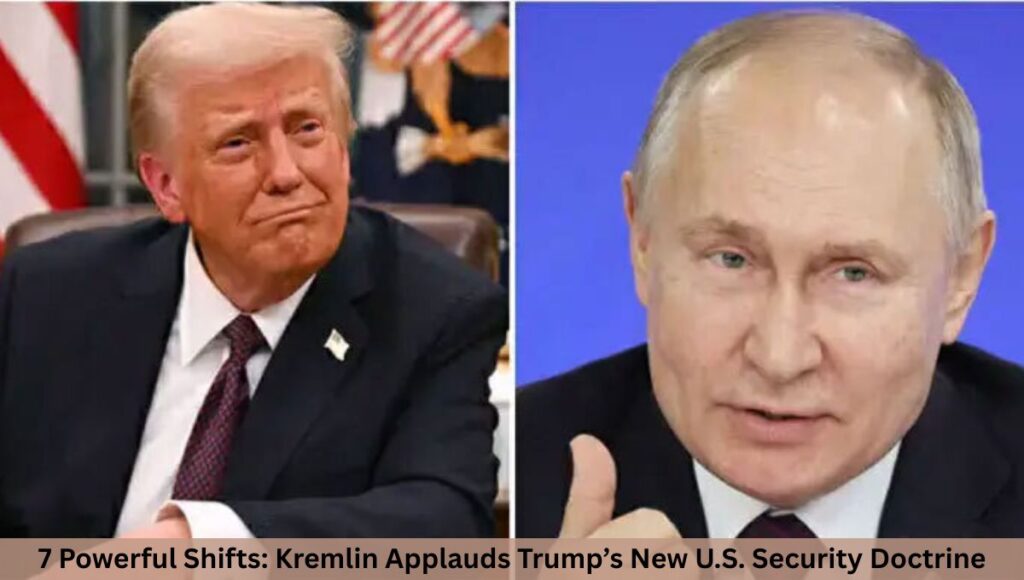
7 Powerful Shifts: Kremlin Applauds Trump’s New U.S. Security Doctrine as aligned with Moscow’s worldview. Russia has offered its strongest endorsement in decades of a US national security strategy after President Donald Trump’s administration unveiled a sweeping new doctrine that the Kremlin says closely mirrors its own worldview.
The newly released US National Security Strategy (NSS) marks a sharp departure from previous American policy frameworks. It adopts what Trump calls “flexible realism,” revives the Monroe Doctrine, softens language toward Moscow, and reframes Europe as facing what the document describes as “civilisational erasure.”
For the Kremlin, the shift is nothing short of remarkable.
“This is largely consistent with our vision,” Kremlin spokesperson Dmitry Peskov said in comments aired on Russian state media and reported by TASS. It is the most positive reaction Moscow has given to a US strategy document since the end of the Cold War.
The response has sent ripples through Washington, European capitals, and global diplomatic circles — raising questions about the future of NATO, the Ukraine war, transatlantic ties, and the balance of power between the United States, Russia, China, and Europe.
7 Powerful Shifts: Kremlin Applauds Trump’s New U.S. Security Doctrine
A Rare Moment of Alignment Between Washington and Moscow
For decades, US national security documents have depicted Russia as a destabilising force or a direct military threat. That framing intensified after Russia’s annexation of Crimea in 2014 and its full-scale invasion of Ukraine in 2022.
The new Trump strategy breaks from that tradition. Instead of explicitly labeling Russia an enemy, the document calls for restoring “strategic stability” with Moscow, identifying negotiations to end the Ukraine war as a “core” American interest.
According to the Kremlin, this represents a significant recalibration. “We consider this a positive step,” Peskov told state news agency TASS, adding that Russia would continue to study the document carefully before drawing final conclusions.
Trump’s ‘Flexible Realism’: What It Means
At the heart of the strategy is Trump’s concept of flexible realism, an approach that prioritises what the administration describes as “what works for America” over ideology, multilateralism, or value-based diplomacy.
Key Principles of Flexible Realism:
- National interest over international norms
- Selective cooperation with rivals
- Reduced emphasis on democracy promotion
- Pragmatic engagement, even with authoritarian states
The document openly states that the nation-state remains the world’s fundamental political unit, echoing long-held Russian objections to Western liberal interventionism. For Moscow, this language aligns closely with its own resistance to Western-led global governance models.
NATO Expansion: A ‘Encouraging’ Shift for the Kremlin
One of the most consequential elements welcomed by Russia is the strategy’s stance on NATO. The document commits the US to ending both “the perception and the reality” of NATO as a perpetually expanding military alliance, a phrase that directly addresses Moscow’s core security grievance.
Peskov described this shift as “encouraging,” noting that NATO enlargement has long been viewed by Russia as an existential threat.
Since the collapse of the Soviet Union in 1991, NATO has expanded eastward across Central and Eastern Europe — a process the Kremlin argues violated informal understandings made at the end of the Cold War.
Ukraine War: Negotiation as a ‘Core’ U.S. Interest
The Trump strategy frames ending the war in Ukraine not primarily as a moral imperative, but as a strategic necessity. It identifies negotiations to end the conflict as a core US national interest, arguing that prolonged war undermines global stability and European economic strength.
This language has deeply unsettled European leaders who fear Washington may pressure Kyiv into territorial concessions.
The document suggests that re-establishing strategic stability with Russia would stabilise European economies, a claim that has drawn criticism for appearing to prioritise economic normalisation over accountability.
Europe Under Fire: ‘Civilisational Erasure’ and Political Turmoil
Perhaps the most controversial section of the strategy concerns Europe. The NSS claims Europe faces “civilisational erasure”, citing mass migration, economic stagnation, censorship, and what it portrays as a growing disconnect between governments and their populations.
The document questions whether some European countries will maintain economies and militaries strong enough to remain reliable allies, and suggests the US should support political forces resisting Europe’s current trajectory.
European Leaders Push Back
European officials reacted swiftly:
- German Foreign Minister Johann Wadephul said freedom of expression and societal organisation do not belong in US security strategy documents.
- Polish Prime Minister Donald Tusk reminded Washington that “Europe is your closest ally, not your problem.”
- Former Swedish Prime Minister Carl Bildt described the document as placing itself “to the right of the extreme right.”
Several EU officials also criticised language they said resembles Kremlin talking points — especially on censorship and migration.
Reviving the Monroe Doctrine: Hemispheric Dominance
Another major shift outlined in Trump’s National Security Strategy is a revival of the Monroe Doctrine, positioning the Western Hemisphere firmly under US influence.
The strategy pledges to:
- Block non-hemispheric powers from strategic assets
- Combat drug trafficking and irregular migration
- Shift US military assets back to the hemisphere
Dubbed the “Trump Corollary” to the Monroe Doctrine, the policy seeks to deny rivals such as China and Russia any significant military or economic foothold in the Americas.
Recent US actions — including increased military activity near Venezuela and aggressive anti-narcotics operations in the Caribbean — signal that this doctrine is already being implemented.
China and the Indo-Pacific: Not the Central Threat
Unlike previous US security strategies, this document does not place China at the centre of America’s global threat assessment. Still, the Indo-Pacific remains a key battleground.
The strategy emphasises:
- Preventing conflict over Taiwan
- Strengthening alliances with Japan, South Korea, Australia, and India
- Rebalancing trade with China
Trump has repeatedly warned against pushing Russia closer to China, famously stating in a Fox News interview:
“You don’t want Russia and China to get together.”
Ironically, European sanctions on Moscow have already pushed Russia into deeper strategic partnership with Beijing — a development that complicates Washington’s objectives.
Middle East: No Longer America’s Primary Focus
The strategy signals a major downgrade of the Middle East in US strategic planning.
It argues that:
- US energy independence reduces reliance on the region
- Large-scale conflict has declined
- Future engagement will focus on investment and technology
The document paints an optimistic picture of a Middle East transitioning into a hub for international investment, including artificial intelligence.
Critics argue this vision ignores ongoing instability, including continued violence in Gaza, the West Bank, Lebanon, Syria, and deep US military entanglement across the region.
Russia No Longer a ‘Direct Threat’
One of the most striking changes welcomed by Moscow is the removal of language explicitly describing Russia as a direct threat to the United States. This marks a reversal of US policy language used consistently since 2014.
According to Peskov, this shift opens the door to limited cooperation on strategic stability, particularly around nuclear risk reduction and arms control. However, the strategy still acknowledges that Russia’s actions in Ukraine remain a central security concern.
Deep State, Diplomacy, and Distrust
Peskov also warned that Trump’s vision may face resistance within the US political system.
He noted that what Trump calls the “deep state” may still view the world very differently from the president — a point Trump himself has frequently emphasised.
This internal struggle could complicate implementation of the strategy, especially if political winds shift in Congress or future administrations.
A Break from Cold War Orthodoxy
The convergence between Washington and Moscow outlined in this strategy is historically unusual.
During the Cold War:
- The US framed the Soviet Union as an “evil empire”
- Moscow depicted America as a collapsing capitalist state
After 1991, brief cooperation gave way to rising tensions over NATO expansion and global influence. Now, Trump’s approach represents the most significant challenge yet to post–Cold War US foreign policy orthodoxy.
Democratic Backlash in Washington
Democrats in Congress have condemned the strategy.
- Representative Jason Crow called it “catastrophic to America’s standing in the world.”
- Representative Gregory Meeks warned it discards decades of value-based US leadership.
Critics argue the strategy risks alienating allies while empowering authoritarian rivals.
What Comes Next
While Moscow has welcomed the document, the long-term impact remains uncertain.
Key questions remain:
- Will US policy translate into real concessions on NATO and Ukraine?
- Can Europe adapt to reduced American security guarantees?
- Will Russia and China deepen cooperation despite US efforts to separate them?
For now, the Kremlin’s endorsement underscores just how dramatically the geopolitical landscape is shifting.
Conclusion
The Kremlin’s backing of Trump’s new national security strategy marks a watershed moment in post–Cold War geopolitics.
By embracing flexible realism, tempering NATO expansion, reframing Europe, and softening language toward Russia, the United States has signalled a profound strategic pivot — one that Moscow welcomes but Europe increasingly fears.
Whether this alignment endures or collapses under political pressure remains to be seen. What is clear is that the rules governing global power, alliances, and influence are being rewritten in real time.
Also Read: 9 Powerful Developments as Trump Pushes New Russia-Ukraine Peace Deal
Also Read: Will Trump’s new security doctrine boost the rise of far right in Europe?
Related Posts:
- 5 Stunning Insights into Trump’s ‘Core 5’ Superclub…
- Trump’s 2025 Gaza Peace Plan Signing and Historic…

- What’s Next for Donald Trump After Court Rules His…
- Trump to Host 2026 G20 Summit at His Florida Golf…

- 9 Explosive Revelations as Trump Declares His Health…
- 7 Key Takeaways from Donald Trump’s Powerful…