

9 Powerful Developments as Trump Pushes New Russia-Ukraine Peace Deal, while boasting of “Settling Eight Wars.” US President Donald Trump has intensified his diplomatic push to end the nearly four-year Russia-Ukraine war, claiming the United States is “settling wars at levels that nobody’s ever seen before.”
His renewed effort — centered around a marathon five-hour meeting between Russian President Vladimir Putin and Trump’s envoys Steve Witkoff and Jared Kushner — has triggered fresh debate about whether a peace breakthrough is finally within reach or if the process remains stuck in familiar deadlock.
In parallel, Washington announced new H-1B and H-4 visa screening rules requiring public social media profiles, while the US also facilitated a landmark peace agreement between Congo and Rwanda. These developments create a wide-ranging picture of how the White House is moving on multiple fronts — diplomacy, immigration, and international conflict resolution.
Below is a complete breakdown of the latest developments, their significance, and what they reveal about the global push for a Russia-Ukraine peace settlement.
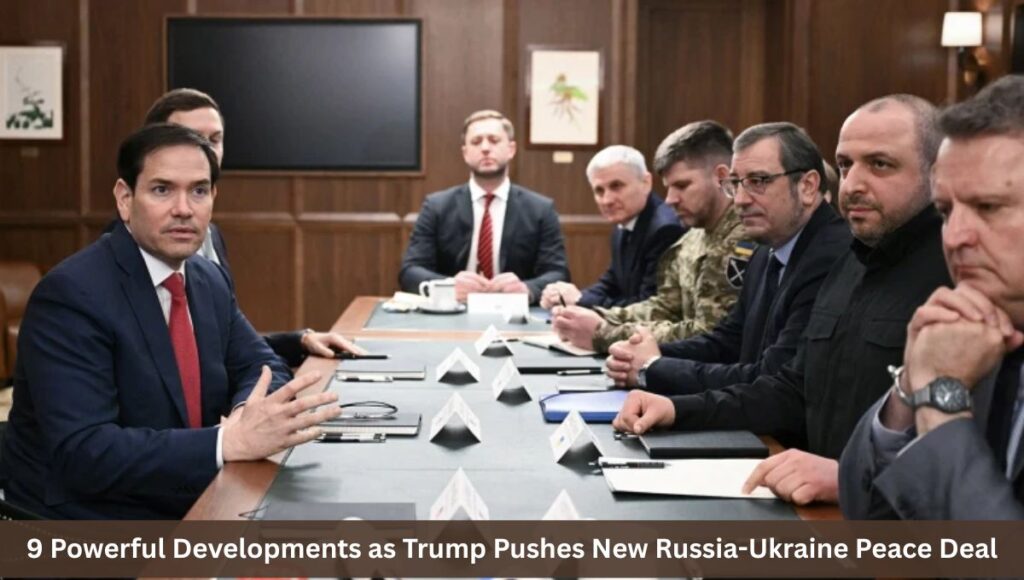
9 Powerful Developments as Trump Pushes New Russia-Ukraine Peace Deal
Trump Boasts About “Settling Eight Wars” and Eyes Russia-Ukraine as Next
President Trump declared on Thursday that the US has been instrumental in halting or easing eight major conflicts worldwide — although he did not specify which ones. He described the United States as “making peace all over the world,” while expressing confidence that the next major breakthrough could be the Russia-Ukraine war.
“We’re settling wars at levels that nobody’s ever seen before. Eight of them,” Trump said. “We’re looking for one more — that’s Russia-Ukraine, if that’s possible, and I think we’ll get there eventually.” The president cited staggering casualty figures — 8,000 soldiers killed just last week and 27,000 last month — as a sign of the urgent need for diplomacy.
His comments reflect the administration’s renewed optimism following private talks with Vladimir Putin. Despite the upbeat tone, the situation on the ground remains bleak, with both armies sustaining continuous losses as winter intensifies.
Congo and Rwanda Sign US-Brokered Peace Deal
In a major foreign policy achievement, the United States helped broker a long-awaited peace agreement between Congo and Rwanda. The leaders of both countries traveled to Washington to finalize the deal, accompanied by several African heads of state.
Trump hailed the development:
“It’s a great day for Africa, a great day for the world. Today we’re succeeding where so many others have failed.”
The agreement includes provisions for opening access to critical mineral reserves — cobalt, lithium, and rare earth elements — to the US government and American companies. These resources are essential for EV batteries, high-tech manufacturing, and defense applications, adding clear geopolitical value.
The success may strengthen Trump’s narrative of being a global dealmaker — something he is likely hoping to replicate in the Russia-Ukraine arena.
US Expands Social Media Checks for H-1B and H-4 Visa Applicants
In a separate policy shift, the State Department has expanded digital vetting rules to include H-1B skilled worker visas and H-4 dependent visas. Applicants must now keep their social media profiles public so that officials can conduct comprehensive reviews. This policy was previously applied mainly to student visas and exchange programs.
Key points of the new directive:
- All H-1B/H-4 applicants must ensure social media profiles are visible to government screeners.
- Reviews begin December 15.
- Only publicly available information will be inspected.
- The expansion aligns H-1B/H-4 vetting with broader US security standards.
Critics warn the rule may raise privacy concerns and deter skilled migration. Supporters argue it strengthens national security by ensuring consistent digital screening across visa categories.
The Russia-Ukraine Peace Effort Enters a New Phase
While US foreign policy advances elsewhere, Ukraine remains the most difficult diplomatic test for the Trump administration. The latest effort has revived international attention — and skepticism.
Trump’s 28-Point Proposal: Why It Hit a Wall
The US presented an initial 28-point peace plan earlier this month. According to multiple reports, several proposals echoed Russian demands, prompting sharp pushback from Ukraine and European allies.
Key disputed clauses included:
- Ukraine giving up claims to occupied territories.
- Conceding additional areas in Donbass still under Kyiv’s control.
- Agreeing never to join NATO — through constitutional amendment.
- Limiting the size of Ukraine’s military.
- Imposing caps on missile ranges.
Ukraine and EU officials argued that these terms amounted to rewarding Russian aggression. Following strong objections, US negotiators softened several points before the plan was taken to Moscow. But Putin still found parts of the revised proposal unacceptable — particularly on territory.
Inside the Five-Hour Putin Meeting: “Difficult Work”
Putin described his discussions with Witkoff and Kushner as intensive and highly detailed:
“We had to go through each point, which is why it took so long. This was a necessary conversation… very concrete.”
He reiterated that Russia was willing to consider some provisions but rejected others outright:
“There were proposals we can discuss, while others we cannot agree to. It’s difficult work.”
Russian officials say the principal sticking point remains territorial control — specifically, the Kremlin’s demand for additional land concessions.
Trump Says Putin “Would Like to Make a Deal”
Trump, however, struck a hopeful tone when addressing reporters at the White House. He said the delegation returned from Moscow convinced Putin “would like to make a deal” despite the lack of consensus.
“It does take two to tango,” Trump noted, acknowledging uncertainties. “But their impression was very strongly that he’d like to make a deal.” The mixed messages reflect the complexity of the moment — signs of diplomatic movement, but no substantive agreement.
Ukraine Reacts: Guarded Optimism and Deep Concerns
Ukrainian Foreign Minister Andrii Sybiha confirmed that US envoy Steve Witkoff briefed Kyiv’s negotiators after the Moscow talks. The tone, he said, was cautiously positive.
“What the representatives of the American delegation reported is that in their assessment, the talks in Moscow were of positive significance.”
Ukraine has not publicly endorsed the revised US proposal, but President Volodymyr Zelenskyy’s government says it remains open to discussions if core interests are protected.
Those interests include:
- Credible security guarantees to prevent another invasion.
- Full sovereignty over internationally recognized borders.
- No forced territorial concessions that could set dangerous precedents.
Zelenskyy has repeatedly said there are “no simple solutions” and that a premature deal could simply pave the way for a more devastating conflict later.
NATO Throws Support Behind Trump’s Role
In a notable show of support, NATO foreign ministers meeting in Brussels praised Trump’s diplomatic initiative. Secretary General Mark Rutte said the US President was uniquely positioned to break the deadlock.
“There is only one person in the whole world who was able to break the deadlock when it comes to war in Ukraine — and that is the American President, Donald J. Trump,” Rutte declared.
This endorsement signals a broader Western willingness to let Washington take the lead, despite earlier concerns over the draft peace plan.
The Roadblocks: Why a Settlement Still Appears Distant
Despite renewed diplomatic energy, the core conflicts remain unresolved.
Russia’s Stance: Confidence Mixed With Grievance
Russia enters negotiations from a position of relative battlefield confidence. Moscow has:
- Made incremental territorial gains.
- Strengthened its conditional demands.
- Reasserted its view that the West is prolonging the conflict.
Putin also revived traditional narratives of Russia being forced into war by Western “illusions” and geopolitical pressure. For Russia, any agreement that does not grant strategic advantages may be unacceptable.
Ukraine’s Dilemma: Exhaustion Without Capitulation
Kyiv faces a dual struggle:
- Enormous human and economic cost of ongoing war.
- The danger of a settlement that encourages future Russian aggression.
Ukraine cannot appear to surrender land after losing thousands of soldiers defending it. Nor can Zelenskyy risk agreeing to a peace deal without ironclad protection from future invasions. This makes territorial negotiations especially fraught.
The US vs Europe: Subtle but Serious Divisions
While Washington is pushing hard for a resolution, European partners are far more cautious.
- The first US proposal was seen in Europe as too accommodating to Russia.
- European governments want Ukraine’s long-term security prioritized, not merely short-term ceasefire optics.
- Differences in urgency and risk-tolerance persist.
This divergence complicates the diplomatic process.
Negotiations Speeding Up — But Fundamental Gaps Persist
The current moment reveals a paradox: diplomacy is intensifying, yet an actual peace agreement remains elusive. Both sides continue to fight even as they negotiate. Claims of battlefield advances from both armies underscore the ongoing belief that the military balance could still shift.
Until one side concludes that the cost of war outweighs the political price of compromise, negotiations remain largely symbolic. Diplomacy is real — but so are the obstacles.
What remains missing is alignment: a point where the interests of the United States, Europe, Ukraine, and Russia intersect enough to make a durable agreement possible. That moment, despite renewed movement, has not yet arrived.
Conclusion
President Trump’s global diplomacy — from brokering the Congo-Rwanda peace deal to tightening H-1B visa screening and pursuing the Russia-Ukraine truce — is reshaping key international dynamics.
His administration’s belief that Putin “would like to make a deal” has revived hopes of progress, but realities on the battlefield and deep territorial disputes continue to block a breakthrough. As Washington prepares for more negotiations — including upcoming meetings in Miami — the world watches closely.
The stakes are enormous, the suffering immense, and the path ahead uncertain. For now, the push for peace is powerful, but the obstacles remain stronger.
Also Read: 7 Powerful Revelations from New Ukraine Peace Talks with Putin
Also Read: Trump’s Ukraine Peace Push Was Always a Naked Cash Grab
Related Posts:
- Trump’s 2025 Gaza Peace Plan Signing and Historic…

- 5 Powerful Highlights as Trump Lands Second Nobel…

- Trump’s 20-Point Gaza Peace Plan Gains Urgent Global…

- 9 Explosive Revelations as Trump Declares His Health…

- 7 Shocking Reasons FIFA’s Peace Prize for Trump…

- 7 Alarming Moments: Trump Appears to Doze Off During…
