7 Crucial Truths About Gaza Ceasefire Phase Two That Could Reshape the War amid ongoing violence and aid disputes. Nearly two months after a United States–brokered ceasefire halted full-scale hostilities in Gaza, Israel and Hamas stand at the edge of what could be the most consequential stage of the deal — phase two.
Israeli Prime Minister Benjamin Netanyahu says it could begin “very shortly.” Hamas has signaled limited flexibility, suggesting it might consider “freezing” its weapons under specific conditions. Yet violence continues, humanitarian aid remains restricted, and core disagreements over Gaza’s future remain unresolved.
The question now dominating diplomatic circles is simple but profound:
Can the fragile truce survive long enough to become something permanent?
This article breaks down what phase one actually delivered, why phase two is far more dangerous, and what the competing visions for Gaza reveal about the road ahead.
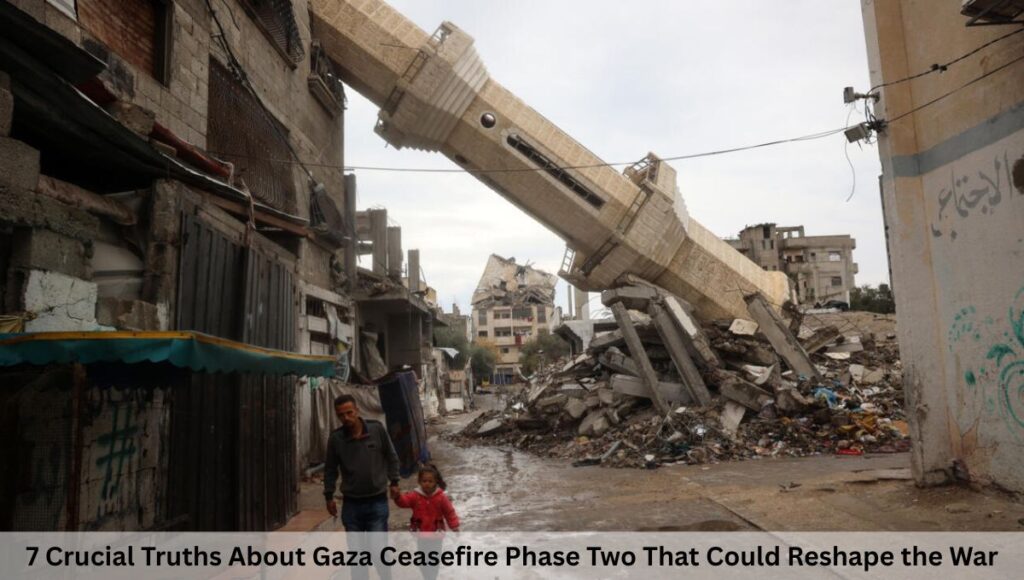
7 Crucial Truths About Gaza Ceasefire Phase Two That Could Reshape the War
Understanding the Gaza Ceasefire: What Was Phase One?
The ceasefire agreement, which took effect on October 10, was built around a 20-point plan proposed by US President Donald Trump. Phase one focused on halting major combat operations and building confidence through reciprocal steps.
Key goals of phase one included:
- A halt to Israel’s military assault on Gaza
- Withdrawal of Israeli troops from population centers
- Entry of large-scale humanitarian aid
- Exchange of Palestinian detainees for Israeli captives
- Preparation for negotiations on Gaza’s post-war future
On paper, phase one was meant to stabilize Gaza and set the groundwork for deeper political compromises. In reality, it has been anything but smooth.
Has Israel Observed the Ceasefire?
Critics say no. Since the ceasefire began, Gaza health officials report that more than 360 Palestinians have been killed in Israeli attacks. Local authorities claim Israel has violated the truce hundreds of times, while Israel insists it is responding to security threats.
Israeli officials have repeatedly stated that the ceasefire does not mark an end to the war. “Israel’s war on Gaza has not ended,” Prime Minister Netanyahu said weeks after the truce began, reiterating that Hamas would eventually be dismantled. For Palestinians in Gaza, daily life remains precarious, with drone strikes, ground incursions, and gunfire still reported in multiple areas.
The “Yellow Line”: Has Israel Withdrawn Its Troops?
Under the agreement, Israeli forces pulled back to positions behind a loosely defined boundary known as the “Yellow Line.” The line runs around parts of the Gaza Strip and separates areas under Israeli military control from those administered by Hamas.
Why the Yellow Line is controversial
- It is poorly marked and constantly shifting
- Hamas accuses Israel of gradually pushing it deeper into Gaza
- Civilians approaching the line have reportedly been shot
- Israeli officials now refer to it as a “new border”
Israeli Chief of Staff Lt. Gen. Eyal Zamir recently stated:
“The Yellow Line is a new border line, serving as a forward defensive line.”
That declaration has fueled fears that Israel intends to retain long-term territorial control over significant portions of Gaza — a direct contradiction of Palestinian expectations under the ceasefire.
Has Humanitarian Aid Reached Gaza as Promised?
Aid has increased since the ceasefire — but far below what was agreed. A full Israeli blockade earlier in the year led to famine conditions recognized by the UN-backed Integrated Food Security Phase Classification (IPC). While the situation has marginally improved, aid agencies say the flow remains insufficient.
Key concerns raised by aid groups:
- Much of the incoming goods are commercial, not humanitarian
- Major agencies like UNRWA face access restrictions
- Malnutrition among children remains alarmingly high
UNICEF reported nearly 9,300 children under five with acute malnutrition, five times higher than during a previous pause in fighting earlier this year.
Is Israel Truly Committed to the Ceasefire?
That depends on whom you ask. Supporters of Prime Minister Netanyahu argue that Israel needs security guarantees before taking deeper risks. Critics counter that the Israeli leader’s political survival heavily shapes his strategy.
Netanyahu faces:
- A long-running corruption trial
- Pressure from far-right coalition partners
- International scrutiny and an ICC arrest warrant
This has made him increasingly reliant on President Trump, whose backing shields him diplomatically and politically.
“Netanyahu can always shrug and say, ‘It’s not me, it’s Trump,’”
— Yossi Mekelberg, Chatham House
What Is Phase Two of the Gaza Ceasefire?
Phase two is where everything gets harder. Unlike phase one, which focused on immediate de-escalation, phase two tackles Gaza’s post-war governance, security, and sovereignty.
Core components of phase two include:
- Return of the final Israeli captive remains
- Disarmament or neutralization of Hamas
- Withdrawal of Israeli troops from Gaza
- Deployment of an international stabilization force
- Establishment of a transitional Palestinian administration
Netanyahu says phase two could begin once Hamas hands over the body of Ran Gvili, the final Israeli captive.
Hamas and the Question of Disarmament
Hamas’s weapons are the single biggest obstacle. Israel insists that Hamas must fully disarm before any lasting settlement. Hamas rejects that demand outright but has hinted at limited compromises.
Senior Hamas official Basem Naim said the group could discuss:
- “Freezing” weapons
- Storing arms under supervision
- A long-term truce lasting 5–10 years
However, Hamas insists disarmament can only come as part of a broader political process that includes a Palestinian state. “We retain our right to resist,” Naim said, rejecting foreign forces overseeing disarmament inside Gaza.
The US Plan for Post-War Gaza Governance
The most developed proposal comes from the United States and has partial backing at the UN Security Council.
Main elements of the US-backed plan:
- A temporary government run by Palestinian technocrats
- Oversight by a multinational “Board of Peace” chaired by President Trump
- Security provided by an International Stabilization Force
- Reconstruction under a renewable UN mandate
Former UK Prime Minister Tony Blair, Trump’s son-in-law Jared Kushner, and envoy Steve Witkoff are expected to play roles in overseeing the transition.
Why Palestinians Are Wary of the Plan
Despite international backing, Palestinian factions strongly oppose what they describe as foreign guardianship over Gaza.
They argue the plan:
- Marginalizes Palestinian political will
- Lacks a clear guarantee of statehood
- Could institutionalize long-term external control
Several groups rejected the UN resolution endorsing aspects of the plan, warning it could impose outcomes “outside the Palestinian national will.”
The International Stabilization Force: Who Will Deploy?
Negotiations are ongoing over the composition of the force.
Countries that have expressed interest include:
- Indonesia
- Azerbaijan
- Egypt
Some nations want Turkey involved, but Israel has vetoed Turkish participation, accusing Ankara of supporting Hamas. US and Arab officials say “boots on the ground” could arrive in early 2026, though no final roadmap exists.
The Rafah Crossing and Regional Concerns
Israel has announced plans to reopen the Rafah crossing with Egypt, allowing Palestinians to leave Gaza. However, multiple Arab states have raised alarm, warning this could turn into forced displacement.
Eight countries, including Egypt, Jordan, Qatar, and Saudi Arabia, issued a joint statement rejecting any attempt to expel Palestinians from their land and insisting the crossing must allow two-way movement.
Germany, Europe, and International Pressure
German Chancellor Friedrich Merz reaffirmed support for Israel during a recent visit but stressed the importance of humanitarian aid and a political solution.
While Germany backs Israel’s security, Merz reiterated support for a two-state solution, diverging from Netanyahu’s outright rejection of Palestinian statehood.
A Rising Death Toll and a Fragile Truce
Even as talks continue, violence persists.
Israeli forces have conducted lethal operations in Gaza and the occupied West Bank, raising fears that another escalation could derail negotiations entirely. Qatar, a key mediator, has warned the ceasefire is at a “critical moment.”
So, Will Phase Two Actually Happen?
At this stage, nothing is guaranteed.
Phase two depends on:
- Hamas returning the final captive remains
- Israel agreeing to troop withdrawal timelines
- Compromises on disarmament
- International coordination on governance and security
With Netanyahu’s political future uncertain and Trump’s approach unpredictable, analysts say forecasting an outcome is nearly impossible.
“It’s Netanyahu,” said Mekelberg.
“Too messy. No straight lines through anything.”
The Bottom Line
Israel and Hamas are closer than ever to entering phase two of the Gaza ceasefire — but they are also closer than ever to its collapse.
The coming weeks will determine whether Gaza moves toward reconstruction and political transition, or slides back into intensified war under a different name. For millions of Palestinians and Israelis alike, the stakes could not be higher.
Also Read: Trump’s Historic Gaza Ceasefire Deal 2025 – Powerful Insights
Also Read: Are Israel, Hamas entering the second phase of the ceasefire?
Related Posts:
- 3 Explosive Conditions Iran Sets to End War with US…
- 5 Major Takeaways from the US Supreme Court's…

- Trump’s 20-Point Gaza Peace Plan Gains Urgent Global…

- Afghanistan–Pakistan War 2025: Inside the 48-Hour Ceasefire

- Israel–Hamas Ceasefire Under Strain: 4 More Hostage…

- 9 Explosive Claims as Trump Says US Winning Iran War