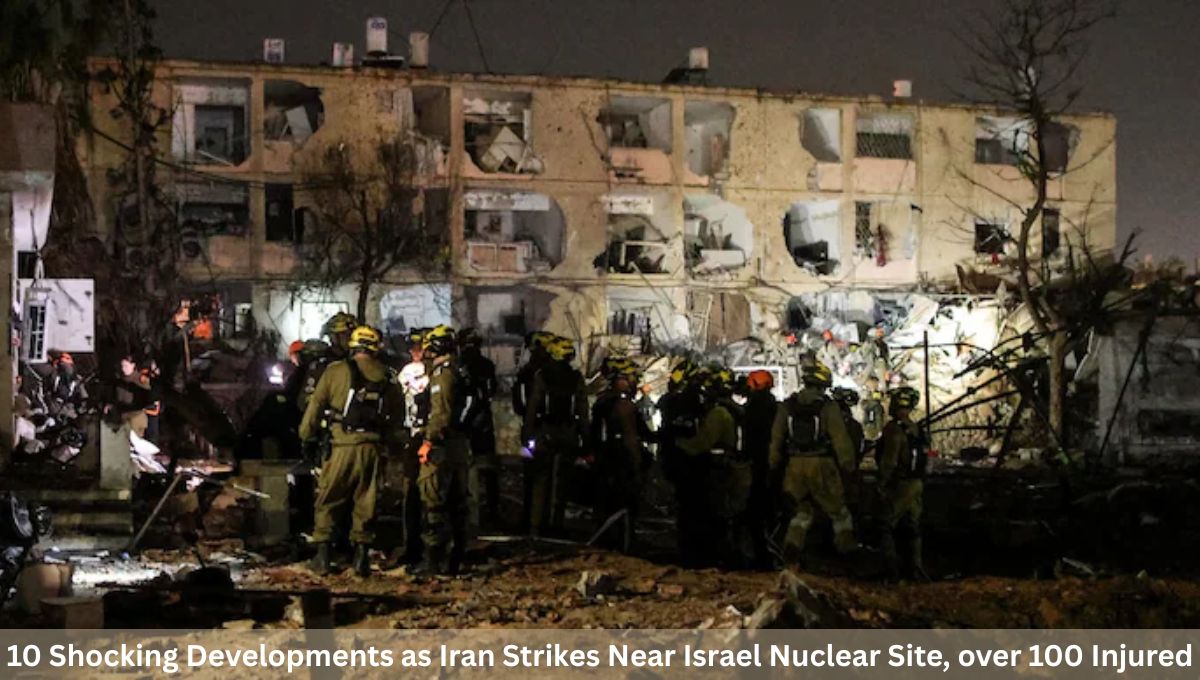
10 Shocking Developments as Iran Strikes Near Israel Nuclear Site, over 100 Injured — A dangerous new phase in the conflict. The ongoing conflict between Iran and Israel has entered one of its most volatile phases yet, as Iranian missile strikes targeted southern Israeli cities near a critical nuclear facility.
The attacks, which left over 100 people wounded, mark a significant escalation in a war that is already reshaping geopolitical dynamics, energy markets, and global security calculations.
The strikes on Dimona and Arad—areas closely linked to Israel’s nuclear infrastructure—signal a shift in both strategy and intensity. What was once a largely indirect confrontation has now evolved into a direct exchange involving high-value and highly sensitive targets.
This latest development raises urgent questions:
Is the conflict nearing a tipping point?
Could nuclear facilities become direct targets?
And how will global powers respond to the widening scope of this war?
10 Shocking Developments as Iran Strikes Near Israel Nuclear Site, over 100 Injured
Iran’s Missile Strikes: What Happened
Coordinated Attacks on Southern Israel
Late Saturday, Iran launched ballistic missile strikes targeting the southern Israeli cities of Dimona and Arad.
These locations are not only residential hubs but also strategically significant due to their proximity to Israel’s nuclear infrastructure.
Emergency services reported:
- Over 100 people injured across both cities
- Dozens in serious condition
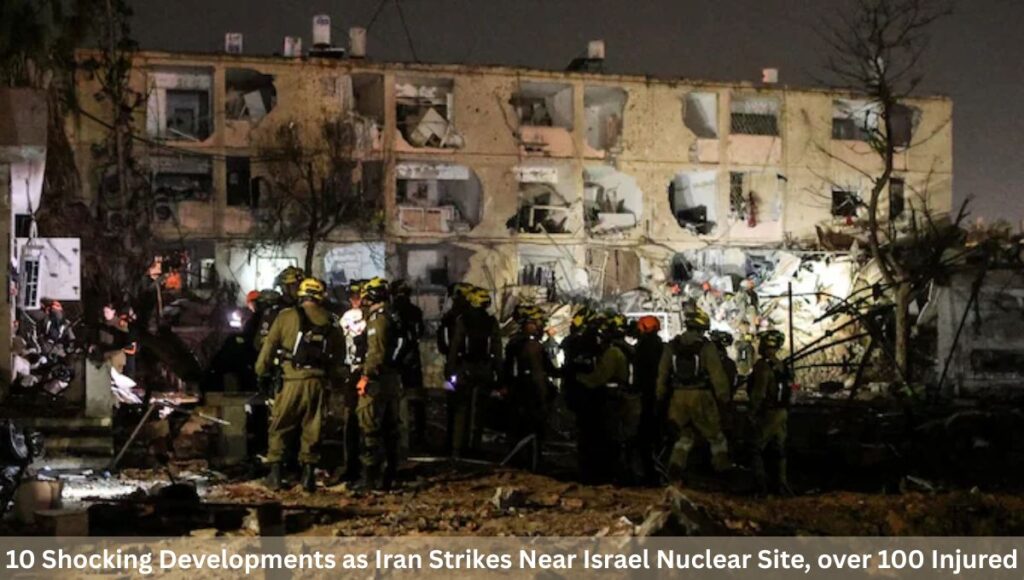
- Significant structural damage to residential buildings
- Fires and partial collapses in multiple locations
In Arad alone, dozens were wounded, with several apartment buildings severely damaged.
In Dimona, a missile strike hit residential areas, leaving civilians—including children—critically injured.
Air Defense Failure Raises Alarm
One of the most concerning aspects of the attack was the apparent failure of Israel’s advanced air defense systems to intercept all incoming missiles.
Officials confirmed:
- Interceptors were launched
- At least two ballistic missiles were not intercepted
- Direct hits caused widespread destruction
This marks a rare and alarming breach, especially in a region heavily protected due to its proximity to sensitive installations.
Dimona: Why This Location Matters
The Heart of Israel’s Nuclear Program
Dimona is widely known as the center of Israel’s nuclear research efforts. The nearby nuclear research facility has long been at the core of the country’s strategic deterrence capabilities.
Although Israel maintains a policy of ambiguity regarding its nuclear arsenal, it is widely believed to possess nuclear weapons developed decades ago.
Global Concern Over Nuclear Safety
Despite the proximity of the strikes, international monitors reported:
- No damage to the nuclear facility
- No abnormal radiation levels
- No immediate nuclear risk
However, the mere targeting of areas near such a facility has triggered global concern.
Even a minor miscalculation could have led to catastrophic consequences.
Iran’s Justification: Retaliation for Natanz Strike
Tit-for-Tat Escalation
Iran described the strikes as a direct response to an earlier attack on its Natanz nuclear enrichment facility.
According to Iranian officials:
- The Natanz site was targeted earlier the same day
- No radioactive leakage occurred
- The strikes on Israel were retaliatory
This “eye-for-an-eye” strategy reflects a broader shift toward direct confrontation, with both sides increasingly targeting each other’s strategic assets.
Disputed Responsibility
While Iran blamed the United States and Israel for the Natanz strike:
- Israel denied involvement
- No official confirmation has emerged
- Investigations are ongoing
This ambiguity adds another layer of complexity, increasing the risk of miscalculation and unintended escalation.
Expansion Beyond the Middle East
Long-Range Missile Capabilities Demonstrated
In a parallel development, Iran reportedly launched long-range missiles toward a military base in the Indian Ocean.
This marks the first time such extended-range capabilities have been used in the current conflict.
Military officials suggested:
- Missiles with a range of up to 4,000 kilometers were deployed
- Potential targets could include parts of Europe
- The attack represents a strategic expansion
Global Implications
This development signals that the conflict is no longer confined to the Middle East.
The ability to strike distant targets introduces:
- New security risks for Europe and beyond
- Greater involvement from global powers
- Increased urgency for diplomatic intervention
Human Cost of the Conflict
Rising Casualties
The war has already taken a heavy toll:
- Over 2,000 deaths reported in Iran
- Dozens killed in Israel
- Thousands injured across both sides
The latest strikes add to a growing humanitarian crisis, with civilians bearing the brunt of the violence.
Impact on Children and Families
Among the injured were several children, highlighting the indiscriminate nature of missile warfare.
Hospitals reported critical cases involving minors, while families faced displacement due to damaged homes.
Widening Regional Conflict
Strikes Across Multiple Fronts
The conflict is no longer limited to Iran and Israel.
It has expanded across the region, involving:
- Lebanon, where clashes with armed groups have intensified
- Gulf nations facing drone and missile threats
- Strategic maritime routes under pressure
Strait of Hormuz Crisis
One of the most critical flashpoints is the Strait of Hormuz, a vital global shipping route.
Recent developments include:
- Disruption of oil and gas shipments
- Increased military presence
- Rising fears of a global energy crisis
The near-closure of this route has already sent shockwaves through international markets.
Global Energy Shock and Economic Fallout
Surging Energy Prices
The conflict has triggered a sharp rise in global energy prices:
- Natural gas prices in Europe surged dramatically
- Oil supply disruptions intensified
- Shipping routes became increasingly unsafe
Impact on Global Economies
Countries dependent on Middle Eastern energy supplies are facing:
- Inflationary pressures
- Supply chain disruptions
- Economic uncertainty
For many nations, the conflict is no longer just a geopolitical issue—it is an economic crisis.
Political Reactions and Strategic Messaging
Israel’s Response
Israeli leadership has vowed to continue military operations, emphasizing:
- Determination to counter Iranian threats
- Commitment to national security
- Ongoing investigations into defense failures
Iran’s Strategic Objective
Analysts suggest Iran’s approach is aimed at:
- Re-establishing deterrence
- Demonstrating military capability
- Forcing a shift in regional power dynamics
International Reactions
Calls for Restraint
Global institutions and governments have urged caution:
- Avoid targeting nuclear facilities
- Prevent further escalation
- Prioritize diplomatic solutions
Growing Global Anxiety
The possibility of:
- A broader regional war
- Direct involvement of major powers
- Nuclear-related incidents
has heightened global concern.
The Risk of a Wider War
Multiple Flashpoints
The conflict now includes several high-risk elements:
- Missile strikes on strategic infrastructure
- Attacks near nuclear facilities
- Expansion into international waters
Potential Scenarios
Experts warn of several possible outcomes:
- Escalation into a regional war
- Global economic crisis due to energy disruption
- Increased involvement from international powers
Conclusion: A Critical Moment in Global Security
The missile strikes near Israel’s nuclear site represent more than just another escalation—they mark a turning point in the conflict.
With both sides targeting increasingly sensitive locations, the margin for error is shrinking. The risks now extend far beyond the region, affecting global security, economic stability, and international diplomacy.
As the war enters its fourth week, the world watches closely, aware that the next move could determine whether the conflict stabilizes—or spirals into something far more dangerous.
Also Read: US B-2 Bombers Strike Iran’s Nuclear Sites: Why Fordow, Natanz, and Esfahan Were Targeted
Also Read: Trump threatens to ‘obliterate’ Iran’s power plants as Iran strikes 2 Israeli cities
Related Posts:
- 7 Powerful Facts About Ayatollah Ali Khamenei’s…

- 3 Explosive Conditions Iran Sets to End War with US…

- 5 Major Takeaways from the US Supreme Court's…

- 10 Explosive Strikes: Israel Bombs Tehran Oil Depots…

- 9 Explosive Claims as Trump Says US Winning Iran War

- 7 Heartbreaking Facts About Venezuela's Earthquake Disaster