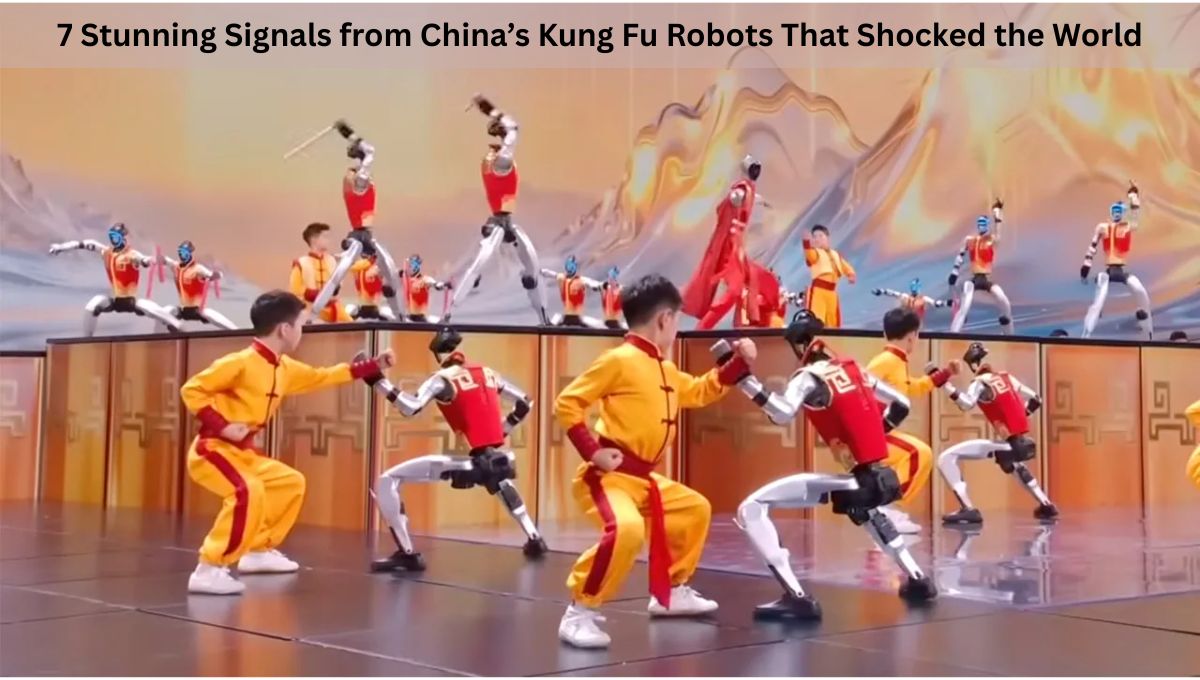
7 Stunning Signals from China’s Kung Fu Robots That Shocked the World during the Lunar New Year gala. When millions tuned in to China’s annual Lunar New Year television extravaganza, they expected tradition—folk music, comedy sketches, and nostalgic performances.
What they witnessed instead was something far more futuristic:
humanoid robots executing kung fu routines, backflips, parkour vaults, and synchronized dance with machine precision and surprising grace.
The Spring Festival Gala, broadcast nationwide and watched by hundreds of millions across China and abroad, became an unlikely stage for a geopolitical and technological signal. Videos from the show spread rapidly across global social media platforms, leaving audiences stunned—and competitors unsettled.
China’s robots did not merely entertain. They communicated intent.
This was not science fiction, nor a laboratory demo. It was a live, prime-time declaration that China’s humanoid robotics ecosystem has crossed a critical threshold.
7 Stunning Signals from China’s Kung Fu Robots That Shocked the World
A Cultural Stage With Global Reach
The Lunar New Year Gala, produced by China Central Television, is one of the most-watched television broadcasts on Earth—often compared to the Super Bowl in cultural reach, but with a much broader audience.
For decades, Beijing has used this event to showcase national achievements, from space exploration to high-speed rail. In 2026, humanoid robots took center stage.
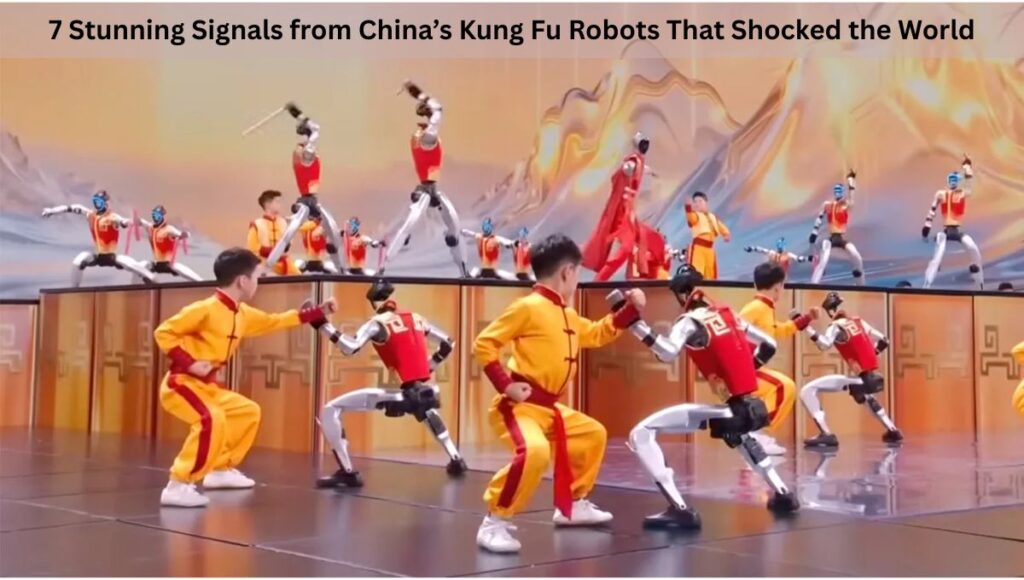
Around two dozen robots appeared alongside human performers, executing synchronized martial arts routines complete with punches, kicks, spins, backflips, and even nunchuck choreography.
Some sprinted across the stage at reported speeds approaching nine miles per hour. Others vaulted over obstacles or recovered smoothly from simulated stumbles.
The crowd reaction was immediate. Social media lit up with amazement—and unease.
The Robots That Went Viral
The standout performers were humanoid robots developed by Unitree Robotics, with contributions from MagicLab, Noetix, and Galbot.
Unlike last year’s slower, more mechanical displays, this year’s robots demonstrated:
- Fluid movement and balance
- Real-time fault recovery
- Coordinated multi-robot choreography
- Close interaction with human performers
This leap was not cosmetic. It reflected deep improvements in motion control, sensor fusion, and embodied AI—the systems that allow robots to “think through movement.”
One subtle moment captured global attention:
a robot adjusting its knee mid-landing after a flip.
That micro-correction, executed in milliseconds, symbolized a new level of machine autonomy.
Entertainment—or Strategic Messaging?
While the kung fu routines were undeniably theatrical, analysts quickly noted the deeper intent.
China’s robotics showcase was widely interpreted as a message to investors, rivals, and policymakers:
humanoid robots are no longer experimental curiosities.
They are becoming scalable industrial assets.
International media reports emphasized that the gala functioned as a stress test, not just a performance.
Live television, dynamic lighting, crowded stages, and unpredictable variables created conditions far harsher than controlled lab environments.
In short, if the robots failed, the world would see it.
They did not fail.
Unitree’s Big Bet on Scale
Following the viral performance, Unitree disclosed ambitious production plans. After selling approximately 5,500 humanoid robots in 2024, the company now aims to manufacture 10,000 to 20,000 units in 2026.
Founder and CEO Wang Xingxing has been clear:
these robots are not designed primarily for stage performances.
Their real destination is industry—particularly automobile assembly lines, logistics hubs, and precision manufacturing.
Unitree is also reportedly preparing for a listing on the Shanghai Stock Exchange, with an estimated valuation of around $7 billion, underscoring investor confidence in China’s humanoid sector.
China’s Dominance in the Humanoid Robot Market
Industry estimates suggest China accounted for nearly 90% of global humanoid robot shipments last year—a staggering figure that places it far ahead of competitors.
The country’s Ministry of Industry and Information Technology has already outlined plans to deploy thousands of humanoid robots across:
- Factories
- Farms
- Warehouses
- Elder care facilities
- Eventually, homes
Major capability upgrades are expected by 2027, with 2026 widely viewed as the year humanoid robots transition from novelty to practical deployment.
A State-Backed Robotics Ecosystem
China’s rapid progress is not accidental.
It is the result of a tightly integrated ecosystem combining:
- State subsidies and tax incentives
- Specialized robotics development zones
- Dense supply chains for sensors, actuators, and AI chips
- Aggressive real-world testing
Public events like the Spring Festival Gala act as high-pressure validation platforms. Success brings not just prestige, but government orders, investor interest, and market access.
This “deploy fast, iterate faster” model contrasts sharply with Western approaches that favor prolonged lab testing and cautious rollout.
Global Reactions—and Growing Anxiety
China’s humanoid robot surge has drawn intense scrutiny abroad.
Western analysts have warned that reliance on Chinese robotics firms could create strategic dependencies, particularly given the dual-use nature of humanoid robots—capable of civilian and security applications.
The Rand Corporation has cautioned that advanced humanoid robotics represent a critical emerging technology with implications for labor markets, surveillance, and defense.
A 2024 U.S. government report highlighted Beijing’s extensive support for the sector, including subsidies and preferential procurement policies.
Notably, China has not publicly outlined military applications for humanoid robots, and some Chinese military analysts have reportedly expressed skepticism about their combat utility. Still, the concerns persist.
The U.S. and the Race to Catch Up
American companies are not absent from the humanoid race—but they operate at a different scale.
Tesla is developing its Optimus humanoid robot, with CEO Elon Musk stating that the company aims to eventually produce up to one million units annually.
Musk has openly acknowledged that Tesla’s biggest competitors in humanoid robotics are likely to be Chinese firms, praising their speed and manufacturing depth.
For now, however, U.S. humanoid production remains far smaller than China’s, with higher costs and longer development cycles.
AI Takes the Spotlight Too
Robots were not the only stars of the gala.
AI platforms also featured prominently, including ByteDance’s chatbot Doubao, which distributed virtual red envelopes containing digital cash during the broadcast.
AI-generated visuals were integrated into multiple performances, reinforcing the theme of AI-driven creativity.
The message was unmistakable:
China is aligning artificial intelligence, robotics, and manufacturing into a single national narrative.
Public Excitement—and Unease
Chinese social media platforms were flooded with reactions. Many viewers celebrated the robots as symbols of national pride and technological progress.
Others expressed discomfort.
“We are looking for humans amid all the robots,” one widely shared comment read.
This tension reflects a broader global debate:
when machines outperform humans in agility, coordination, and endurance—even on cultural stages—what does that mean for identity, labor, and value?
Beyond the Stage—Real-World Applications
Despite their theatrical debut, humanoid robots are increasingly being tested in practical environments:
- Assembly lines
- Logistics centers
- Scientific laboratories
- Elder care facilities
The same balance algorithms that enable a backflip can allow a robot to carry heavy loads, navigate uneven terrain, or assist humans safely.
China’s aging population and shrinking workforce add urgency to automation.
Humanoid robots, capable of operating in human-designed spaces, offer a potential solution where traditional industrial robots fall short.
Competing Models of Innovation
At its core, the humanoid race reflects differing philosophies.
Western innovation often emphasizes controlled testing, regulatory caution, and incremental deployment.
China prioritizes scenario-driven experimentation—deploying early, testing under pressure, and refining in public view.
As Chinese robots spread into global markets, their software architectures, communication protocols, and hardware standards may increasingly shape international norms.
This is not just a competition of machines—it is a competition of ecosystems.
Are We Ready for This Future?
The kung fu robots of the Lunar New Year Gala were dazzling, but they also raised uncomfortable questions:
- How will labor markets adapt?
- Where should humanoid robots be restricted?
- How do societies govern machines that move, decide, and learn in human spaces?
These are not abstract concerns. They are policy challenges arriving faster than many governments anticipated.
The Signal Behind the Spectacle
The backflips, nunchucks, and choreography were not the endpoint. They were the opening move.
China used its biggest cultural stage to demonstrate that power, intelligence, and manufacturability have converged in its humanoid robotics sector. What looked like entertainment was, in reality, a compressed display of industrial ambition.
If the last era defined China as the factory of the world, the next may define it as one of its principal engineers. And it all began—with a robot landing perfectly on its feet.
Also Read: 7 Explosive Revelations Behind Xi Jinping’s Military Purge and China’s Water-Filled Missiles
Also Read: China: Humanoid robots perform kung fu moves with Shaolin monks in a viral video
Related Posts:
- 5 Major Takeaways from the US Supreme Court's…

- Meet Xiao He: Humanoid Robot Assisting Journalists…

- 7 Heartbreaking Facts About Venezuela's Earthquake Disaster

- ‘Dragon and Elephant Must Come Together’: PM Modi…

- In 8 Moves, EU Targets China-Linked Refineries and…

- 7 Powerful Reasons Russia’s Lunar Nuclear Plan…