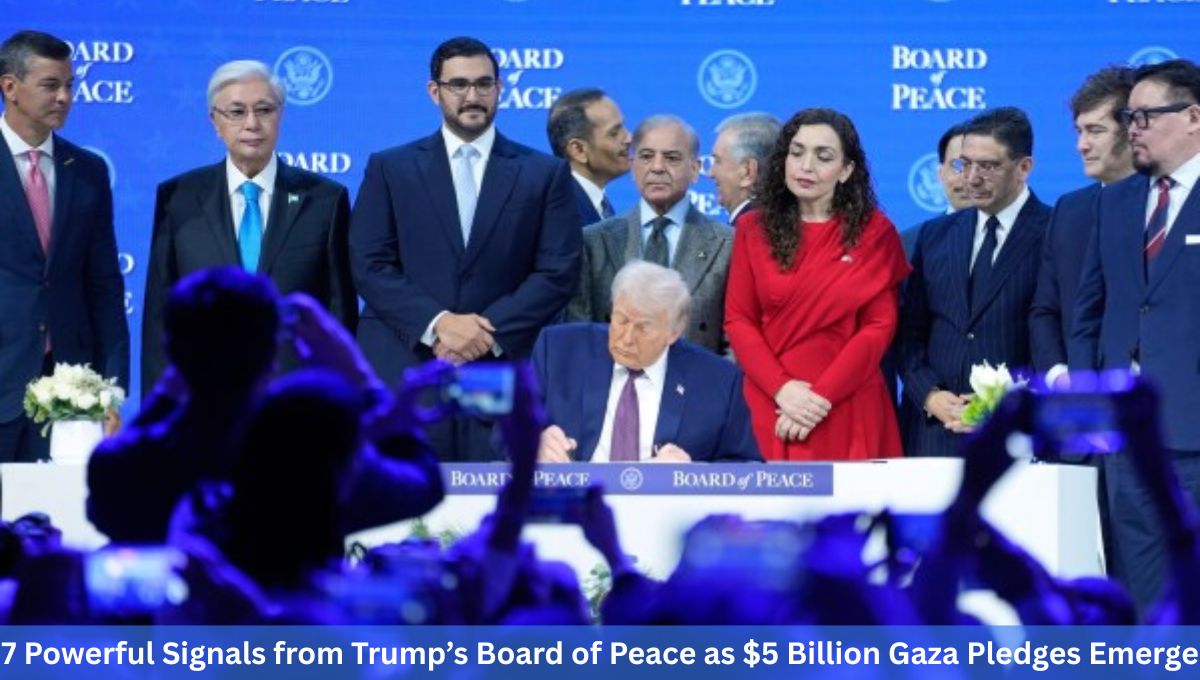
7 Powerful Signals from Trump’s Board of Peace as $5 Billion Gaza Pledges Emerge amid global skepticism and geopolitical recalibration. The first formal meeting of US President Donald Trump’s newly created Board of Peace is shaping up to be one of the most closely watched diplomatic gatherings of 2026.
Scheduled for February 19 in Washington, the summit brings together delegations from more than 20 countries amid bold financial pledges, skepticism from traditional US allies, and sharp debate over whether the initiative represents genuine conflict resolution—or an attempt to bypass the United Nations system.
At the center of the unfolding moment is Romania, whose president has opted for observer status while weighing deeper engagement.
7 Powerful Signals from Trump’s Board of Peace as $5 Billion Gaza Pledges Emerge
Romania Steps in as Observer, Not Member
Romanian President Nicușor Dan confirmed that he will attend the inaugural Board of Peace meeting as an observer, responding to a direct invitation from Trump.
In a post on X, Dan said Romania would use the platform to reaffirm its support for international peace initiatives and signal openness to participating in Gaza’s reconstruction—without formally joining the organization.
Romania’s caution reflects broader European unease. While at least 19 countries have signed the Board’s founding charter, several EU and Western partners remain wary of its structure, funding model, and governance.
Dan has emphasized that Bucharest’s position is shaped by Romania’s historic diplomatic ties with both Israel and Arab states, as well as Europe’s direct stake in stability along the Mediterranean’s eastern flank.
What Is the Board of Peace—and Why It’s Controversial
Originally conceived as a mechanism to oversee Gaza’s postwar reconstruction, the Board of Peace has since evolved into something far broader.
According to its charter, the body aims to:
- Resolve global conflicts
- Deploy international stabilization forces
- Support postwar governance transitions
- Mobilize rapid reconstruction funding
Trump has described it as potentially “the most consequential international body in history,” with himself serving as chairman and sole US representative—a design choice that has drawn intense criticism.
The $1 Billion Membership Question
Permanent members are required to contribute $1 billion to join, prompting accusations that the board is a “pay-to-play” alternative to the UN Security Council.
Several countries—including France, Italy, Norway, New Zealand, and Croatia—have declined membership outright, citing governance concerns.
$5 Billion Pledged for Gaza—But Questions Remain
Trump announced that member states have pledged more than $5 billion for humanitarian aid and reconstruction in the Gaza Strip, with formal announcements expected during the Washington meeting.
In addition to funding, participating nations have committed:
- Thousands of personnel for an international stabilization force
- Support for local policing and security structures
- Assistance in transitioning Gaza to a post-Hamas governing framework
However, Trump has not disclosed which countries are making which pledges, fueling skepticism among diplomats and analysts.
The Reality Check: $70 Billion Needed
Estimates from the World Bank, the UN, and the European Union suggest Gaza’s reconstruction will ultimately cost around $70 billion, dwarfing current commitments.
Indonesia Signals First Major Troop Commitment
The most concrete military contribution so far has come from Indonesia, whose armed forces say up to 8,000 troops could be ready by June for a humanitarian and peacekeeping role in Gaza.
This would mark the first large-scale deployment under the Board of Peace framework and could set a precedent for other non-Western contributors.
Still, many countries remain hesitant to deploy personnel into a volatile environment where:
- Hamas has not fully disarmed
- Israeli forces remain partially deployed
- Ceasefire violations continue
Israel’s Calculated Participation
While Benjamin Netanyahu will not attend in person, Israel will be represented by Foreign Minister Gideon Sa’ar.
Israel formally joined the Board of Peace earlier this year, with Netanyahu personally signing its charter during talks with US officials.
The board’s mandate aligns with key Israeli demands:
- Disarmament of Hamas
- International oversight of Gaza’s security
- Prevention of Hamas’ return to power
However, Hamas has repeatedly declared that full disarmament is a red line, even as it signals openness to transferring weapons to a future Palestinian authority.
Saudi Arabia and the Gulf: Money With Conditions
Saudi Foreign Minister Faisal bin Farhan Al-Saud has expressed conditional support for the Board of Peace, making clear that funding depends on clarity regarding:
- Israeli troop withdrawal timelines
- Hamas’ compliance with disarmament
- Enforcement of Trump’s 20-point Gaza plan
US officials hope to announce $1.25 billion in donations from the UAE, Qatar, and Kuwait, with Washington reportedly considering a comparable contribution.
A Board That Rivals the UN?
Perhaps the most consequential question surrounding the Board of Peace is whether it represents a parallel global governance structure.
Many European diplomats view it as:
- An attempt to sidestep UN mechanisms
- A challenge to the Security Council’s authority
- A US-centric model of crisis management
EU foreign policy chief Kaja Kallas has warned that concentrating decision-making power in a single leader risks undermining international law and equality among states.
Trump, by contrast, argues that existing institutions are too slow, politicized, and ineffective to manage modern conflicts.
The Venue Itself Is Symbolic—and Contested
The meeting will be held at the Donald J. Trump Institute of Peace, formerly the US Institute of Peace.
The renaming—and the administration’s seizure of the building—has sparked ongoing litigation from former staff and executives, further highlighting the controversial nature of Trump’s approach to institutional power.
Why Europe Is Watching Closely
For Europe, Gaza’s future is not a distant issue:
- Refugee flows
- Energy security
- Terrorism spillover
- Regional instability
Romania’s observer role reflects a broader EU strategy:
engage without endorsing, influence without committing.
Whether other European states follow suit may depend on what emerges from this first meeting—specifically whether the board evolves into a transparent multilateral platform or consolidates power around Washington.
What Happens Next
The February 19 summit is unlikely to resolve Gaza’s future—but it will set the tone.
Key signals to watch:
- Which countries publicly confirm funding
- Whether troop commitments expand beyond Indonesia
- How enforcement of ceasefire terms is addressed
- Whether governance in Gaza moves beyond theory
For now, Trump’s Board of Peace stands at a crossroads:
a bold experiment in global leadership—or a divisive challenge to the post-war international order.
What unfolds in Washington may shape not just Gaza’s recovery, but the architecture of diplomacy in the years ahead.
Also Read: 7 Explosive Facts About Trump’s $1 Billion Gaza Peace Board
Also Read: Board of Peace to unveil $5 billion in Gaza reconstruction at inaugural meeting, Trump says
Related Posts:
- Trump’s 2025 Gaza Peace Plan Signing and Historic…

- 5 Powerful Highlights as Trump Lands Second Nobel…

- 7 Shocking Reasons FIFA’s Peace Prize for Trump…

- Dramatic Moments Behind Trump’s Gaza Peace Push and…

- Trump Stole the Show at 2025 Gaza Peace Summit in Egypt
- Trump to Host 2026 G20 Summit at His Florida Golf…