7 Powerful Signals as Kim Jong Un’s Daughter Enters Succession Spotlight with first mausoleum visit.A single appearance can carry enormous political weight in North Korea—and Kim Jong Un’s decision to bring his daughter, Kim Ju Ae, to the country’s most sacred political shrine has done exactly that.
Thank you for reading this post, don't forget to subscribe!On January 1, as North Koreans marked the New Year, state media released photographs showing Kim Jong Un, his wife Ri Sol Ju, and their daughter Ju Ae paying respects at the Kumsusan Palace of the Sun in Pyongyang.
The visit marked Ju Ae’s first-ever public appearance at the mausoleum, where the embalmed bodies of North Korea’s founder Kim Il Sung and his successor Kim Jong Il lie in state. For analysts, intelligence agencies, and observers of the secretive regime, the symbolism was unmistakable.
Ju Ae’s presence at such a highly choreographed and politically sacred site has fueled renewed speculation that she is being positioned as North Korea’s future leader, potentially becoming the fourth generation of the Kim dynasty.
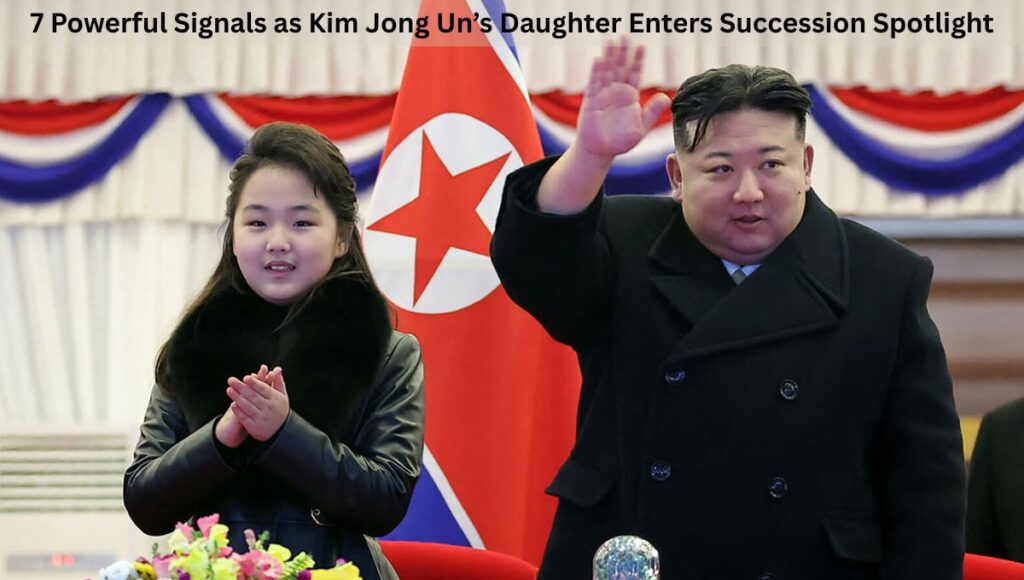
7 Powerful Signals as Kim Jong Un’s Daughter Enters Succession Spotlight
Why the Kumsusan Mausoleum Matters So Much
A Symbol of Absolute Legitimacy
The Kumsusan Palace of the Sun is not merely a mausoleum. It is the spiritual and ideological heart of the North Korean regime, representing the eternal authority of the Kim family.
Every major leader transition in North Korea has been accompanied by ritualized visits to Kumsusan. Kim Jong Un himself has used the site repeatedly since taking power to reinforce his legitimacy as the grandson of Kim Il Sung and son of Kim Jong Il.
By bringing Ju Ae to this location—standing her between her parents in the main hall—Kim Jong Un sent a deliberate message: she belongs within the sacred lineage of leadership.
The Paektu Bloodline
North Korean propaganda has long emphasized the so-called “Paektu bloodline”, a mythical narrative linking the Kim family to Mount Paektu, considered the birthplace of the Korean revolution.
Analysts say Ju Ae’s presence reinforces this dynastic mythology, visually inserting her into the lineage that has ruled the country since its founding in 1948.
What State Media Showed—and Why It Matters
Photographs released by the Korean Central News Agency (KCNA) showed:
- Kim Jong Un bowing before the mausoleum
- Ju Ae standing prominently between her parents
- Senior party officials and top military leaders in attendance
According to KCNA, Kim “paid New Year greetings to the great leaders,” and all attendees pledged loyalty to the ruling ideology.
Notably, Ju Ae was not treated as a passive child figure. Her placement and presentation mirrored how previous successors were gradually introduced into the public eye—though never at such a young age.
Ju Ae’s Growing Public Profile
From Secrecy to Spotlight
Ju Ae was unknown to the public until November 2022, when she appeared alongside her father during the launch of an intercontinental ballistic missile.
That debut alone surprised foreign observers, as neither Kim Jong Un nor Kim Jong Il were publicly acknowledged until adulthood.
Since then, her visibility has steadily increased:
- Attendance at missile launches and military events
- Appearances at major national celebrations
- Participation in New Year festivities
- A first public overseas visit to Beijing in September
North Korean media have referred to her using honorifics such as “the beloved child” and even “hyangdo”, a term historically reserved for senior leaders or designated successors.
Why Analysts See Succession Signals
A Gradual, Unspoken Process
North Korea has never formally announced a successor. Instead, leadership transitions are signaled through carefully staged appearances, expanded responsibilities, and symbolic gestures.
Analysts say Ju Ae’s mausoleum visit fits this pattern precisely.
Cheong Seong-chang of the Sejong Institute described the visit as a calculated move ahead of an upcoming Workers’ Party Congress, where succession issues could quietly take shape.
Other experts point to the consistency of her appearances and the increasingly reverent language used by state media as indicators of long-term planning.
Contrasting Views: Is She Too Young?
Despite mounting speculation, not all experts are convinced.
Age and Gender Barriers
Ju Ae is believed to be around 13 years old, though North Korea has never confirmed her age.
Critics argue that:
- She is too young to join the Workers’ Party
- North Korea’s leadership remains overwhelmingly male-dominated
- Kim Jong Un is only in his early 40s and shows no major health issues
Hong Min of the Korea Institute for National Unification cautioned that publicly designating such a young successor would be unprecedented.
“There is still room for caution,” Hong said, noting speculation about Kim Jong Un having other children, including a possible son who has never been publicly seen.
Why Kim Jong Un May Be Moving Early
Stability Through Continuity
Some analysts believe Kim Jong Un’s strategy is less about immediate succession and more about long-term regime stability.
By familiarizing the public with Ju Ae now, Kim may be:
- Normalizing a fourth-generation leadership
- Reinforcing the inevitability of dynastic rule
- Strengthening internal elite loyalty
The portrayal of a “stable family unit” — Kim Jong Un, his wife, and daughter — also serves to humanize the leader while reinforcing the permanence of his rule.
The New Year Context: Timing Was Not Accidental
The visit took place on January 1, a date rich with symbolism in North Korea. Kim Jong Un traditionally uses the New Year period to outline policy priorities and reinforce ideological unity.
Ju Ae’s presence during both New Year celebrations and the mausoleum visit ties her image directly to state continuity, loyalty, and the future of the regime.
Images from New Year’s Eve also showed Ju Ae kissing her father on the cheek—a rare display of intimacy in North Korean propaganda, further amplifying public attention.
International Reaction and Intelligence Assessments
South Korea’s National Intelligence Service (NIS) has previously stated it views Ju Ae as Kim Jong Un’s likely heir, though officials have since urged caution.
The South Korean Unification Ministry declined to comment directly on her appearance, saying it remains too early to draw firm conclusions.
Still, intelligence agencies across the region are closely monitoring her appearances as part of broader assessments of North Korea’s political future.
Military Backdrop: Power and Succession Intertwined
Ju Ae’s rising visibility comes as Kim Jong Un continues to emphasize military strength.
In recent statements, Kim pledged to further increase production of:
- Missiles
- Artillery shells
- Nuclear deterrent capabilities
By pairing his daughter’s public emergence with displays of military power, Kim reinforces the message that the dynasty and the state’s military might are inseparable.
A Break from Historical Norms
Ju Ae’s early exposure marks a significant departure from how previous successors were handled.
- Kim Jong Il remained largely unseen until adulthood
- Kim Jong Un was virtually unknown to the public until shortly before succession
Revealing Ju Ae so early suggests Kim Jong Un is reshaping succession norms to suit a more media-conscious era—both domestically and internationally.
What Comes Next: Quiet Signals, Not Announcements
If North Korea follows historical precedent, there will be no official announcement of Ju Ae as successor anytime soon.
Instead, observers will watch for:
- Increased solo appearances
- Expanded ceremonial roles
- Elevated language in state media
- Possible party titles in the future
Each step will be subtle—but intentional.
Conclusion: A Small Step with Enormous Symbolism
Kim Ju Ae’s first public visit to the Kumsusan Mausoleum may have lasted only moments, but its implications will echo for years.
In North Korea, symbolism is power. By placing his daughter at the heart of the regime’s most sacred space, Kim Jong Un has inserted her into the narrative of eternal leadership—whether or not succession comes soon.
For now, Ju Ae remains a child. But in Pyongyang’s carefully curated political theater, her role is already far larger than her age suggests. The world will be watching closely.
Also Read: Kim Ju Ae: What We Know About Kim Jong Un’s Daughter and North Korea’s Potential Successor
Also Read: Kim Jong Un’s daughter steps into spotlight