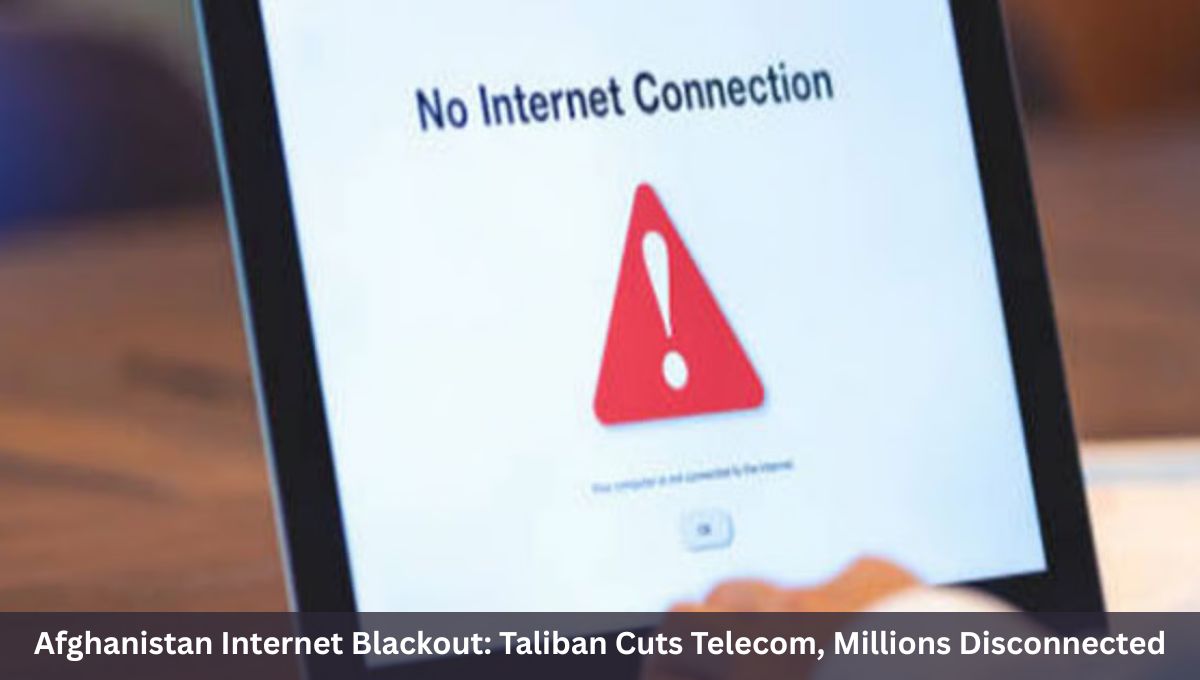
Afghanistan Internet Blackout: Taliban Cuts Telecom, Millions Disconnected sparking panic and global concern. Afghanistan has entered a total internet and telecom blackout, one of the most extensive shutdowns since the Taliban seized power in 2021.
The sweeping ban, which authorities say is intended to curb so-called “immoral activities,” has left millions across the country without connectivity, sparking panic both inside and outside Afghanistan. Internet watchdog Netblocks confirmed late Monday that multiple networks across Afghanistan were disconnected, bringing connectivity to less than 1% of normal levels.
Telephone services were also disrupted, leaving 43 million people largely cut off from one another and from the outside world. For many Afghans, this is more than a loss of communication—it is the severing of a lifeline in a country already facing humanitarian, economic, and political crises.
Afghanistan Internet Blackout: Taliban Cuts Telecom, Millions Disconnected
Families Cut Off: Diaspora in Panic
Across the Afghan diaspora, panic has set in. For Afghans living abroad, the sudden inability to reach loved ones has created a deep sense of fear and helplessness.
“From yesterday there is no communication with a single person,” said Mohammad Hadi, a 30-year-old Afghan in Delhi. “There is no means to talk, to be sure that they are safe or not.”
Others echoed the sentiment, describing the silence as unbearable. Wahida Faizi, an Afghan journalist now in Denmark, said:
“It has only been a few hours since the internet was cut off in Afghanistan, but for me, it feels like a lifetime has passed. Every day after work, my mother and father’s voice brought peace to my heart. Today, I realize even faulty internet was a blessing.”
For many in exile, the blackout has been compared to a return to the Taliban’s first regime (1996–2001), when television, satellite dishes, and most forms of communication were banned.
Impact on Media and Daily Life
The blackout has paralyzed media operations in the country. Kabul-based Tolo News TV reported severe disruptions to its broadcasting. International agencies including AFP and AP said they had lost contact with their Kabul bureaus.
“It is disrupting everything,” Hadi said. “At least before, we could make a call.”
Flights have also been affected. Data from Flightradar24 showed several incoming flights to Kabul cancelled, while local media reported disruptions at Kabul International Airport.
The economic fallout has been immediate. Diplomats and business leaders warn that banking, customs, and e-commerce systems—all dependent on fibre optic internet—are grinding to a halt. A Kabul shopkeeper summed up the feeling:
“We are blind without phones and internet. All our business relies on mobiles. Deliveries are with mobiles. The market is totally frozen.”
What Triggered the Blackout?
The Taliban have not issued a formal explanation, but officials in Balkh province previously warned that internet access would be restricted to prevent “vice.”
“The order came directly from Mawlawi Haibatullah Akhundzada,” said provincial governor Haji Zaid, referring to the Taliban’s reclusive supreme leader. Zaid promised an “alternative system” for essential needs, though no details have been provided.
This latest shutdown follows weeks of restrictions, during which users reported slow or blocked connections. On September 16, Balkh provincial spokesman Attaullah Zaid announced a ban on fibre optic internet in northern provinces, saying it was necessary “to prevent vice.”
By Monday evening, Afghan officials confirmed to AFP that “eight to nine thousand telecommunications pillars” would be shut down. Hours later, Netblocks confirmed connectivity had collapsed nationwide.
Voices From Inside Afghanistan
Residents still able to communicate through rare satellite channels or international contacts have described the blackout as devastating.
“We are totally disconnected,” said a man in Kabul. “There is no way to call my relatives. We are blind.”
A 42-year-old shopkeeper named Najibullah explained how the shutdown has paralyzed commerce:
“All our business relies on mobiles. Without internet, it’s like a holiday—everyone is at home, markets are frozen.”
For students, especially girls banned from classrooms, the blackout has destroyed their last hope of education.
“My daughters’ English classes online were their last opportunity to study,” said a father in Takhar province. “That chance is gone.”
A young woman studying medicine said:
“When my midwifery course was banned, I turned to online study. With the internet cut, the world feels dark to me.”
Women and Girls: The Hardest Hit
Since returning to power, the Taliban have enforced sweeping restrictions on women:
- Banning girls from school beyond grade six.
- Shutting down midwifery courses in 2024.
- Removing books by women from universities.
- Outlawing classes on human rights and sexual harassment.
For many, the internet had become the only access point for education, employment, and global connection. With the blackout, women and girls are once again among the worst affected.
“Cutting internet is not only silencing Afghans,” said Sabena Chaudhry of Women for Afghan Women (WAW). “It is extinguishing their lifeline.”
International Reactions and Calls for Starlink
The blackout has triggered international outrage.
Mariam Solaimankhil, a former Afghan lawmaker now in exile, wrote on X:
“The silence online without Afghan voices is deafening. Our people are being cut off, and the world is left in darkness without them.”
She called on Elon Musk to make Starlink internet available in Afghanistan:
“Starlink is the only way to break the chains of Taliban censorship. Musk must stand on the right side of history.”
Currently, Starlink is not available in Afghanistan, though some activists argue that satellite internet may be the only way to bypass Taliban censorship in the future.
Also Read: The Taliban rejects reports of nationwide internet ban in Afghanistan
A Return to Isolation
For many Afghans, the blackout feels like history repeating itself. During the Taliban’s first regime, they banned television, music, and most media, enforcing near-total isolation.
Today, the internet shutdown signals an even deeper isolation in the digital age—cutting Afghans not only from the outside world but from one another.
Former Afghan journalist Hamid Haidari summed it up:
“Loneliness enveloped the entire country. Afghanistan has now officially taken first place alongside North Korea for internet disconnection.”
Economic Fallout
The internet blackout is also crippling Afghanistan’s fragile economy:
- Banking services are frozen as online transactions stop.
- Customs and trade at borders are stalled.
- Small businesses relying on WhatsApp, social media, and online orders have been shut down.
- International aid agencies are unable to coordinate relief efforts.
Afghanistan’s 9,350-kilometre fibre optic network, largely built under US-backed governments, had once been touted as a “priority project” to lift the nation from poverty. Now, its deliberate dismantling underscores how deeply the Taliban are reversing modern infrastructure.
A Nation in Darkness
The Taliban’s decision to impose a comprehensive communications blackout is seen by many as an attempt to tighten control, stifle dissent, and eliminate outside scrutiny.
But the silence is already taking a human toll. For Afghans abroad, every passing hour without contact deepens anxiety. For those inside, life has been reduced to a state of fear and uncertainty.
As one Afghan student put it:
“We complained about slow internet before. Now, even that slow connection feels like a blessing we have lost forever.”
Conclusion
The Afghanistan internet blackout is more than a policy decision—it is a humanitarian crisis. By severing internet and telecom services, the Taliban have not only cut off communication but also stripped away education, commerce, media, and hope for millions.
From Kabul to Kandahar, from Afghan homes to the diaspora abroad, the silence is deafening. Until services are restored—or alternatives like satellite networks become available—Afghanistan remains in the dark, its people isolated in one of the most connected eras in history.
Related Posts:
- 5 Major Takeaways from the US Supreme Court's…

- 7 Heartbreaking Facts About Venezuela's Earthquake Disaster

- 7 Powerful Facts About Ayatollah Ali Khamenei’s…

- Afghanistan–Pakistan War 2025: Inside the 48-Hour Ceasefire

- In 8 Moves, EU Targets China-Linked Refineries and…

- ICC Issues Arrest Warrants for Taliban Leaders Over…