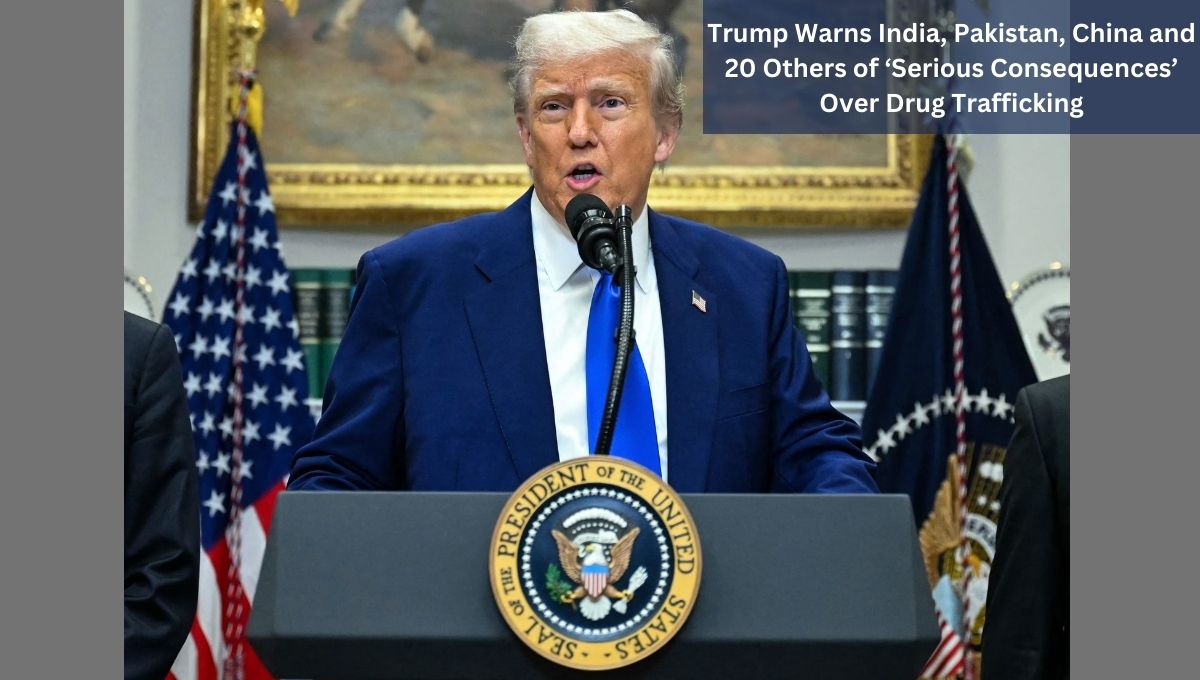
In his war on drugs, Trump Warns India, Pakistan, China and 20 Others of ‘Serious Consequences’ Over Drug Trafficking. US President Donald Trump has escalated his administration’s global war on drugs, issuing a sharp warning to 23 nations designated as major drug transit or major illicit drug-producing countries. India, Pakistan, China, and Afghanistan are among those listed in the White House’s annual Presidential Determination on Major Drug Transit or Illicit Drug Producing Countries, submitted to Congress this week.
Trump declared that countries failing to curb drug flows to the United States would face “serious consequences”, stressing that narcotics trafficking — particularly synthetic opioids like fentanyl — has become a national emergency and the leading cause of death for Americans aged 18 to 44.
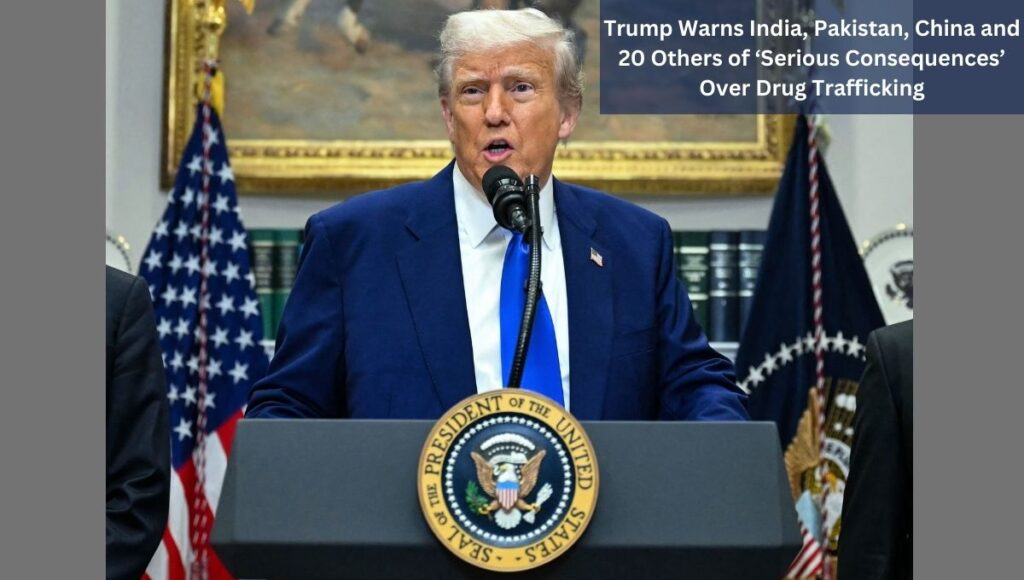
Trump Warns India, Pakistan, China and 20 Others of ‘Serious Consequences’ Over Drug Trafficking
The Full List of Countries on Washington’s Drug Watchlist
The 23 nations include:
- Asia: Afghanistan, Burma (Myanmar), China, India, Pakistan, Laos
- Americas: The Bahamas, Belize, Bolivia, Colombia, Costa Rica, the Dominican Republic, Ecuador, El Salvador, Guatemala, Haiti, Honduras, Jamaica, Mexico, Nicaragua, Panama, Peru, Venezuela
Among these, five countries — Afghanistan, Bolivia, Burma, Colombia, and Venezuela — were accused of having “failed demonstrably” to meet their international counternarcotics obligations.
Trump’s determination noted that while inclusion on the list does not necessarily reflect poor cooperation, it highlights geographic, commercial, and economic conditions that make certain countries hubs for production or transit of narcotics and precursor chemicals.
Trump’s Warning: ‘Shut Off the Supply or Face Consequences’
Delivering his warning, Trump linked the global narcotics trade directly to the opioid crisis devastating US communities.
- He cited that over 200 Americans die every day due to illicit drugs.
- He highlighted fentanyl as the leading killer of young Americans.
- He accused China of being the “world’s largest source” of precursor chemicals fueling fentanyl production.
- He accused the Taliban of profiting from drug trade despite its claimed ban on narcotics in Afghanistan.
“Countries where these drugs originate and transit must fulfill their obligations and shut off these supplies — or face serious consequences,” Trump declared.
India’s Inclusion: Geography and Trade at the Core
While India was not accused of “failing demonstrably,” it was again placed on the “Major’s List.”
- Washington cited geographic position, commercial trade routes, and precursor chemical flows as reasons for India’s inclusion.
- The White House stressed that India has been a key US partner in global anti-drug cooperation.
- India’s Narcotics Control Bureau (NCB) recently dismantled a global trafficking network using encrypted platforms, drop-shipping, and cryptocurrency.
The US Embassy in New Delhi publicly thanked Indian authorities, stating:
“Thanks to NCB and Indian authorities for helping protect Americans against illegal drugs and saving American lives!”
Pakistan, China, and Afghanistan: Key Concerns
Pakistan
Pakistan remains a crucial transit hub for heroin and other narcotics moving from Afghanistan to international markets. Despite counter-narcotics efforts, Washington remains wary of trafficking routes running through Pakistan’s porous borders.
China
Trump placed heavy blame on China, calling it the world’s largest supplier of precursor chemicals for fentanyl, methamphetamine, and other synthetic narcotics.
- The US accused Beijing of inaction and demanded stronger enforcement.
- China’s chemical industry continues to fuel both domestic and global drug epidemics.
Afghanistan
Despite the Taliban’s public ban on narcotics, Trump said drug stockpiles and continued opium production prove that Taliban leaders still profit from the trade.
- Afghanistan was singled out as one of the five countries that have “failed demonstrably” to meet drug control obligations.
- Trump tied Afghan drug revenues directly to terrorism financing.
Colombia: The Most Explosive Clash
The most severe diplomatic clash arose with Colombia, long regarded as America’s top partner in Latin America against cocaine cartels.
- The Trump administration decertified Colombia, saying cocaine production had surged to all-time highs under President Gustavo Petro.
- Colombia was placed in the “failed demonstrably” category for the first time since 1997.
- Trump blamed Petro’s peace talks with armed groups for hindering drug enforcement.
In response, Petro accused the US of interference, announcing:
“From this moment on, weapons will not be purchased from the United States.”
This marks a dramatic break: Colombia, which receives nearly $380 million in annual US aid for anti-drug programs, is now halting American arms purchases.
Petro’s Counterattack: ‘The Problem Is Theirs, Not Ours’
President Gustavo Petro hit back hard:
- He accused Washington of trying to “install a puppet president” in Colombia.
- He claimed Colombia has seized more cocaine under his government than any predecessor.
- He said the real problem lies in US and European demand for cocaine.
- He argued that US drug policy had failed, noting that many Americans have simply shifted from cocaine to fentanyl.
“We are the ones who help them, because the problem is theirs, not ours,” Petro declared.
The Global Dimension: Drugs, Geopolitics, and Power
Trump’s designation of 23 countries as major drug hubs underscores how the war on drugs is now deeply entwined with global geopolitics.
- With China, it intersects with the trade war and rivalry for global influence.
- With Afghanistan, it merges with the US fight against terrorism financing.
- With India and Pakistan, it highlights the regional complexities of South Asia.
- With Colombia, it raises questions about US dominance in Latin America.
Israel, Gaza, and Wider Frictions
The diplomatic storm is not limited to narcotics. President Petro of Colombia has also cut ties with Israel over its war in Gaza, making Colombia one of the few US partners to openly sever relations with a key American ally.
This deepens the rift, as Petro positions himself against US foreign policy not just in the drug war but also in the Middle East conflict.
US Domestic Crisis: Fentanyl at the Center
At the heart of Trump’s aggressive push lies America’s domestic opioid crisis:
- Fentanyl is now the leading cause of death for Americans aged 18–44.
- 40% of Americans know someone who has died from an overdose.
- Trump vowed to use “every aspect of American power” to defeat the narcotics threat.
The administration views the fight not just as a public health battle, but as one of national security.
Conclusion: A Tougher Phase of the Drug War
Trump’s latest declaration signals a hardening of US global drug policy, with a wider net cast than ever before.
- India, Pakistan, and China face growing pressure despite being partners.
- Colombia is now in open confrontation with Washington.
- Afghanistan and the Taliban remain at the center of suspicion.
For the US, the war on drugs has now become a multi-front battle spanning Asia, Latin America, and beyond, with fentanyl at its deadly core.
Also Read: Trump Signs Secret Order Targeting Latin American Drug Cartels
Also Read: Venezuelan fishermen in fear after US strikes on boats in the Caribbean