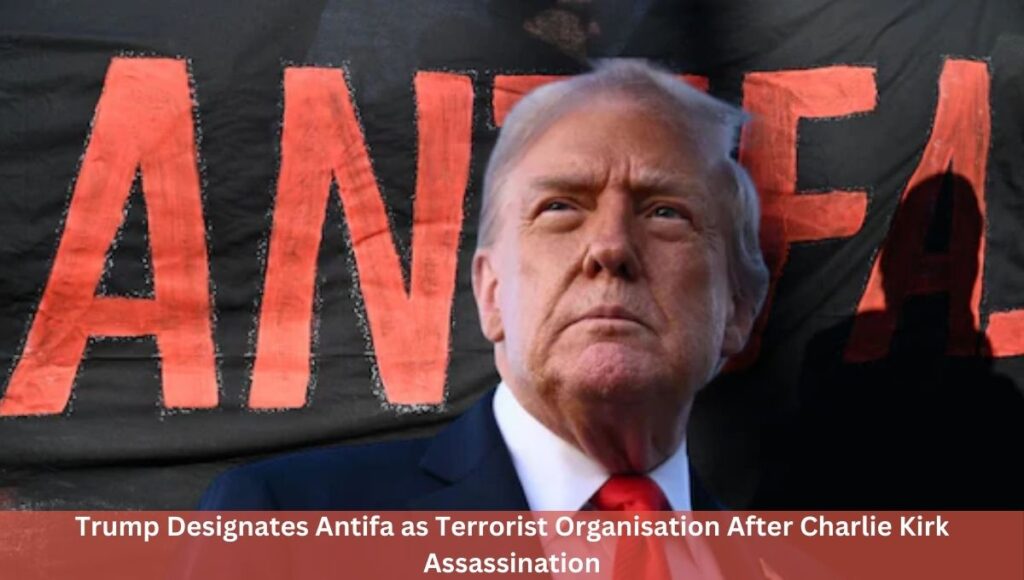
Citing a radical left disaster, Trump Designates Antifa as Terrorist Organization After Charlie Kirk Assassination. In a move that has reignited one of America’s most polarising debates, US President Donald Trump has officially designated the anti-fascist Antifa movement a “major terrorist organisation.”
The announcement, made on his Truth Social platform, came days after the assassination of conservative commentator and Trump ally Charlie Kirk, whose killing has shaken right-wing circles across the United States. Calling Antifa a “sick, dangerous, radical left disaster,” Trump vowed to investigate those funding the movement and to dismantle what he described as a “vast domestic terror network.”
Critics, however, warn that this designation is not only legally questionable but also politically dangerous, threatening to blur the line between violent extremism and constitutionally protected dissent. This article takes an in-depth look at Trump’s designation of Antifa, its historical roots, its ideology, and why it has become a lightning rod in America’s culture wars.
Trump Designates Antifa as Terrorist Organisation After Charlie Kirk Assassination
Trump’s Announcement on Truth Social
In the early hours of Thursday, Trump posted on Truth Social in his trademark all-caps style:
“I am pleased to inform our many U.S.A. Patriots that I am designating ANTIFA, A SICK, DANGEROUS, RADICAL LEFT DISASTER, AS A MAJOR TERRORIST ORGANIZATION. I will also be strongly recommending that those funding ANTIFA be thoroughly investigated in accordance with the highest legal standards and practices. Thank you for your attention to this matter!”
The post quickly dominated political news cycles, triggering applause from Republican lawmakers and criticism from Democrats and civil liberties groups.
Trump has long demonised Antifa, frequently portraying it as a violent leftist threat undermining America. Yet this time, the move carries heightened political stakes: it comes directly in response to the murder of Charlie Kirk, a prominent conservative activist who built his career around challenging left-wing groups on college campuses.
The Assassination of Charlie Kirk and Its Political Fallout
What Happened to Charlie Kirk?
On September 10, 2025, Charlie Kirk was shot dead at Utah Valley University. Police arrested 22-year-old Tyler Robinson, a Utah native, who was charged with first-degree murder. Investigators have not yet determined a definitive motive, but law enforcement confirmed Robinson left behind writings containing anti-fascist references.
For Trump and his allies, this was enough to tie the killing to Antifa, branding it part of a coordinated campaign of left-wing domestic terrorism.
The White House Response
Senior officials swiftly linked the murder to Antifa. Stephen Miller, White House deputy chief of staff, declared:
“We are going to channel all of the anger that we have over the organised campaign that led to this assassination, to uproot and dismantle these terrorist networks.”
Vice President JD Vance also vowed to “go after the NGO network that foments, facilitates and engages in violence,” pointing to groups accused of backing left-wing activists.
Republican Senator Bill Cassidy echoed the sentiment, insisting that Antifa “seized upon a movement of legitimate grievances to promote violence and anarchy, working against justice for all.”
Critics Cry Foul
Democrats and civil liberties advocates argue that Trump is using Kirk’s death as a pretext for political crackdowns. They stress that Antifa is not a formal group but a loose movement without leaders, making it impossible to classify in the same way as designated foreign terrorist organisations.
What Is Antifa?
Origins of Antifa
The term “Antifa” is shorthand for anti-fascist, with roots in Europe during the 1920s and 1930s when militant leftist groups resisted Mussolini’s fascists in Italy and Hitler’s Nazis in Germany.
In the United States, Antifa gained prominence after Trump’s 2016 election, particularly during protests against white supremacist and far-right rallies.
The 2017 “Unite the Right” rally in Charlottesville, where white supremacists marched with torches and a counter-protester was killed, was a tipping point. Antifa activists were visible on the frontlines, clashing with neo-Nazis and far-right militias.
Structure and Membership
Antifa is not an organisation in the traditional sense. It has no headquarters, no national leadership, and no formal membership rolls. Instead, it is a decentralised network of activists who share tactics and ideology.
Local groups, such as Rose City Antifa in Portland, are among the more visible collectives, but most participants operate anonymously. Activists often adopt black bloc tactics—dressing in black, covering faces, and moving in formations to avoid identification.
Online, Antifa supporters engage in “doxxing” far-right activists by publishing personal details and coordinate counter-protests via social media.
Antifa’s Goals
At its core, Antifa seeks to oppose fascism, white supremacy, xenophobia, and authoritarianism. Supporters view their activism as a form of self-defence against hate groups.
However, their methods are controversial. Antifa members have engaged in property damage, confrontations with right-wing activists, and efforts to shut down conservative speakers at universities. Critics argue this undermines free speech and escalates political violence.
Why Trump Targets Antifa
A Political Foil
Antifa has long served as a convenient foil for Trump. He has sought to link Democrats, and even President Joe Biden, to the movement, painting them as soft on left-wing extremism.
During the George Floyd protests in 2020, Trump repeatedly blamed Antifa for instigating riots, though his own FBI director at the time, Christopher Wray, testified that Antifa was “an ideology, not an organisation.”
The Kirk Assassination as a Turning Point
Trump’s decision to designate Antifa a terrorist group comes directly after Kirk’s killing. By connecting the assassination to Antifa, Trump bolsters his long-standing narrative that leftist extremism poses the greatest threat to US security.
Expanding the Crackdown
Trump has signalled that his administration may go further. Beyond Antifa, he has floated revoking tax-exempt status for left-wing nonprofits, investigating donors, and even pursuing RICO (racketeering) charges against activist groups.
Legal Hurdles to Designating Antifa
No Mechanism for Domestic Terrorist Designations
Under US law, the government can designate foreign organisations as terrorist entities, but there is no equivalent process for domestic groups.
Legal scholars stress that designating Antifa as a terrorist organisation could face serious constitutional challenges. Mary McCord, a former senior DOJ official, warned such efforts raise First Amendment concerns, as political ideology—even if radical—is protected under free speech.
Enforceability Questions
Even conservatives sceptical of Antifa raise doubts:
- How can you designate a non-organisation?
- Can you criminalise providing support to an ideology?
- Will courts uphold attempts to prosecute people for affiliating with a decentralised movement?
Antifa in America’s Culture Wars
Conservatives’ Perspective
For Republicans, Antifa embodies left-wing violence hidden under the banner of social justice. Conservative commentators highlight violent clashes, property destruction, and assaults on Trump supporters as evidence of its danger.
Charlie Kirk himself frequently spoke against Antifa, portraying it as an existential threat to conservative values. His assassination has only amplified calls on the right to crush the movement.
Liberals’ Perspective
Democrats and civil liberties groups agree that violence should be prosecuted, but they caution against painting an entire movement as terrorism.
Historians point out that authoritarian leaders often conflate left-wing militancy with far-right violence to justify crackdowns. Critics argue Trump downplays white supremacist violence, which data shows accounts for more deadly attacks in the US than leftist activism.
The Media’s Role
The debate over Antifa has also become a media battleground. Right-leaning outlets amplify fears of “radical left terrorists,” while progressive outlets stress the group’s decentralisation and accuse Trump of political opportunism.
Historical Parallels: Trump’s First Term and Antifa
Trump previously threatened to designate Antifa as a terrorist group in 2020, during nationwide Black Lives Matter protests after George Floyd’s killing.
Back then, his Attorney General William Barr declared that Antifa’s activities constituted “domestic terrorism,” though no official designation occurred.
In 2019, Republican Senators Ted Cruz and Bill Cassidy even introduced a resolution to classify Antifa as a domestic terrorist organisation. It stalled in Congress, but the political push to target Antifa never disappeared.
Now, with Kirk’s assassination as a rallying cry, Trump has revived the effort—this time attempting to follow through.
What Comes Next?
Legal Battles
Trump’s announcement is likely to face immediate legal challenges. Courts may be asked to determine whether his administration even has the authority to designate a domestic movement.
Political Strategy
Politically, the move may energise Trump’s conservative base ahead of future elections, rallying voters around the narrative of a strong president cracking down on radical leftists.
At the same time, it risks further polarising the country and could galvanise left-wing activists who see themselves as unfairly targeted.
Broader Implications
The designation also raises troubling questions:
- Could other movements be labelled “terrorist organisations”?
- Will political dissent increasingly be criminalised?
- How will law enforcement distinguish between lawful protest and alleged terrorism?
Conclusion
Trump’s decision to designate Antifa as a terrorist organisation following the assassination of Charlie Kirk is a watershed moment in America’s ongoing struggle with extremism, free speech, and political identity.
For supporters, it is a long-overdue crackdown on violent left-wing militants. For critics, it is a dangerous overreach that weaponises tragedy to silence dissent and expand presidential powers.
The battle over Antifa is not just about one movement—it is a reflection of America’s broader culture wars, where definitions of terrorism, patriotism, and democracy itself are fiercely contested. As the legal challenges mount and the political rhetoric intensifies, one thing is clear: Trump’s declaration ensures that Antifa will remain a defining flashpoint in US politics for years to come.
Also Read: Charlie Kirk Could Have Been President, Says Trump’s Aide Peter Navarro After Assassination
Also Read: Charlie Kirk gets a hero’s treatment at White House ceremony