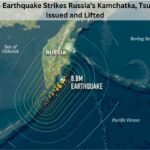
No major damage reported as a Magnitude 7.8 Earthquake Struck Russia’s Kamchatka, Tsunami Warnings Issued Across Pacific. Russia’s Far East was jolted early Friday by a magnitude 7.8 earthquake in the Kamchatka Peninsula, one of the world’s most seismically active regions. The U.S. Geological Survey (USGS) said the quake, which struck at a shallow depth of 10 km (6.2 miles), triggered tsunami warnings across the Pacific, including for Russia’s eastern coast, the Kuril Islands, and parts of Alaska.
The tremor, classified as an “aftershock” of July’s record 8.8 megaquake, sent shockwaves through Petropavlovsk-Kamchatsky, the regional capital, where residents were startled by swaying buildings and car alarms blaring in the streets.
Magnitude 7.8 Earthquake Struck Russia’s Kamchatka, Tsunami Warnings Issued Across Pacific
Tsunami Alerts and Immediate Response
The Russian Emergencies Ministry initially reported the quake at magnitude 7.2 but confirmed tsunami warnings for coastal towns along Kamchatka’s eastern shore.
Governor Vladimir Solodov placed emergency services on high readiness, urging residents to remain vigilant. “This morning is once again testing the resilience of Kamchatka residents,” Solodov said on Telegram. Teams began rapid inspections of schools, hospitals, and residential complexes to ensure structural safety.
Authorities confirmed tsunami waves between 30 and 62 centimeters (1–2 feet) along the coastline, though no widespread flooding occurred.
The US Pacific Tsunami Warning Center issued advisories for Alaska, warning of potentially hazardous currents. However, the threat to Hawaii and Canada’s Pacific coast was quickly ruled out.
Aftershocks Continue to Shake the Region
The quake was followed by a series of aftershocks, the strongest registering magnitude 5.8. Kamchatka residents reported tremors lasting for nearly a minute, with videos showing lamps swinging, furniture rattling, and cars rocking in parking lots.
Officials reassured that no casualties or serious damage had been reported, but emphasized that the risk of further seismic activity remained high.
A Region of Constant Seismic Activity
The Kamchatka Peninsula lies along the Pacific “Ring of Fire”, where the Pacific Plate collides with the North American Plate, making it one of the most earthquake-prone zones on Earth.
In the past week alone, the region recorded two quakes above magnitude 7.0. The most devastating in recent history came on July 29, 2025, when a magnitude 8.8 megaquake struck offshore, triggering tsunami warnings across the Pacific. Waves up to 4 meters battered parts of Kamchatka and the Kuril Islands, forcing mass evacuations.
That July quake was tied as the sixth-largest earthquake in modern records, comparable in strength to the 2011 Tohoku earthquake in Japan that led to the Fukushima disaster.
Tsunami Warning Extended to Kuril Islands and Alaska
The Kuril Islands, located between Russia and Japan, were also placed under tsunami watch. Local officials prepared evacuation routes for residents in low-lying towns.
In Alaska, the National Weather Service warned of dangerous coastal currents but lifted the advisory later in the day after wave surges subsided.
Japan’s Meteorological Agency confirmed monitoring for unusual wave activity, though no significant threat was detected.
Kamchatka Volcano Eruption Adds to Concerns
The quake struck just weeks after the Krasheninnikov volcano on Kamchatka erupted for the first time in centuries, spewing ash nearly 6 kilometers into the sky. The eruption, which coincided with a 7.0-magnitude tremor, raised fears of linked seismic and volcanic activity.
Experts say the peninsula’s volatile geology means earthquakes, volcanic eruptions, and tsunamis often occur in cycles, heightening risks for the 300,000 people living in the region.
Local Impact: Fear but No Major Damage
Residents of Petropavlovsk-Kamchatsky described the earthquake as one of the strongest they had felt since July. Many rushed outdoors as tremors rocked apartment buildings.
Authorities said schools and critical facilities remained operational after inspections. Power, water, and internet services were briefly disrupted in some neighborhoods but restored within hours.
International Reactions and Monitoring
Global seismic monitoring agencies, including the USGS and Japan Meteorological Agency, have been closely tracking activity in Russia’s Far East.
The Pacific Tsunami Warning Center (PTWC) emphasized that while no Pacific-wide tsunami was generated this time, the quake underscored the need for constant preparedness in coastal nations.
Comparing With Past Disasters
- July 2025 (M8.8 Kamchatka): Triggered tsunami waves across the Pacific, causing flooding and mass evacuations.
- September 2025 (M7.4 Kamchatka): Struck just a week before the latest quake, reinforcing fears of a seismic chain reaction.
- 2011 Tohoku Quake (M9.1, Japan): Sparked a devastating tsunami and nuclear meltdown at Fukushima, a constant reference point for Pacific disaster planning.
What’s Next for Kamchatka?
Seismologists warn that the region may continue experiencing large aftershocks for weeks or months following July’s megaquake. The repeated high-magnitude tremors highlight the need for improved early warning systems, coastal evacuation infrastructure, and international cooperation on tsunami monitoring.
Governor Solodov urged residents not to panic but to remain prepared. “Kamchatka is resilient,” he said. “But nature reminds us constantly of our vulnerability.”
Conclusion
The magnitude 7.8 earthquake in Kamchatka is the latest reminder of the volatile seismic activity in Russia’s Far East. While no major damage or casualties have been reported, the quake’s link to July’s historic 8.8 megaquake raises concerns about long-term seismic risks in the Pacific. For now, tsunami warnings have been lifted, but with the region sitting at the heart of the Pacific Ring of Fire, experts caution that preparedness remains the only safeguard against nature’s unpredictability.
Also Read: Earthquake today: 6.2 magnitude quake jolts Afghanistan, tremors felt in Delhi-NCR