

Israel’s approval of Netanyahu’s Gaza City Takeover Plan Sparks Global Outrage. Prime Minister Benjamin Netanyahu’s decision to approve a plan for the Israeli military to take control of Gaza City has sparked a firestorm of criticism both inside Israel and across the globe. While Netanyahu insists the move aims to “free Gaza from Hamas” rather than occupy it, world leaders, humanitarian organizations, and families of hostages warn the plan risks worsening the Gaza war and escalating the humanitarian catastrophe already gripping the territory.
Netanyahu’s Gaza City Takeover Plan Sparks Global Outrage
Netanyahu’s Gaza City Plan: “Free Gaza From Hamas”
Following approval by Israel’s security cabinet, Netanyahu announced that the military will seize Gaza City as part of a broader strategy to defeat Hamas.
His office outlined five guiding principles, including Gaza’s demilitarization and the creation of a civilian administration “neither Hamas nor the Palestinian Authority.”
In a post on X, Netanyahu stated:
“We are not going to occupy Gaza we are going to free Gaza from Hamas. A peaceful civilian administration and demilitarisation will help free our hostages and prevent future threats.”
Netanyahu also emphasized that the plan includes distributing humanitarian aid outside active combat zones.
However, critics argue that ground operations in the densely populated city home to nearly 900,000 residents, many displaced from other areas will inevitably cause further civilian suffering.
Germany Halts Arms Exports, UK Urges Reconsideration
Germany, traditionally a staunch Israeli ally, took the unprecedented step of suspending military exports that could be used in Gaza.
Chancellor Friedrich Merz said it was becoming “increasingly difficult to understand” how the new operation aligns with Israel’s legitimate security aims.
Netanyahu sharply criticized the move, calling it a reward for Hamas.
In the UK, Prime Minister Keir Starmer labeled the decision to escalate into Gaza City “wrong” and urged Israel to reconsider immediately. He warned:
“This action will do nothing to bring an end to this conflict or to help secure the release of the hostages. It will only bring more bloodshed.”
The foreign ministers of Australia, Germany, Italy, New Zealand, and the UK issued a joint statement condemning the plan, warning it risks violating international humanitarian law.
Hostage Families: “March of Recklessness”
Domestically, Netanyahu’s plan has faced strong opposition from hostage families and some political leaders.
The Hostage and Missing Families Forum accused the government of abandoning captives in Gaza, saying:
“The cabinet chose to embark on another march of recklessness, on the backs of the hostages, the soldiers, and Israeli society as a whole.”
Out of 251 hostages taken during Hamas’s October 7, 2023 attack, 49 remain in Gaza 27 confirmed dead by Israeli military sources.
Opponents warn that ground fighting in Gaza City, where hostages are likely held, could endanger their lives.
Opposition leader Yair Lapid condemned the move as a “disaster” that ignores the advice of security officials, accusing far-right coalition members Itamar Ben Gvir and Bezalel Smotrich of pushing Netanyahu toward a prolonged, costly campaign.
Gaza Residents Fear Renewed Displacement
In Gaza City, where the Israeli army claims to already control 75% of the strip, residents expressed fear and exhaustion. Many have been displaced multiple times since the war began.
“They tell us to go south, then back north, and now they want to send us south again. We are human beings, but no one hears us or sees us,” said 52-year-old mother of six Maysa al-Shanti.
Maghzouza Saada, displaced from northern Gaza, echoed the desperation:
“Where should we go? Do we throw ourselves in the sea?”
International Leaders Warn of “Dangerous Escalation”
United Nations Secretary-General António Guterres warned the plan could deepen “catastrophic consequences” for millions of Palestinians.
The UN Security Council is scheduled to meet Sunday to discuss the development.
Regional power Saudi Arabia condemned any move to occupy Gaza, reiterating that normalization of ties with Israel is impossible without the creation of a Palestinian state.
European Commission President Ursula von der Leyen urged Israel to reconsider, stressing the urgent need to protect civilians.
Humanitarian Crisis Deepens
The humanitarian situation in Gaza remains dire. A UN-backed assessment warns of unfolding famine, with the World Health Organization reporting at least 99 deaths from malnutrition this year a likely underestimate.
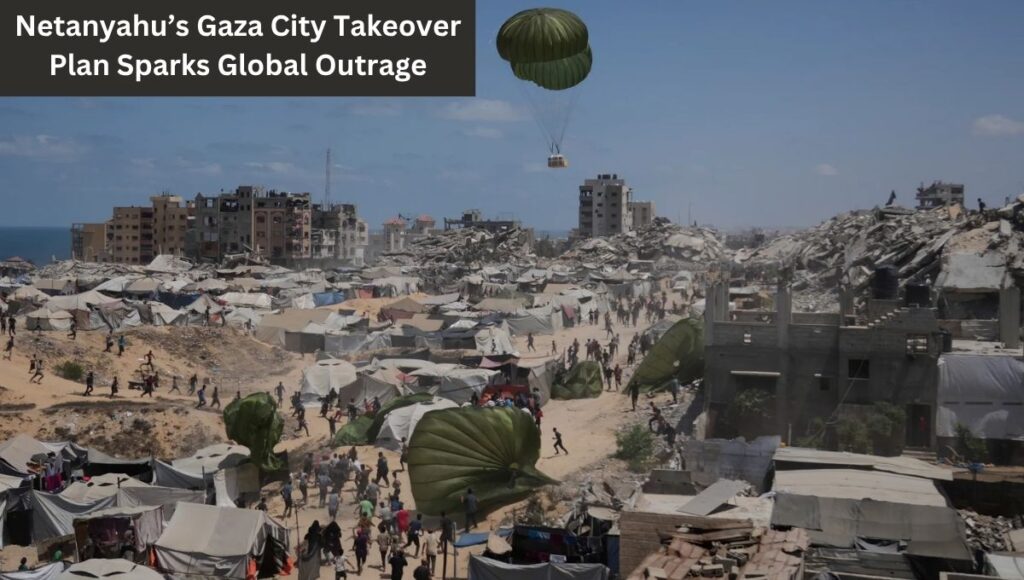
Aid delivery efforts remain hazardous. Gaza’s civil defense reported a 19-year-old seriously injured when an aid parcel dropped from the air struck him.
Spokesman Mahmud Bassal noted that heavy packages in crowded areas cause injuries and fatalities, while stampedes often break out during distributions.
Israeli strikes killed at least 16 people across Gaza on Friday alone, according to Gaza’s civil defense agency.
Military and Strategic Perspectives
Retired Israeli brigadier general Amir Avivi called Gaza City “the heart of Gaza,” stating that its fall would be a “game changer” in the fight against Hamas.
He estimated that taking the city would give Israel control of about 85% of the strip.
Before the war, Gaza City housed Hamas’s strongest fighting units. Israeli media suggest that a full takeover could cripple the group’s operational capabilities.
Still, critics warn that such gains could come at the cost of massive civilian displacement, prolonged urban warfare, and irreparable damage to Israel’s international standing.
U.S. Voices and Divided Diplomacy
Mike Huckabee, former U.S. ambassador to Israel under President Donald Trump, criticized nations that pressure Israel rather than Hamas.
He argued that Hamas remains unwilling to reach a “reasonable settlement” and must be disarmed.
The Biden administration has not formally endorsed the Gaza City plan but continues to emphasize Israel’s right to self-defense alongside the need for humanitarian protections.
Historical Context: Gaza Occupation and Withdrawal
Israel occupied Gaza from 1967 until 2005, when it withdrew troops and settlers under then-Prime Minister Ariel Sharon.
Despite the withdrawal, Israel has maintained control over Gaza’s borders, airspace, and utilities.
A full reoccupation would reverse that 2005 decision an outcome that many in Israel and abroad fear could entangle the military in another costly, open-ended occupation.
Public Opinion and Political Stakes
Recent opinion polls show most Israelis want the war to end through a diplomatic deal that frees the hostages. However, Netanyahu has repeatedly stated that there will be no end to the war until Hamas is fully disarmed.
For now, the Gaza City takeover plan stands as a test of Netanyahu’s political survival, Israel’s military endurance, and the world’s ability or inability to influence the trajectory of one of the most destructive conflicts of the 21st century.
Also Read: Netanyahu Pushes Gaza City Takeover Despite UN Warnings and Rising Civilian Deaths
Also Read: Netanyahu’s plan to take over Gaza sparks anger and threat of sanctions from allies
Related Posts:
- Trump’s 20-Point Gaza Peace Plan Gains Urgent Global…

- Israel–Hamas Ceasefire Under Strain: 4 More Hostage…

- Israel’s Gaza Takeover Plan: What’s Been Achieved…

- 5 Key Developments as Israel Confirms Hamas Handed…

- Dramatic Moments Behind Trump’s Gaza Peace Push and…

- Trump’s Breakthrough Gaza Ceasefire Deal 2025: Key Insights
