Cautiously India Reacts to White House Pitch for Trump’s Nobel Peace Prize Claiming Role in India-Pakistan Ceasefire. India on Friday dismissed questions regarding the White House’s campaign to nominate U.S. President Donald Trump for the 2026 Nobel Peace Prize, particularly for his alleged role in de-escalating tensions between India and Pakistan. In response to a journalist’s question, Ministry of External Affairs (MEA) spokesperson Randhir Jaiswal said plainly:
“It is better to take this question to the White House.”
The remark came following White House Press Secretary Karoline Leavitt’s statement advocating for Trump’s nomination, citing that the U.S. President had “brokered peace” in several global conflicts including between India and Pakistan since taking office in January 2025.
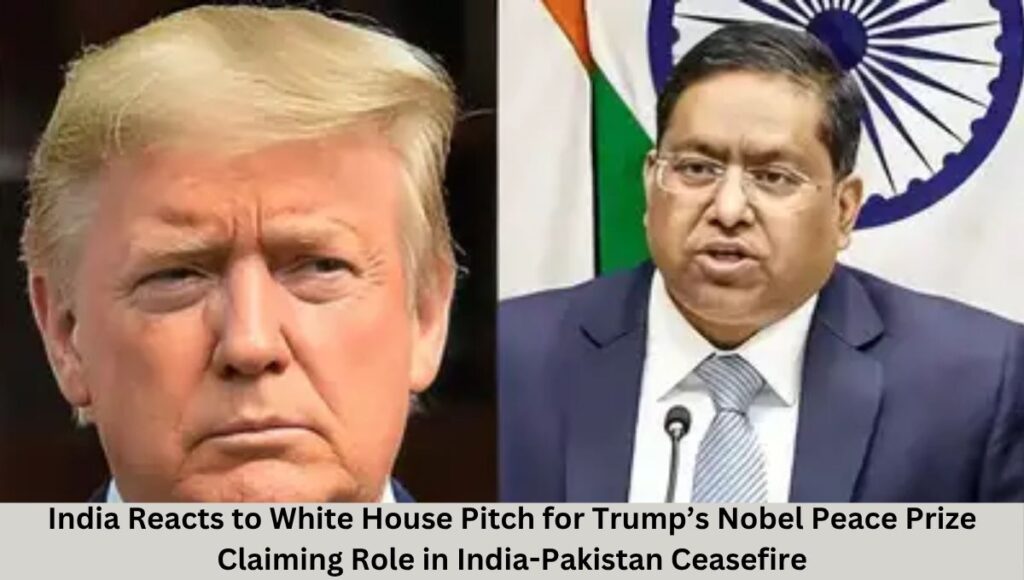
India Reacts to White House Pitch for Trump’s Nobel Peace Prize Claiming Role in India-Pakistan Ceasefire
White House Claims: Trump Ended Global Conflicts
At a press briefing earlier this week, Karoline Leavitt stated that President Trump had played a decisive role in ending conflicts in seven major flashpoints:
- India and Pakistan
- Thailand and Cambodia
- Israel and Iran
- Rwanda and Democratic Republic of the Congo
- Serbia and Kosovo
- Egypt and Ethiopia
According to Leavitt, Trump has successfully brokered, on average, one peace deal per month since his return to office.
“It’s well past time that President Trump was awarded the Nobel Peace Prize,” she said.
Trump’s Ceasefire Claims Rejected by India
Despite the White House’s assertions, India has repeatedly rejected claims that Donald Trump had anything to do with the May 2025 ceasefire between New Delhi and Islamabad.
Following a deadly terror attack in Jammu and Kashmir’s Pahalgam region on April 22, where 26 civilians lost their lives, India launched Operation Sindoor on May 7 targeting terror camps in Pakistan and Pakistan-occupied Kashmir.
Pakistan retaliated with a massive drone and missile assault, intercepted by India’s armed forces, prompting India to strike back at Pakistani airfields.
A ceasefire was declared on May 10, ending several days of hostilities.
PM Modi and Jaishankar Deny External Mediation
Indian Prime Minister Narendra Modi directly contradicted Trump’s claim, stating in Parliament that no international leader intervened to stop India’s military operations.
“On the night of 9th May, the Vice President of America tried to talk to me. He tried for an hour, but I was in a meeting with my army… He later said Pakistan was planning a big attack. I responded that if they attack, it will cost them heavily,” Modi recounted in the Lok Sabha.
External Affairs Minister S. Jaishankar also emphasized in the Rajya Sabha that India’s decisions during the conflict were sovereign and unilateral:
“There was no leader, nobody, anywhere in the world, who asked India to stop its operations.”
Pakistan and Israel Support Trump’s Nobel Bid
In contrast, Pakistan and Israel have thrown their support behind Trump’s Nobel Peace Prize nomination.
In June 2025, Islamabad formally announced that it had recommended President Trump for the 2026 prize:
“In recognition of his decisive diplomatic intervention and pivotal leadership during the recent India-Pakistan crisis.”
Likewise, Israeli Prime Minister Benjamin Netanyahu submitted a letter to the Norwegian Nobel Committee lauding Trump’s efforts to mediate peace in Gaza, where Trump has tried to broker a ceasefire between Israel and Hamas.
India Maintains Strategic Autonomy in Foreign Policy
Responding to the controversy, MEA spokesperson Randhir Jaiswal reiterated that India’s foreign policy remains independent and strategic.
“Our ties with any country stand on their merit and should not be seen from the prism of a third country,” he said. “We remain focused on the substantive agenda that our two countries have committed to, and are confident that the relationship will continue to move forward.”
Jaiswal also reaffirmed India’s long-standing partnership with Russia, calling it “time-tested,” while characterizing the India-U.S. relationship as one based on shared democratic values and mutual interests.
The Nobel Peace Prize: What Lies Ahead for Trump?
If awarded, Donald Trump would become the fifth U.S. president to receive the Nobel Peace Prize, joining the ranks of:
- Theodore Roosevelt (1906)
- Woodrow Wilson (1919)
- Jimmy Carter (2002)
- Barack Obama (2009)
However, the Norwegian Nobel Committee the body responsible for selecting recipients has not commented on Trump’s nomination status.
Nominations for the 2026 Nobel Prize closed in January 2025, and recipients will be announced in October 2026.
Whether Trump will be honored remains uncertain, especially amid global skepticism about the legitimacy of some of his peace deal claims.
Trump’s Peace Narrative Faces Diplomatic Reality
While Trump’s administration continues to promote his foreign policy achievements, India’s response underscores the limits of those claims.
The May 2025 ceasefire between India and Pakistan was, according to Indian leadership, a product of direct bilateral decisions, not external negotiation.
The Indian government’s call to “ask the White House” reflects both diplomatic tact and a firm dismissal of any third-party mediation narrative.
As international observers and the Nobel Committee weigh Trump’s record, India’s firm stand on its sovereignty and military independence remains an essential counterpoint in the global conversation.
Final Thoughts
The White House’s public relations push for Donald Trump’s Nobel Peace Prize has stirred debate across the globe but especially in South Asia, where the truth of conflict resolution between India and Pakistan lies firmly in the hands of domestic actors.
India’s firm diplomatic tone reminds the world that, while alliances may shift and global leaders may claim credit, national sovereignty remains non-negotiable especially when peace is earned on the battlefield and at the negotiation table, not in press briefings.
Also Read: Why Did PM Modi-Trump Call On June 17 Turn Tense? NYT Report Claims US President Cancels India Visit
Also Read: US Monitors India-Pakistan “Every Single Day,” says Rubio Amid Trump’s Ceasefire Claim
Related Posts:
- 5 Powerful Highlights as Trump Lands Second Nobel…

- Trump Deserves Nobel Peace Prize, Says White House,…
- Trump Says “They Won’t Give It to Me” as Pakistan…
- Trump’s 2025 Nobel Peace Prize Snub: Politics Over…

- 7 Shocking Reasons FIFA’s Peace Prize for Trump…

- Trump’s Nobel Peace Prize Bid: Gaza Peace Plan, 8…