Scratching their head over the deal’s feasibility and strategic intent, Experts Puzzled by Trump’s “Massive Oil Deal” with Pakistan Despite Dismal Reserves. President Donald Trump’s announcement of a “landmark energy partnership” with Pakistan has drawn widespread attention and confusion. Energy analysts, diplomats, and regional observers alike are struggling to understand what Trump calls Pakistan’s “massive oil reserves,” especially given that Pakistan ranks only 50th globally in proven recoverable conventional crude oil.
With a modest 234 to 353 million barrels of proven oil reserves just 0.021% of the global total Pakistan remains a net petroleum importer, relying heavily on Middle Eastern suppliers. So, what’s behind Trump’s claim? And why is Washington backing an oil development partnership with a country that barely produces enough to meet its own needs?
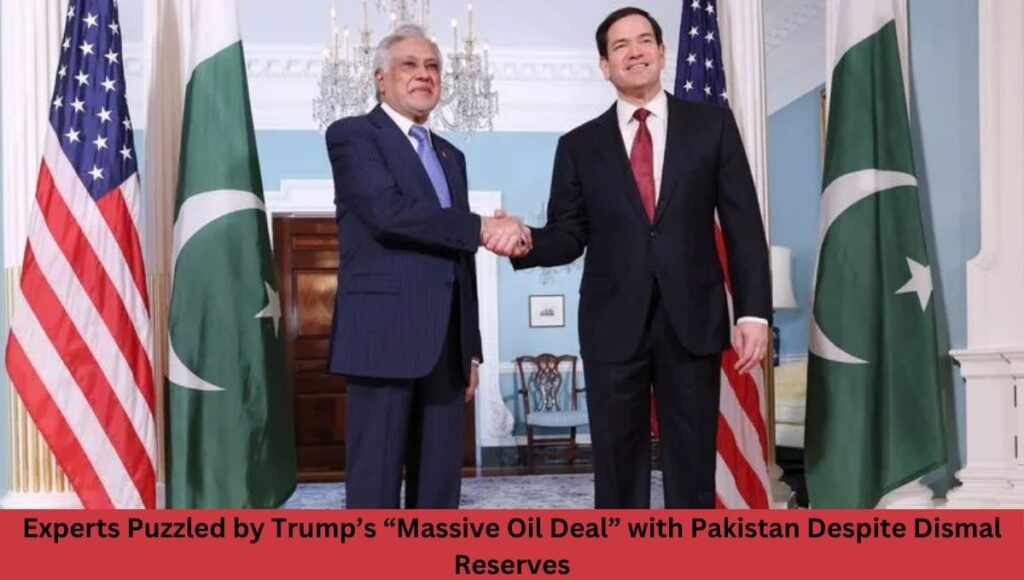
Experts Puzzled by Trump’s “Massive Oil Deal” with Pakistan Despite Dismal Reserves
A Deal Built on Dubious Reserves?
Trump’s August announcement, shared on Truth Social, touted a long-term partnership aimed at developing “massive untapped oil resources” in Pakistan.
However, most experts argue the evidence of such reserves is slim at best. Pakistan has historically struggled with offshore exploration, with repeated failures to discover commercially viable deposits.
In fact, a much-publicized 2019 announcement by then-PM Imran Khan claimed Pakistan had discovered “Asia’s largest oil reserve” off the Karachi coast.
But within hours, Pakistan’s Petroleum Division denied any such find. Drilling by major firms like ExxonMobil, ENI, Pakistan Petroleum Ltd, and others reached depths over 5,500 meters but yielded no results. The project was abandoned.
“This is a desperate attempt by the US-China-Pakistan axis to blackmail India,” said G. Parthasarathy, former Indian high commissioner to Pakistan. “If China thought there was oil, it would have moved faster.”
Pakistan’s Shaky Energy Reality
Pakistan’s oil sector is plagued by underdevelopment, geopolitical instability, and a heavy import burden.
Oil is its largest import item, worth $11.3 billion as of June 2025, nearly 20% of its import bill, according to the central bank.
Even with all its reserves, Pakistan can’t sustain its own demand for more than two years without imports.
Pakistan has no developed shale oil sector, despite a 2015 U.S. Energy Information Administration estimate of 9.1 billion barrels of technically recoverable shale oil. As petroleum analyst Santanu Saikia explains:
“Even if seismic surveys suggest reserves, it takes a decade or more before they’re confirmed and commercially viable.”
Most of Pakistan’s conventional oil is located in Balochistan, a restive province with deep anti-state sentiment and security challenges that have already led to the exit of firms like Total, Shell, and ENI.
The First-Ever US Crude Shipment to Pakistan
Despite the uncertain outlook, Pakistan has begun taking steps toward diversifying its crude imports.
Under the new US-Pakistan energy deal, Cnergyico, Pakistan’s largest refiner, will import 1 million barrels of West Texas Intermediate (WTI) crude from global trader Vitol in October.
“This is a test spot cargo under our umbrella term agreement with Vitol,” said Usama Qureshi, Vice Chairman of Cnergyico. “If it’s commercially viable, we could do one cargo per month.”
The cargo, to be shipped from Houston and received at Cnergyico’s offshore terminal in Karachi, marks Pakistan’s first-ever purchase of American crude.
The refiner, operating at 30–35% capacity, sees this move as a way to reduce dependence on Gulf suppliers.
A Strategic Diversion from China?
Many observers believe this deal is about more than oil. The U.S. has long sought to limit Pakistan’s strategic dependency on China, especially as part of Trump’s broader geopolitical ambitions in South Asia.
Islamabad itself admitted that the oil deal is part of a “larger economic and strategic agreement” with Washington, hinting at a pivot in its traditionally China-dominated foreign policy.
The move also plays into Trump’s domestic political narrative, presenting him as a dealmaker securing American influence in volatile regions and possibly building support for his 2026 Nobel Peace Prize bid.
Trump’s Mixed Signals: Energy Deal, Then Tariffs
In a surprising twist, just one day after announcing the energy deal, Trump imposed a 19% tariff on Pakistani imports as part of his broader “Liberation Day” tariff program.
Previously, Pakistan faced a 29% duty, but the oil deal allowed it to negotiate the rate down. The new reciprocal tariff structure, effective August 7, includes:
- 25% tariffs on Indian goods
- 20% on Taiwanese and Vietnamese goods
- 30% on South African products
- 19% on Thailand, Cambodia, and Pakistan
Trump did not address the new tariffs in his oil deal announcement, but analysts suggest it may have been a bargaining tactic to finalize the agreement.
Indian Response: Strategic Silence
When asked about Trump’s remark that “Pakistan might sell oil to India someday,” Indian officials dismissed it with measured restraint.
“We have nothing to say,” said MEA spokesperson Randhir Jaiswal.
“India’s energy decisions are based on market offerings and global conditions.”
India has continued to buy discounted oil from Russia, despite global sanctions, and maintains a steady, time-tested energy partnership with Moscow.
As for Trump’s 25% tariffs on Indian exports, New Delhi noted it had “taken note” and was reviewing the move carefully, but remained focused on preserving the momentum of the U.S.-India relationship.
Could Pakistan Become an Energy Exporter?
Despite skepticism, some industry observers see a potential opportunity. Piyush Pandey, a petroleum expert, believes the U.S.-Pakistan oil deal, if sustained, could boost Pakistan’s infrastructure and energy security.
“Even modest reductions in oil imports could improve Pakistan’s trade deficit. If Pakistan eventually exports downstream oil products, India could face pricing pressure in the regional LNG and refined product markets,” he said.
However, this outcome appears distant. A 2024 report by Iran International revealed that $1.02 billion of Iranian fuel was illegally smuggled into Pakistan in 2023 14% of Pakistan’s annual fuel use underscoring both the black market and the absence of energy self-sufficiency.
Oil Politics Meets Regional Strategy
The announcement comes amid a swirl of political theater. Pakistan has nominated Trump for the Nobel Peace Prize, crediting his role in de-escalating May 2025 hostilities with India a claim India flatly denies.
Former Pakistani leaders like Imran Khan used oil discovery announcements to bolster political standing.
Trump, similarly, may be using the energy deal to reinforce his image as a global peacemaker and economic strategist ahead of the 2026 U.S. elections.
But with security risks, infrastructure challenges, and a shaky energy sector, Pakistan’s transition from importer to exporter appears more aspirational than imminent.
Conclusion: A Deal More Political Than Petroleum
The Trump Pakistan oil deal has set off alarm bells in energy and foreign policy circles. On the surface, it suggests a bold strategic shift but beneath it lies a complex web of dubious reserves, political opportunism, and fragile economics.
While Cnergyico’s deal with Vitol marks a meaningful diversification step for Pakistan, the narrative of “massive oil reserves” is disconnected from geological reality. And Trump’s subsequent 19% tariff imposition further muddies the waters, raising doubts about the true nature of this so-called energy alliance.
India, for now, is staying on course, watching closely, and sticking to what’s best available on the market whether from Russia, the Gulf, or elsewhere. As the drama unfolds, one thing is clear: Pakistan’s path to energy independence is filled with more uncertainty than oil.
Also Read: Trump Strikes Major Oil Deal with Pakistan, Hints at Future Sales to India Amid Tariff Tensions
Also Read: Trump brags of ‘massive’ oil deal in Pakistan – but drilling has not found any