
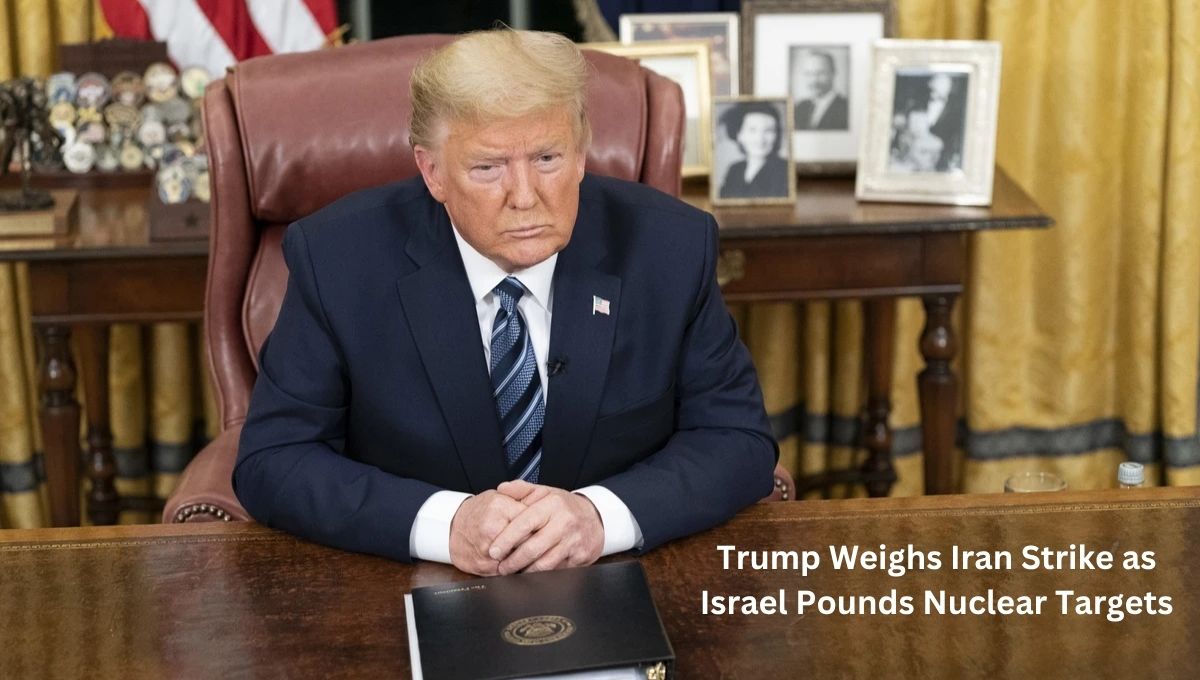
Trump Weighs Iran Strike as Israel Pounds Nuclear Targets: Final Decision in Two Weeks.As Israel continues its intense bombing campaign against Iranian military and nuclear infrastructure, U.S. President Donald Trump has signaled that a direct American military intervention may be imminent with a final decision expected within the next two weeks. Trump’s evolving position reflects a delicate balance between military readiness and diplomatic posturing, as negotiations with Iran teeter on the edge.
Trump Weighs Iran Strike as Israel Pounds Nuclear Targets
Trump: “It’s Very Hard to Ask Israel to Stop”
Speaking to reporters in Morristown, New Jersey, President Trump made clear that he sees little incentive to ask Israel to pause its attacks on Iran, given Israel’s current military momentum.
“If somebody is winning, it’s a little bit harder to do than if somebody is losing,” he said. “It’s very hard to stop when you look at it. Israel’s doing well in terms of war, and Iran is doing less well.”
Despite mounting international calls for de-escalation, Trump has stopped short of calling for a ceasefire, reinforcing his stance that the U.S. supports Israel’s right to defend itself and perhaps more.
Trump Confirms U.S. Strike Plans Are Ready
According to multiple senior officials, Trump has already approved detailed attack plans for Iran, including a potential strike on the underground Fordo nuclear facility, one of the most fortified sites in the Islamic Republic.
However, he has not yet given the final order, holding back to see if Iran will respond to renewed diplomatic efforts. “Finishing the job means destroying Fordo,” one intelligence source told CBS News.
Fordo, located beneath a mountain in northwest Iran, is widely believed to be central to Tehran’s uranium enrichment program. The U.S. would likely need to deploy specialized bunker-buster bombs to reach it a move that would all but guarantee a full-scale regional war.
A “Two-Week” Diplomatic Window or a Pressure Tactic?
At a White House press briefing, Press Secretary Karoline Leavitt relayed Trump’s latest timeline:
“Based on the fact that there is a substantial chance of negotiations… the president will make his decision whether or not to go within the next two weeks.”
The announcement has raised eyebrows among analysts. While it may offer a last chance for diplomacy, others suggest it could be a calculated pressure tactic designed to force Iran to the negotiating table.
Jamal Abdi, president of the National Iranian American Council, argued that Trump is deploying the “madman theory” acting unpredictable to extract maximum concessions from Tehran on its nuclear and ballistic missile programs.
Mounting Death Toll from Israeli Strikes
As of Friday, the Human Rights Activists News Agency (HRANA) reported that at least 657 people have been killed in Iran, including senior commanders of the Islamic Revolutionary Guard Corps (IRGC) and nuclear scientists. Over 2,000 others have been wounded.
Iran’s retaliatory missile and drone strikes have killed 24 civilians in Israel and wounded hundreds. One of the most shocking attacks targeted Soroka Medical Center in Beersheba, wounding more than 240 people.
In response, Israeli Defense Minister Israel Katz directly threatened Ayatollah Khamenei, saying, “In order to achieve all of its goals, this man absolutely should not continue to exist.”
Netanyahu Pushes Trump for Direct U.S. Involvement
Israeli Prime Minister Benjamin Netanyahu, visiting the bombed hospital, made a direct appeal to the U.S. president:
“I trust that President Trump will do what’s best for America,” he said. “I can tell you that they’re already helping a lot.”
Indeed, although the U.S. has not officially joined Israel’s campaign, it has reportedly helped intercept Iranian missile barrages and has increased military readiness in the region.
Intelligence Divided on Iran’s Nuclear Status
Inside the U.S. government, there is disagreement about how close Iran is to producing a nuclear weapon. CIA Director John Ratcliffe reportedly told lawmakers that Iran is “very close” comparing it to a football team just one yard from the goal line.
However, the official intelligence assessment still maintains that Iran’s Supreme Leader has not ordered weaponization, and no active research is ongoing into a bomb delivery mechanism.
Sen. Mark Warner, top Democrat on the Senate Intelligence Committee, said: “They were enriching uranium, but not weaponizing. If there’s been a change in that intelligence, I want to know and it better be based on fact, not political influence.”
European Diplomacy Rushes to Avert War
UK Foreign Secretary David Lammy arrived in Washington this week, meeting with Secretary of State Marco Rubio and special envoy Steve Witkoff. Lammy described the moment as “a window for peace.”
On Friday, Iranian Foreign Minister Abbas Araghchi is expected in Geneva for meetings with EU foreign policy chief and officials from France, Germany, and the UK.
Several neutral countries including Turkey, Norway, Oman, and Italy have offered to host direct or indirect U.S.-Iran talks, though none have been confirmed.
Iran in Disarray as Talks Loom
Inside Iran, conditions are increasingly chaotic. Cyberattacks have crippled the banking system, and international communication is severely disrupted. Diplomats say this may be why arranging talks with Araghchi has proven difficult.
Multiple sources also suggest the Iranian leadership is fearful of surveillance and intelligence intercepts, especially after Israeli strikes killed multiple high-ranking IRGC officers.
Despite Tehran’s vow not to “negotiate under duress,” U.S. envoy Steve Witkoff continues backchannel diplomacy, using Qatar as an intermediary.
Trump’s Pattern of Deadlines: Real or Rhetorical?
This isn’t Trump’s first time setting a ticking clock. In the past year:
- He gave Iran 60 days to reach a nuclear agreement talks continued, and Israel acted first.
- He gave Russia two weeks to engage in serious Ukraine peace talks there was no result, and a key working group was disbanded.
- He paused trade tariffs for 90 days, but that deadline is now expected to be extended.
As Mona Yacoubian of CSIS noted, “Trump’s two-week deadline may be more about strategic ambiguity than actual policy shifts.”
Trump Says Khamenei “Safe for Now”
In a Truth Social post, Trump said the U.S. knows exactly where Ayatollah Khamenei is located but would not target him yet. “He is an easy target, but is safe there. We are not going to take him out (kill!), at least not for now.”
That comment followed reports that Trump had blocked an Israeli plan to assassinate Iran’s Supreme Leader earlier in the conflict.
The Road Ahead: Diplomacy or Direct Conflict?
With no direct U.S.-Iran talks scheduled, the world watches as Geneva consultations unfold. Behind the scenes, U.S. and EU officials are already discussing post-strike scenarios including who might lead Iran if its government collapses, how to secure nuclear material, and what environmental risks exist if a nuclear facility like Fordo is bombed.
Whether Trump follows through on his threat, delays action, or surprises everyone with a last-minute deal, the coming two weeks are shaping up to be among the most consequential in recent Middle East history.
Also Read: Iran Uses Cluster Bombs as Israel Strikes Nuclear Sites on Day 8 of War
Also Read: The U.S. could join Israel’s war with Iran to deploy this 30,000-pound bomb
Related Posts:
- 11 Explosive Warnings as Trump Vows to ‘Knock the…

- Trump’s 2025 Gaza Peace Plan Signing and Historic…

- 10 Explosive Warnings as Donald Trump Calls Iran…
- 12 Explosive Claims as Donald Trump Says Iran War…
- 9 Explosive Revelations as Trump Declares His Health…

- 5 Powerful Highlights as Trump Lands Second Nobel…
