7 Crucial Stakes as Zelensky Seeks Trump’s Backing on Ukraine Peace Deal, with Kyiv reeling from massive missile and drone attacks.Ukrainian President Volodymyr Zelensky has arrived in the United States for what could become one of the most consequential diplomatic meetings since Russia launched its full-scale invasion of Ukraine nearly four years ago.
On Sunday, Zelensky is set to meet US President Donald Trump at his Mar-a-Lago residence in Florida, seeking Washington’s endorsement of a newly drafted 20-point peace proposal designed to end the grinding war with Russia. The high-stakes talks come at a moment of renewed violence.
Just hours before Zelensky’s departure, Russia unleashed one of its most intense missile and drone barrages on Kyiv in months, killing civilians, crippling energy infrastructure, and leaving hundreds of thousands without power and heating in freezing temperatures.
Against this backdrop, Zelensky hopes to persuade Trump that diplomacy—backed by security guarantees—remains Ukraine’s only viable path to peace.
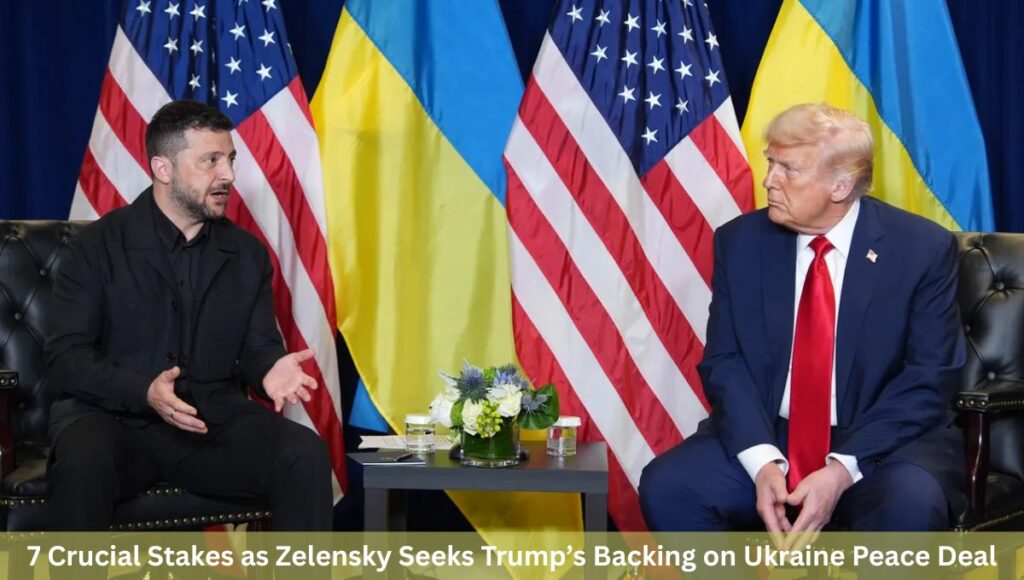
7 Crucial Stakes as Zelensky Seeks Trump’s Backing on Ukraine Peace Deal
A Meeting Laden With Expectations
The Florida meeting will mark the first in-person encounter between Zelensky and Trump since October, when the US president declined Ukraine’s request for long-range Tomahawk missiles. While Trump has positioned himself as a “president of peace,” promising to end both the Ukraine and Gaza wars during his second term, he has also made clear that no deal moves forward without his personal approval.
“He doesn’t have anything until I approve it,” Trump told Politico ahead of the meeting. “So we’ll see what he’s got.”
For Zelensky, this meeting is about far more than optics. It is a bid to secure US political backing for a framework that has already been shaped by weeks of intense negotiations between Ukrainian and American officials—but which still lacks any formal approval from Moscow.
What Is the 20-Point Peace Plan?
A Framework Born of US-Ukraine Talks
The proposed peace deal is a streamlined version of an earlier 28-point draft developed in November by Trump’s negotiating team, including envoy Steve Witkoff and adviser Jared Kushner.
According to officials familiar with the talks, the revised 20-point plan aims to balance military realities on the ground with diplomatic feasibility.
At its core, the proposal would freeze the war along current front lines, potentially halting further territorial losses and bloodshed. It also envisions the creation of demilitarized buffer zones, possibly including a “free economic zone” intended to stabilize contested areas and encourage reconstruction.
Territorial Concessions—With Limits
Perhaps the most striking element of the plan is Kyiv’s implicit acknowledgment that some territorial concessions may be unavoidable. Under the proposal, Ukraine could be asked to pull back troops from certain eastern areas.
However, the plan stops short of Russia’s primary demand: full Ukrainian withdrawal from the entire Donetsk region. Kyiv would retain control over roughly 20 percent of Donetsk still held by Ukrainian forces—a red line Zelensky has repeatedly said Ukraine cannot cross.
Trump’s Calculus: Peace Broker or Power Broker?
Trump has repeatedly expressed frustration with both Kyiv and Moscow, arguing that each side alternately blocks progress toward a ceasefire. Yet he remains cautiously optimistic.
“I think we have a good shot at it,” Trump told The New York Post. “I settled eight wars, and this is the most difficult of them all. But I think we’ll get it done.”
Still, Trump has not committed to endorsing Zelensky’s proposal, emphasizing that he wants to evaluate the plan personally. His stance underscores the reality that US political will—especially under Trump—will shape any future peace architecture.
Kyiv Under Fire as Diplomacy Accelerates
Russia’s Message in Missiles
Zelensky’s diplomatic push has unfolded alongside escalating Russian attacks. Ukrainian authorities reported that Russia launched nearly 500 drones and 40 missiles, including ballistic missiles, in a coordinated overnight assault on Kyiv.
At least two people were killed, dozens injured, and nearly a third of the capital temporarily lost electricity. Residential buildings were hit, despite Moscow’s claim that the strikes targeted energy infrastructure used by Ukraine’s armed forces.
Zelensky called the attacks “Russia’s answer to our peace efforts,” adding that they showed President Vladimir Putin “doesn’t want peace.”
Europe Closes Ranks Behind Zelensky
Unified Support From EU Leaders
Before heading to Florida, Zelensky made a strategic stop in Canada, where he met Prime Minister Mark Carney and participated in a conference call with European leaders.
According to German Chancellor Friedrich Merz, European allies pledged full and unwavering support for Ukraine’s peace efforts.
European Commission President Ursula von der Leyen and European Council President Antonio Costa echoed that commitment, vowing continued pressure on the Kremlin to engage seriously in negotiations.
Carney reinforced that support with substance, announcing $2.5 billion in additional economic aid for Ukraine and condemning Russia’s strikes as acts of “barbarism.”
Security Guarantees at the Heart of Talks
“Diplomacy Will Not Work Without Security”
Zelensky has been clear that any peace deal must be underpinned by robust security guarantees.
Speaking to reporters en route to the US, he outlined five core issues he intends to raise with Trump:
- US-Ukraine security guarantees
- European security guarantees
- Military dimensions of post-war security
- A prosperity and reconstruction plan, potentially involving up to $800 billion in investment
- A step-by-step implementation roadmap, including engagement with Russia
“Diplomacy will not work without security,” Zelensky warned, stressing that air defence supplies remain an urgent priority even as peace talks intensify.
Russia’s Position: Silence and Skepticism
So far, Moscow has offered no formal response to the 20-point proposal. Kremlin spokesman Dmitry Peskov confirmed only that dialogue would continue, while Russian officials accused Ukraine and its European allies of attempting to “torpedo” earlier US-brokered efforts.
Meanwhile, Russia claims incremental battlefield gains, announcing the capture of towns in both Donetsk and Zaporizhzhia—regions central to its territorial ambitions.
Putin, speaking to military officials, reiterated that Russia would achieve its goals “by military means” if Kyiv refused a peaceful settlement, underscoring the fragile backdrop against which negotiations are unfolding.
Why the Trump-Zelensky Meeting Matters
This meeting represents a rare convergence of diplomacy, military reality, and political ambition. For Zelensky, securing Trump’s backing could unlock US leverage over both allies and adversaries, potentially turning a framework into a formal negotiation track.
For Trump, the talks offer a chance to validate his self-image as a global dealmaker capable of ending a war that has defied previous diplomatic efforts.
Yet the risks are equally high. A deal perceived as forcing Ukraine into unacceptable concessions could fracture Western unity, while failure to reach consensus could embolden further Russian escalation.
A Narrow Window Before the New Year
Zelensky has suggested that the peace framework is “about 90 percent ready”, and that “a lot can be decided before the New Year.” Whether that optimism is justified will depend largely on the outcome of Sunday’s meeting in Florida.
As missiles fall on Kyiv and diplomats shuttle between capitals, the coming days may determine whether the war inches toward a negotiated settlement—or slides into yet another year of devastating conflict.
For now, all eyes are on Mar-a-Lago, where one conversation could reshape the future of Europe’s bloodiest war in generations.
Also Read: 9 Powerful Developments as Trump Pushes New Russia-Ukraine Peace Deal
Also Read: Trump to POLITICO: Zelenskyy ‘doesn’t have anything until I approve it’