Rachel Maddow slams Trump’s DC National Guard Deployment Sparks “Authoritarian” Fears. The streets of Washington DC now have armored vehicles, camouflaged troops, and federal agents patrolling under the direct orders of President Donald Trump. The move which Trump says is about reducing crime has been slammed by critics as a dangerous step toward authoritarianism, with MSNBC host Rachel Maddow leading the charge.
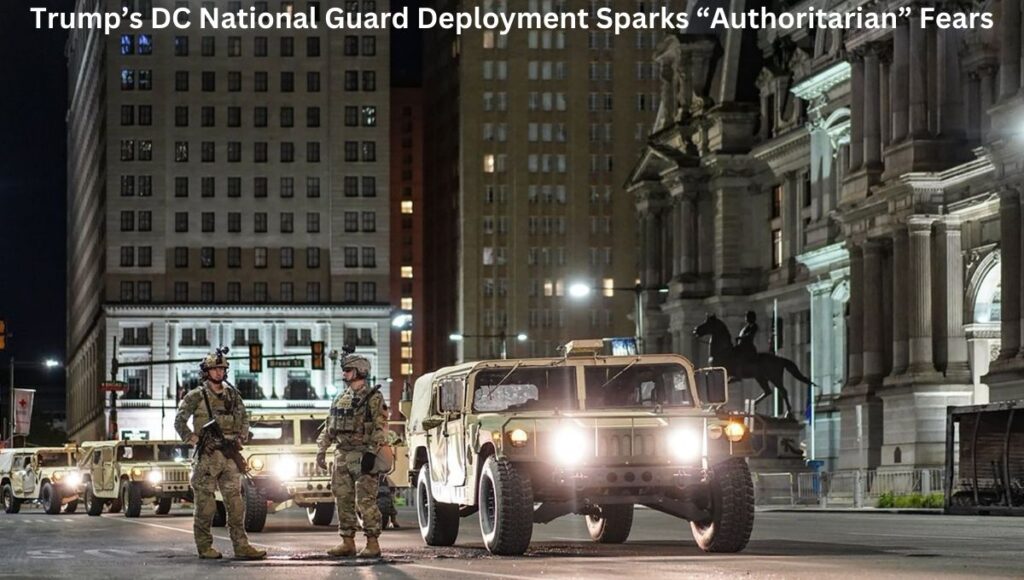
Trump’s DC National Guard Deployment Sparks “Authoritarian” Fears
Rachel Maddow: “Watch What They Do, Not What They Say”
On her Tuesday, August 12 broadcast, Rachel Maddow launched a fierce critique of Trump’s decision to federalize DC’s police department and deploy 800 National Guard troops to the capital.
Maddow accused the president of pushing an “authoritarian takeover” rather than focusing on public safety.
“Maybe he enjoys it,” Maddow said. “Maybe he really enjoys using US military force against American civilians on American soil and wants any excuse to do it anywhere he can. Watch what they do, not what they say.”
She also suggested the move was politically motivated an attempt to control the seat of federal power while projecting an image of strength.
Trump Declares Public Safety Emergency
On Monday, August 11, Trump declared a public safety emergency in Washington DC.
Standing alongside his attorney general, defense secretary, and FBI director, he announced the takeover of the Metropolitan Police Department for 30 days under the Home Rule Act.
The president justified the move by citing violent crime, homelessness, and what he described as “slums” in the capital.
“We’re going to take our capital back,” Trump told reporters.
According to the White House, the federal deployment includes:
- 800 National Guard troops
- 500 federal law enforcement agents
- Patrols near federal buildings and tourist sites
- Crackdowns on violent crime, gun offenses, and drug activity
Is DC Really in a Crime Crisis?
Mayor Muriel Bowser disputes the president’s characterization.
Official Metropolitan Police Department data shows a 35% drop in violent crime in 2024, reaching the lowest levels in three decades, and another 26% decline in the first seven months of 2025.
The FBI’s own numbers back up the downward trend.
However, DC Police Union Chairman Gregg Pemberton claims the city’s statistics are misleading and that residents are still suffering from high crime rates.
While Washington’s homicide rate remains above the national average for major cities, 2025’s numbers so far are on track to be significantly lower than in 2023, when violent crime spiked.
Legal Powers: What Trump Can and Cannot Do
Under the 1973 Home Rule Act, Washington DC has an elected mayor and city council but remains under congressional authority.
The president has unique powers over DC that he does not have over states, including:
- Control of the DC National Guard (without local approval)
- Temporary takeover of the Metropolitan Police Department during emergencies (limited to 30 days unless extended by Congress)
Trump invoked this provision citing “special conditions of an emergency nature.”
While he can deploy troops and federal agents, a full federalization of DC repealing home rule entirely would require an act of Congress and likely fail in the Democratic-controlled Senate.
Militarization Concerns and Historical Warnings
The sight of armored vehicles near the Capitol and National Guard troops setting up barricades has reignited fears about the militarization of US cities.
Former Trump administration officials including Defense Secretaries Jim Mattis and Mark Esper, former Joint Chiefs Chairman Mark Milley, and former Chief of Staff John Kelly have all warned against using the military in domestic law enforcement.
Mattis famously said in 2020 that militarizing responses “erodes the moral ground” between civilians and the armed forces.
Esper recounted Trump once asking why protesters couldn’t be shot “in the legs.” Milley even feared Trump could use troops to cling to power after the 2020 election, likening the danger to Germany’s Reichstag fire.
Muriel Bowser’s Response: “Protect Our Autonomy”
Mayor Bowser has been one of Trump’s most vocal critics on this issue, calling it an “authoritarian push.”
At a town hall on Tuesday, she urged residents to vote for a Democratic House majority to preserve DC’s home rule.
“We have to protect our city, protect our autonomy, and protect our home rule,” Bowser said.
The Homeless Encampment Crackdown
Trump’s public safety plan includes clearing homeless encampments, with 70 dismantled so far by the US Park Police.
Officials say displaced residents are being offered shelter and addiction treatment, but those who refuse could face fines or jail time.
Under federal law, the president can remove encampments from federally owned land such as parks and certain streets but cannot simply expel people from the city for being unhoused.
30 Days and Counting
Trump’s emergency control over the Metropolitan Police Department expires after 30 days unless Congress passes a joint resolution to extend it.
White House press secretary Karoline Leavitt says the administration will “reevaluate and reassess” at the end of the period.
Pattern of Deployments
This is not the first time Trump has deployed the National Guard to a major city during his presidency.
Two months ago, he sent troops to Los Angeles in what critics saw as a publicity move. He has also hinted at doing the same in New York and Chicago.
Rachel Maddow argues this is part of a broader effort to normalize military involvement in civilian law enforcement.
“We are now in the part of the attempted authoritarian takeover where our authoritarian leader just starts trying to turn our own military to face us,” she warned.
Supporters vs. Critics
Supporters of Trump’s move point to recent high-profile crimes in DC, including a homicide near Logan Circle just a mile from the White House, as proof the crackdown is necessary.
Critics argue it’s an unnecessary power grab that undermines democracy and blurs the line between civilian policing and military force.
Civil liberties advocates warn that once normalized, military policing could become a permanent fixture in American life.
The Bigger Picture: Public Safety or Power Play?
The clash between Trump’s justification for the National Guard deployment and the warnings from critics underscores a broader question is this truly about crime reduction, or is it a step toward authoritarian rule?
For now, the capital remains under an unusual federal security regime, with armed troops stationed in public spaces and local law enforcement operating under presidential control.
How history remembers this moment will depend on what happens in the coming weeks both in Washington DC and in the halls of Congress.
Also Read: Trump Seizes Control of DC Police, Deploys National Guard Amid Crime Debate
Also Read: Black D.C. Residents Say Trump’s Tactics Bring More Fear, Not Safety