Sparks controversy as Trump Seizes Control of DC Police, Deploys National Guard Amid Crime Debate. In an unprecedented move, President Donald Trump has invoked emergency powers to place Washington, D.C.’s Metropolitan Police Department under direct federal control, deploying 800 National Guard troops to the capital. The decision, announced on Monday, August 11, is framed by the White House as a decisive action to tackle violent crime and homelessness despite official data showing that crime in D.C. is currently at its lowest level in 30 years.
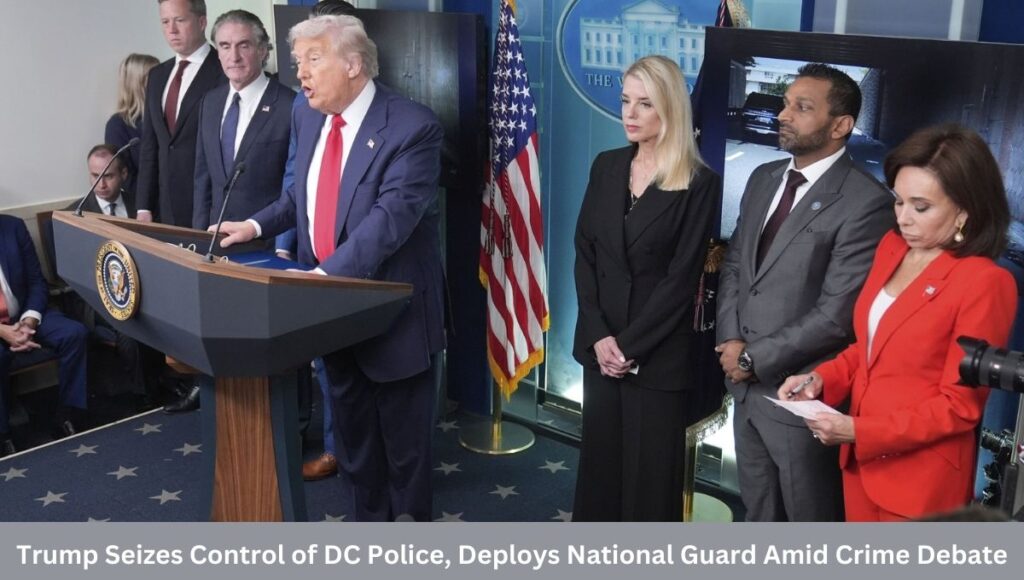
Standing alongside Attorney General Pam Bondi and Defense Secretary Pete Hegseth, Trump described Washington as having been “overtaken by violent gangs, bloodthirsty criminals, roving mobs of wild youth, drugged-out maniacs, and homeless people.” He vowed to restore “law and order” through the use of extraordinary presidential powers.
Trump Seizes Control of DC Police, Deploys National Guard Amid Crime Debate
Invoking the Home Rule Act: Trump’s Legal Basis
The president cited Section 740 of the District of Columbia Home Rule Act of 1973, a provision allowing the president to assume control of the city’s police force if “special conditions of an emergency nature exist.”
While D.C.’s 700,000 residents elect a mayor and city council, the federal government retains unique authority over the district.
“This is Liberation Day in DC, and we’re going to take our capital back,” Trump said in a 78-minute press conference, confirming that Attorney General Bondi will oversee the police department during the federal control period.
Mayor Muriel Bowser immediately challenged the move, insisting that Metropolitan Police Chief Pamela Smith remains in charge of the force. “Nothing about our organisational chart has changed,” Bowser told reporters.
National Guard Deployment Details
Trump’s plan calls for 800 National Guard troops to assist with logistics, transportation, and security operations across the city.
According to Defense Secretary Pete Hegseth, between 100 and 200 soldiers will be on active duty at any given time.
The troops will serve under Title 32 status, meaning they remain technically under local command but are federally funded.
This arrangement allows them to assist law enforcement without violating the Posse Comitatus Act, which restricts military involvement in domestic policing.
While soldiers are not expected to openly carry rifles during routine patrols, Hegseth confirmed that they will have weapons nearby for self-defense.
Crime Data Challenges the Narrative
The president’s grim portrayal of Washington, D.C., as a crime-ridden city stands in contrast to official statistics.
Data from the D.C. Metropolitan Police Department shows:
- Violent crime fell 35% between 2023 and 2024.
- Homicides dropped 12% so far in 2025.
- Assaults with dangerous weapons declined 20% in 2025 to date.
Nationwide, FBI data indicates a 4.5% drop in violent crime in 2024 compared to the previous year, suggesting D.C.’s trend mirrors a broader national decline.
Mayor Bowser emphasized that “violent crime is now at a 30-year low,” arguing that the real need is more resources for prosecutors rather than a military presence.
The Edward Coristine Incident
One incident that reportedly influenced the president’s decision was the August 3 attack on Edward Coristine, a former staffer for the Department of Government Efficiency and close associate of Elon Musk.
Police say Coristine and his partner were assaulted by a group of ten teenagers; two 15-year-olds were arrested.
Following the attack, Trump posted on Truth Social, warning that the federal government might take over if the city didn’t “get its act together.”
Homelessness and Public Order Measures
Trump also announced that the mission will include the removal of street encampments and a crackdown on homelessness in the capital.
While details remain vague, Defense Secretary Hegseth confirmed that the National Guard will “stand alongside law enforcement” in clearing public spaces and maintaining order.
Civil rights advocates have expressed concern over what they call “militarized homelessness sweeps,” warning that such measures risk criminalizing poverty rather than addressing root causes.
Federal vs. Local Authority
Under the Home Rule Act, the president’s emergency control over D.C.’s police is limited to 48 hours without congressional notification and up to 30 days with it.
Trump has already signaled that he will formally notify Congress to extend the takeover.
Legal scholars say the move could set a precedent for future federal interventions in U.S. cities raising concerns about the balance of power between local governance and presidential authority.
Supporters and Critics React
Reaction to Trump’s DC police takeover has been sharply divided:
- Supporters argue that federal intervention is necessary to “restore order” and protect both residents and government institutions.
- Critics see it as a dangerous overreach of presidential power, with some calling it a “soft launch of authoritarianism.”
Greggory Pemberton, chairman of the D.C. Police Union, backed the president’s move, telling Fox News, “Something needs to be done.”
Political Theater or Security Measure?
Some analysts suggest the move may be more about political optics than crime prevention.
By portraying Washington as unsafe, Trump positions himself as a strong leader taking bold action where local officials supposedly fail.
Karen Bass, mayor of Los Angeles, warned that the capital could be a “test case” for federal control of other cities. “The president can say, ‘We can take over your city whenever we want,’” she cautioned.
Timing and International Optics
The announcement comes days before Trump’s scheduled meeting with Russian President Vladimir Putin.
Critics note that authoritarian leaders often consolidate control over their capitals to project strength abroad.
Trump himself said it was “embarrassing” to discuss America’s “unsafe” capital with foreign leaders.
His statement that police are now “allowed to do whatever the hell they want” drew praise from conservative outlets but condemnation from civil rights groups.
Link to Other Controversies
The federal takeover coincides with mounting criticism of Trump’s Justice Department and FBI leadership over unreleased Jeffrey Epstein case files, a campaign promise yet to be fulfilled.
Standing alongside Bondi and FBI chief Kash Patel, Trump presented a united front a move some see as diverting attention from those controversies.
Historical Parallels
Historians note that leaders who deploy troops to their own capitals often do so as an early show of centralized authority.
Trump’s move echoes previous moments in U.S. history when federal force was used in cities including his own deployment of Marines in Los Angeles during immigration raids.
Political historian references to Alexander Hamilton’s Federalist No. 1 warn that demagogues can end up as tyrants, a comparison some critics have drawn in light of recent events.
Looking Ahead: Temporary Operation or Lasting Precedent?
For now, Mayor Bowser has adopted a cautious stance, calling the move “unsettling and unprecedented” but avoiding direct confrontation with federal authorities.
If the takeover ends within the legally allowed period, it may fade into history much like Trump’s brief Los Angeles deployment. But if extended or repeated in other cities it could fundamentally alter the balance of power between local governments and the presidency.
As National Guard trucks prepare to roll into the capital’s streets, the debate over crime statistics, political motives, and presidential powers is far from over. Whether Washington, D.C. truly faces an emergency or is caught in a political storm remains at the center of America’s most heated national conversation.
Also Read: Trump’s DC National Guard Deployment Sparks “Authoritarian” Fears
Also Read: Trump deploys National Guard to Washington DC and pledges crime crackdown