Cracking down on homelessness, Trump Orders Homeless Eviction from Washington DC, Considers National Guard Deployment. United States President Donald Trump has intensified his tough stance on crime and homelessness in Washington DC, ordering that homeless residents “move out immediately” and signaling a broader federal crackdown. In a fiery post on Truth Social, Trump declared that homeless people would be relocated “far from the Capital” and criminals would be jailed, promising swift action to “make our Capital safer and more beautiful than it ever was before.”
“The Homeless have to move out, IMMEDIATELY. We will give you places to stay, but FAR from the Capital. The Criminals, you don’t have to move out. We’re going to put you in jail where you belong,” Trump wrote. The president’s post included photographs of tents, litter-strewn sidewalks, and makeshift shelters, depicting parts of DC that he said represent an unacceptable state for the nation’s capital.
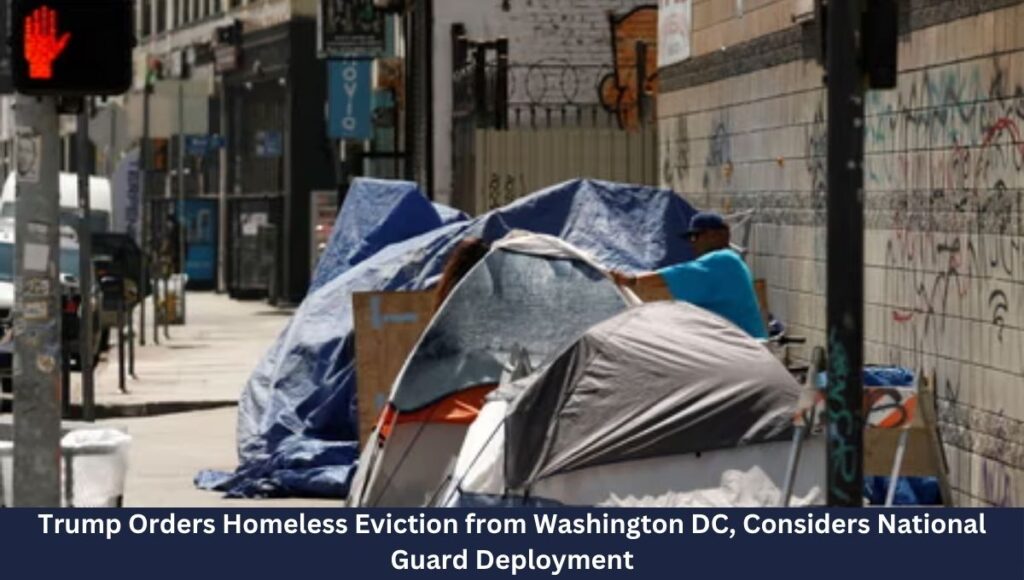
Trump Orders Homeless Eviction from Washington DC, Considers National Guard Deployment
Mayor Bowser Pushes Back: “No Crime Spike in DC”
Washington DC Mayor Muriel Bowser, a Democrat, pushed back against Trump’s claims, saying the city is “not experiencing a crime spike.”
Speaking on MSNBC’s The Weekend, she highlighted official figures showing that violent crime dropped 35% in 2024 compared to 2023, reaching the lowest level in three decades, with a further 26% decline in the first seven months of 2025.
Bowser stressed that the city has worked tirelessly to bring down crime rates, crediting coordinated efforts between local and federal law enforcement.
She also took issue with White House Deputy Chief of Staff Stephen Miller’s comparison of DC to Baghdad, calling it “hyperbolic and false.”
Federal Law Enforcement Surge in DC
Trump’s directive follows his recent order to flood Washington DC with federal law enforcement officers.
According to the White House, about 450 federal officers including members of the US Park Police, FBI, Drug Enforcement Administration, and US Marshals Service were deployed over the weekend.
Federal agents were tasked with addressing various offenses, from unlicensed firearm possession to dirt bike riding on city streets.
The deployment was partly triggered by the violent assault of a 19-year-old former Department of Government Efficiency employee, an incident that visibly angered Trump and spurred his demand for immediate action.
Trump Weighs National Guard Deployment
In addition to increased federal patrols, Trump is considering activating hundreds of National Guard troops for deployment in Washington DC.
According to Reuters, the US military is on standby, awaiting the president’s final decision.
Two US officials, speaking anonymously, said the troops could be used to protect federal personnel or handle administrative duties, freeing up law enforcement for active patrols.
Mayor Bowser acknowledged Trump’s authority over the DC National Guard but questioned whether such a deployment would be an “efficient use of resources,” especially given the city’s recent decline in crime.
Legal Authority Under Scrutiny
The White House has declined to specify what legal authority Trump would use to forcibly remove homeless individuals from the city.
As president, Trump’s jurisdiction is largely limited to federal land and buildings in Washington DC.
Bowser noted that the president could assume greater control over the Metropolitan Police Department only under very specific conditions, none of which she says currently exist.
For Trump to federalize the city’s governance, Congress would likely need to pass legislation rolling back DC’s local autonomy a controversial move that would require significant political maneuvering.
Homelessness in DC: The Numbers
Data from The Community Partnership for the Prevention of Homelessness indicates that on any given night, about 3,782 individuals in Washington DC experience homelessness.
Most are in emergency shelters or transitional housing, while roughly 800 remain unsheltered.
These numbers are lower than pre-pandemic levels, contradicting claims of a homelessness crisis spiraling out of control.
Washington DC ranks 15th among major US cities for its homeless population, according to government statistics from last year.
Trump’s Past Proposals on Homeless Relocation
Trump’s current proposal echoes remarks he made in 2022, when he suggested building “high-quality” tent facilities on inexpensive land outside major cities.
These facilities, he said, would include access to restrooms, food services, and medical care.
Critics have argued such plans risk isolating vulnerable populations and could lead to legal challenges over human rights concerns.
Supporters, however, claim it could help clean up city streets while still offering basic care to the homeless.
Political Tensions and Public Backlash
Advocacy groups and DC residents have reacted strongly to Trump’s remarks. The nonprofit Free DC has already announced plans for a protest to coincide with Trump’s upcoming press conference.
They accuse the administration of stigmatizing homelessness rather than addressing underlying causes like housing affordability and mental health support.
Some political analysts believe Trump’s crackdown is partly a political strategy aimed at highlighting urban decay in Democratic-led cities an issue he frequently raised during his first term.
Others see it as a direct challenge to local governance, especially in cities historically at odds with Republican administrations.
Crime Data Tells a Different Story
Despite Trump’s repeated assertions of rising crime, official statistics paint a different picture.
The Metropolitan Police Department reports that overall crime is down about 7% in 2025 compared with last year, while violent crime has dropped sharply.
Federal data released in January showed that 2024 was DC’s safest year in three decades when combining statistics on assault, robbery, and carjacking.
The one caveat: homicide rates remain relatively high, with 98 homicides recorded so far in 2025, keeping DC among the top US cities for per-capita murder rates.
National Guard Deployment Precedents
Trump’s threat to deploy the National Guard to DC is not without precedent.
In June, he directed California’s National Guard to assist with immigration enforcement in Los Angeles a move that sparked controversy and legal challenges.
Bowser has warned that deploying the Guard in DC without a clear, immediate threat could strain relations between local authorities and the federal government.
Constitutional and Federal Control Issues
Washington DC has a unique political structure. As a federal district, it is not a state and remains under partial congressional oversight.
While residents elect a mayor and city council, Congress retains authority over the district’s budget and can override local laws.
Trump has previously expressed frustration over this arrangement, suggesting he would prefer the White House have the final say in city governance a stance that has fueled speculation about potential moves to curtail DC’s home rule.
Monday Press Conference: High Expectations
Trump has scheduled a White House news conference at 10:00 EDT (14:00 GMT) on Monday, promising to announce measures to “stop violent crime” and improve the city’s “cleanliness.”
Whether he will provide specific details about his homeless relocation plan remains to be seen.
His remarks are expected to draw both intense support and fierce opposition, given the charged political and humanitarian implications.
The Road Ahead: Legal Battles and Public Opinion
Any attempt to forcibly remove homeless individuals from Washington DC would almost certainly face legal challenges. Civil rights organizations are likely to contest mass relocation orders, especially if they target individuals on public rather than federal land.
Meanwhile, the prospect of deploying the National Guard for non-emergency urban management could trigger debates about the militarization of domestic law enforcement.
With tensions high and public opinion sharply divided, the coming weeks will reveal whether Trump’s plan is an achievable policy shift or a political flashpoint that fuels further division.
Also Read: Pentagon Withdraws 2,000 National Guard Troops From Los Angeles Amid Ongoing Immigration Raids