

Setting clear boundaries, Zelensky Rejects Land Swap Ahead of Trump-Putin Alaska Peace Talks. Ukrainian President Volodymyr Zelensky has delivered a direct message to both Washington and Moscow ahead of one of the most anticipated diplomatic events of the year: Ukraine will not give up its land in exchange for peace.
The statement comes just days before U.S. President Donald Trump and Russian President Vladimir Putin are set to meet in Alaska on August 15, 2025, for high-stakes negotiations aimed at ending the war that has raged since February 2022. The Alaska summit is already being called a pivotal moment one that could redefine the geopolitical balance in Eastern Europe.
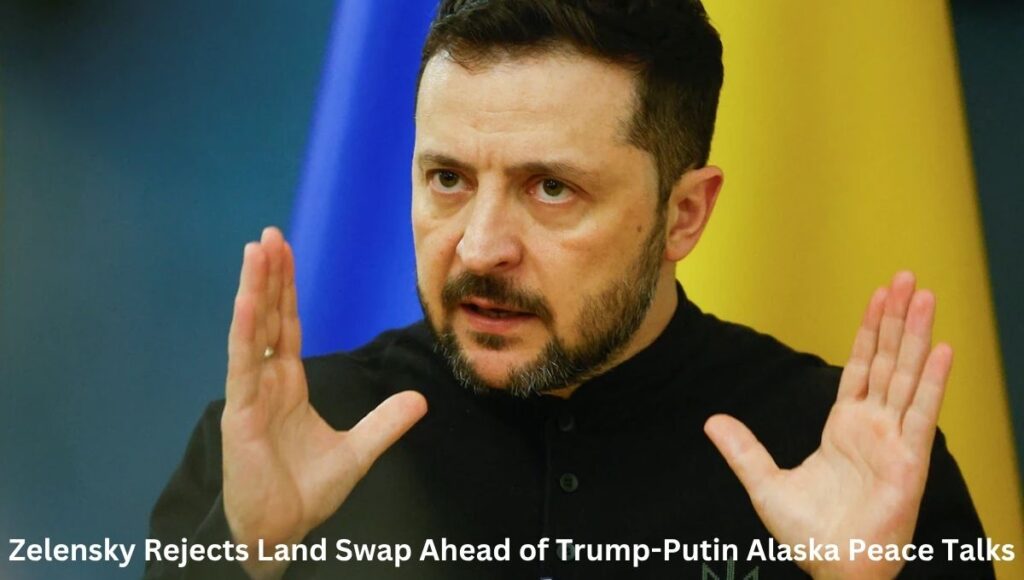
Zelensky Rejects Land Swap Ahead of Trump-Putin Alaska Peace Talks
Trump Suggests “Territorial Swaps” Could Be on the Table
President Trump has hinted at the possibility of “swapping territories to the betterment of both” Ukraine and Russia as part of a ceasefire plan.
While he did not provide specifics, reports from Bloomberg suggest the proposal could allow Russia to retain control of territories seized during its invasion.
Such a move would be deeply controversial in Kyiv, where ceding around 20% of the nation’s land including strategic and resource-rich regions is considered politically and morally unacceptable.
Kremlin Signals Openness to “Long-Term Resolution”
The Kremlin confirmed that the Alaska meeting will focus on “options for achieving a long-term peaceful resolution to the Ukrainian crisis.” Putin’s aide, Yuri Ushakov, admitted the process will be “challenging” but said Moscow is committed to “active and constructive dialogue.”
Russia claims sovereignty over the regions of Luhansk, Donetsk, Zaporizhzhia, and Kherson, as well as Crimea, annexed in 2014.
However, its forces do not fully control all of these territories, leaving the issue of borders a key sticking point in negotiations.
Zelensky: “We Will Not Gift Our Land”
In a firm address to the Ukrainian people, Zelensky rejected any idea of a territorial trade-off.
“We will not allow this second attempt to partition Ukraine. Knowing Russia, where there is a second, there will be a third,” Zelensky said.
He accused Moscow of seeking to “legalize” its occupation under the cover of a peace deal and warned against a ceasefire that merely serves as a pause for Russia to regroup.
“What is needed now is not a pause in the killings, but a real, lasting peace. Not a ceasefire sometime in the future, in months, but immediately.”
Western Allies in the Loop Ahead of Talks
Ukraine has been working closely with Western partners in the lead-up to the summit. Zelensky’s chief of staff, Andriy Yermak, recently held discussions with officials from the United States, United Kingdom, France, Germany, Italy, Finland, and Poland to coordinate positions.
Zelensky described these consultations as “constructive” and aimed at forming a “united diplomatic front.”
He stressed that any settlement must be made “together with Ukraine” and must prioritize the restoration of full sovereignty.
Tensions Over U.S. Approach to Peace
While Trump has alternated between praising and criticizing Putin since returning to office in January, his administration has also taken economic measures against Russia.
Recently, Washington imposed a 25% tariff on Indian imports in response to India’s purchase of Russian oil the first indirect financial penalty aimed at Moscow during Trump’s second term.
Last week, Trump’s special envoy, Steve Witkoff, met with Putin in Moscow for three hours of what both sides described as “constructive” talks.
Meanwhile, Polish Prime Minister Donald Tusk a strong supporter of Kyiv suggested that a “freeze” in the conflict might be close, though he stopped short of predicting a full peace agreement.
Why Alaska Matters for This Summit
The choice of Alaska as the venue carries historical symbolism. Once part of the Russian Empire before its sale to the United States in 1867, Alaska represents both shared history and strategic geography.
Hosting the talks there sends a message of neutrality and historical closure but also positions the U.S. as the central broker in the peace process.
For Trump, securing a deal would be a major diplomatic win. For Putin, it’s a chance to consolidate territorial gains.
For Zelensky, it’s about protecting Ukraine’s future and preventing the conflict from becoming a frozen war.
Analysts Warn Against “Quick Fix” Solutions
International policy experts warn that a rushed agreement involving territorial concessions could undermine both Ukrainian sovereignty and international law.
Tyson Barker, a senior fellow at the Atlantic Council and former U.S. State Department official, told Bloomberg that Ukraine’s best approach is to “remain firm in their objections and their conditions for a negotiated settlement, while showing gratitude for American support.”
A deal that legitimizes Russian occupation, analysts say, would likely embolden other territorial aggressions worldwide and weaken the global order.
Zelensky’s Non-Negotiable Conditions
As the summit draws near, Zelensky is holding firm to three key demands:
- Immediate Ceasefire – Ending hostilities without delay.
- Complete Withdrawal of Russian Forces – Including Crimea and all occupied territories.
- Restoration of Ukraine’s Sovereignty – Without compromise on borders.
“The path to peace for Ukraine must be determined together with Ukraine this is fundamental,” Zelensky reiterated. “Ceasefire. End of occupation. End of war.”
With the eyes of the world on Alaska, the outcome of this summit could either open the door to genuine peace or mark another missed opportunity in a conflict that has already claimed hundreds of thousands of lives.
Also Read: Trump, Putin to Meet in Alaska Friday for High-Stakes Ukraine War Talks
Also Read: Ukraine’s European allies say peace talks must include Kyiv
Related Posts:
- 7 Critical Reasons the Donbas Is the Most Explosive…
- Putin’s Shocking Risks Ahead of Trump–Hungary Summit 2025

- Impacts of the Trump-Putin Call on Ukraine’s 2025 Strategy

- Trump’s 20-Point Gaza Peace Plan Gains Urgent Global…

- 11 Explosive Revelations From Ted Cruz’s Leaked…

- 7 Powerful Signals US-Ukraine Peace Talks Are…
