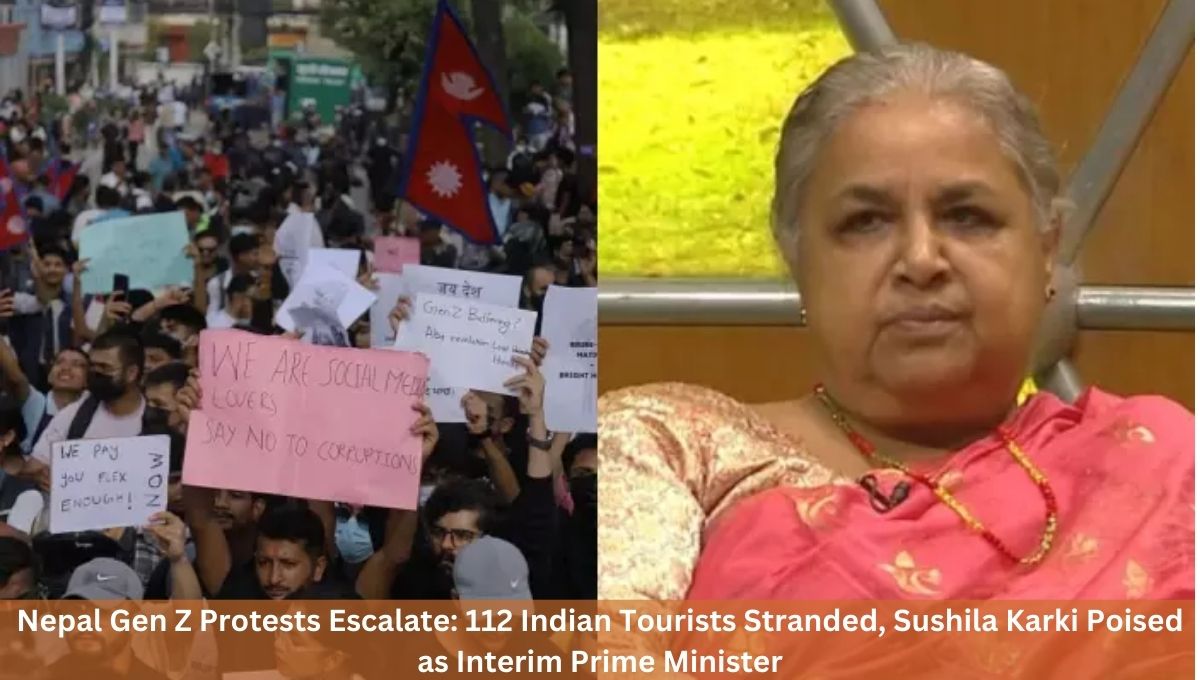
In its worst political crisis in years, Nepal Gen Z Protests Escalate: 112 Indian Tourists Stranded, Sushila Karki Poised as Interim Prime Minister. Nepal is witnessing one of the worst political crises in recent history as youth-led “Gen Z” protests have brought down Prime Minister KP Sharma Oli’s government, leaving at least 30 people dead and more than 1,000 injured.
The demonstrations, triggered by a controversial ban on social media platforms, quickly transformed into a broader anti-government movement against corruption, economic inequality, and political mismanagement.
Amid this turmoil, 112 Indian tourists from Maharashtra’s Thane district remain stranded in Kathmandu and Pokhara, appealing for urgent evacuation as violent protests grip the Himalayan nation.
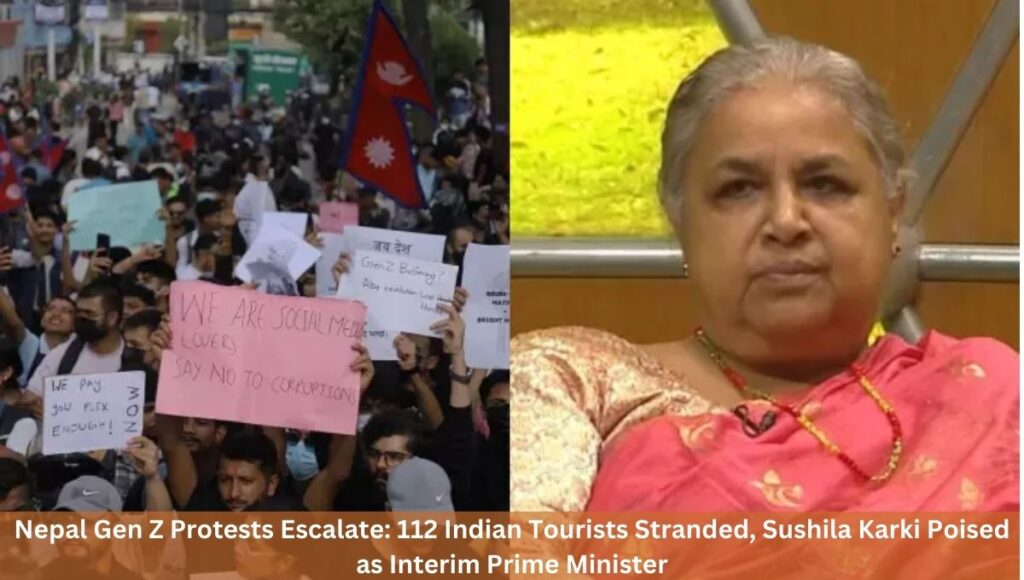
At the same time, former Chief Justice Sushila Karki has emerged as the protesters’ choice to lead Nepal’s interim government, symbolizing a generational shift in the country’s politics.
Nepal Gen Z Protests Escalate: 112 Indian Tourists Stranded, Sushila Karki Poised as Interim Prime Minister
112 Indian Tourists from Thane Stranded in Nepal
As protests spread across Nepal, Indian citizens caught in the chaos have expressed deep concern for their safety.
According to Murbad MLA Kisan Kathore, a group of 112 tourists from Murbad taluka in Thane district has been stranded since early this week.
- 47 tourists are sheltering in a hotel in Kathmandu, where the protests have been most violent.
- 65 others are staying in Pokhara, another major protest hub where several hotels were torched.
In a video call with Kathore, the tourists described their ordeal, highlighting the terrifying situation on the ground. With curfews, arson attacks, and violent clashes erupting around them, the stranded tourists urged the Maharashtra government to ensure immediate evacuation.
Kathore confirmed that he has spoken to Chief Minister Devendra Fadnavis and the Thane district collector, requesting urgent steps for the group’s safe return.
Nepal’s Gen Z Protests: From Social Media Ban to Full-Scale Uprising
The unrest began on September 8, 2025, when the government imposed a sweeping ban on social media platforms, citing tax and cybersecurity concerns.
But what started as online activism quickly spilled into the streets, spearheaded by Nepal’s Gen Z youth, who saw the ban as symbolic of deeper issues—corruption, nepotism, and lack of opportunities.
Escalation of Violence
- Protests spread rapidly across Kathmandu, Pokhara, Butwal, and Birgunj.
- Government buildings, including the Supreme Court, Parliament, and ministers’ homes, were set ablaze.
- Even Prime Minister KP Sharma Oli’s private residence was attacked.
- Over 7,000 prisoners reportedly escaped nationwide during the chaos.
- At least five juvenile inmates were killed in clashes with police.
By Thursday, Nepal’s Health Ministry confirmed 30 deaths and over 1,033 injuries.
Security forces resorted to tear gas, rubber bullets, and curfews in Kathmandu and surrounding areas, but the protests only intensified.
Also Read: Nepal Blocks Facebook, Instagram, YouTube and X: Ban Sparks Outrage, Press Freedom Concerns
KP Sharma Oli Resigns as Prime Minister
Facing mounting pressure, Prime Minister KP Sharma Oli resigned on Tuesday, acknowledging that his government had lost the trust of the people.
His departure marks a major political turning point, with Nepal’s leadership now in the hands of the army and youth-led protest groups, who are negotiating to form an interim administration.
Sushila Karki: Protesters’ Choice for Interim Prime Minister
The most striking development of the crisis has been the emergence of Sushila Karki, Nepal’s first female Chief Justice (2016–2017), as the leading candidate to head the interim government.
Chosen by Gen Z protesters, Karki is seen as a symbol of integrity and accountability in contrast to the country’s discredited political elite.
Who is Sushila Karki?
- Born in Biratnagar, near the India-Nepal border.
- Completed her master’s degree in political science at Banaras Hindu University (BHU), Varanasi in 1975.
- Rose through the judicial ranks to become Nepal’s first female Chief Justice.
- Known for her anti-corruption stance and constitutional role in 2006 reforms.
Speaking to CNN-News18, Karki expressed gratitude for the youth’s trust, saying:
“I am humbled by their faith. The people of Nepal, especially the youth, have entrusted me with a great responsibility.”
Karki’s Ties with India and Views on PM Modi
Karki also emphasized her longstanding ties with India.
- She described herself as a “friend of India”, recalling her years in Varanasi.
- She fondly remembered the Ganga river, BHU teachers, and Indian classmates.
- In Hindi, she said:
“Main Modi ji ko namaskar karti hoon. I have a good impression of Modi ji.”
Karki stressed that while government-to-government relations may face challenges, the people-to-people bond between India and Nepal remains strong.
She assured safety for Indian citizens in Nepal and promised justice for victims of the protests.
Kathmandu Mayor Balendra Shah (Balen): Another Popular Youth Leader
Another figure who has emerged during the crisis is Kathmandu Mayor Balendra Shah, popularly known as Balen.
- At 35 years old, he is considered one of the most popular leaders among Nepalese youth.
- Balen completed his M.Tech in Structural Engineering from Nitte Institute of Technology, Karnataka, India (2016–2018).
- He became the first independent mayor of Kathmandu in 2022.
While Balen has voiced strong support for Karki, he has declined to lead an interim government himself, insisting he would only contest leadership through elections.
In a Facebook post, he wrote:
“This is an unprecedented moment. I respect the wisdom of our youth. I support the choice of Sushila Karki.”
Rising Casualties and Security Measures
The death toll of 30 and over 1,000 injuries make these protests Nepal’s deadliest in years.
The army has imposed curfews, with soldiers patrolling Kathmandu to prevent further violence.
Flights at Kathmandu’s Tribhuvan International Airport were suspended for more than 24 hours before resuming.
- Air India operated the first inbound flight.
- Nepal Airlines operated the first outbound evacuation flight.
India’s Civil Aviation Ministry has asked Air India and IndiGo to run extra flights between Delhi and Kathmandu to evacuate stranded Indians.
India, China, and Global Reactions
India’s Response
Prime Minister Narendra Modi appealed for peace, urging Nepal’s citizens to act with restraint. He also assured that Indian authorities are coordinating to ensure the safety and evacuation of stranded citizens.
China’s Reaction
Beijing expressed hope for the restoration of social order and stability, given Nepal’s strategic location between India and China.
Former King’s Statement
Former monarch King Gyanendra condemned the bloodshed, calling it “against the values of peace-loving Nepali society,” while voicing support for the youth’s anti-corruption cause.
Public Anger and the “Nepo Babies” Outrage
One of the biggest triggers for public frustration has been the exposure of Nepal’s political elite’s children, widely referred to as “Nepo Babies” on social media.
Photos and stories of their lavish lifestyles sparked anger among young Nepalis struggling with unemployment and poverty.
This widened the protests from a social media ban into a movement against systemic corruption, favoritism, and inequality.
Outlook: Nepal at a Crossroads
Nepal now stands at a critical juncture.
- If Sushila Karki assumes the role of interim Prime Minister, she would be the first woman to lead the country in a political capacity.
- The Gen Z-led movement has shifted the country’s political dynamics, sidelining traditional parties in favor of independent and youth-backed figures.
- For India, ensuring the safe evacuation of citizens remains an urgent priority, alongside maintaining stable ties with a changing Nepalese leadership.
The coming days will determine whether Nepal can restore peace and stability—or descend deeper into political turmoil.
Conclusion
The Gen Z protests in Nepal have toppled a government, claimed 30 lives, injured over 1,000, and left 112 Indian tourists stranded in the middle of unprecedented unrest.
With Sushila Karki poised to lead as interim Prime Minister, the crisis also signals a potential new chapter in Nepal’s political history—one shaped not by the old guard, but by the demands and aspirations of its youth.
As India and other neighbors monitor developments closely, the immediate focus remains on restoring order, ensuring humanitarian safety, and charting a democratic path forward for Nepal.
Related Posts:
- Nepal’s Gen Z Protests Push Sushila Karki and Kulman…

- Sushila Karki Sworn In as Nepal’s First Woman Prime…

- 9 Powerful Reasons Why Balen Shah’s Victory Could…

- Kathmandu Airport Reopens after Nepal Gen Z Protests…

- 10 Explosive Shifts: Nepal Votes in First Election…
- 7 Shocking Developments in KP Sharma Oli Arrest Over…