
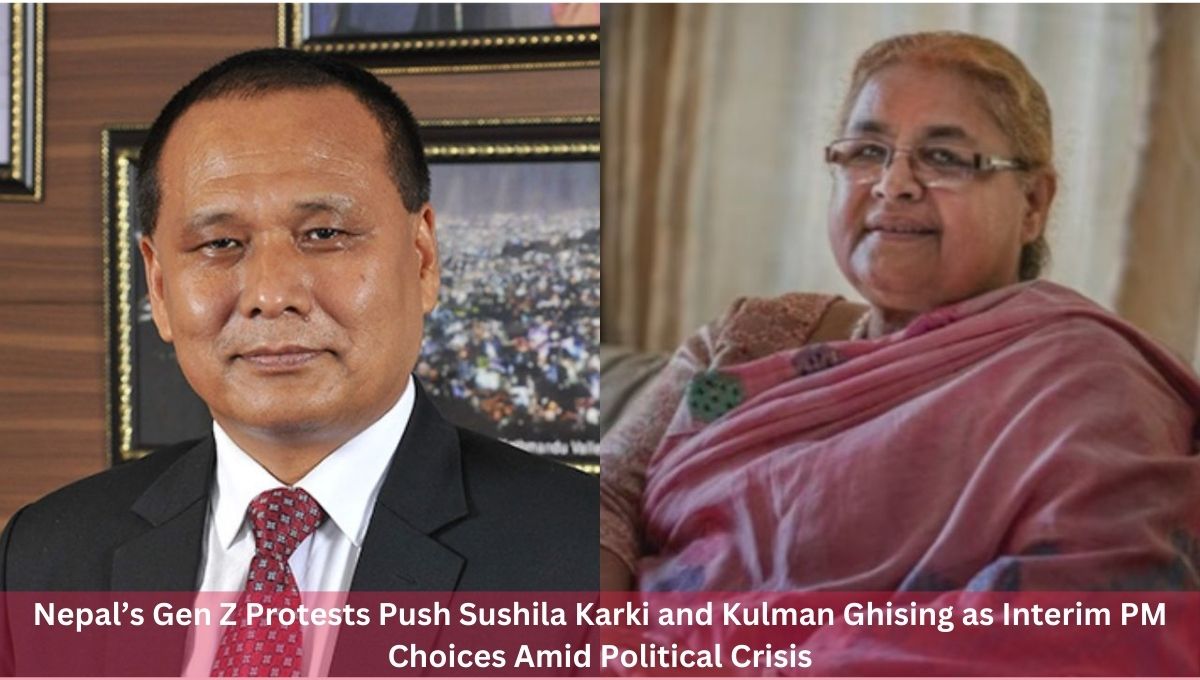
Facing a leadership crossroads, Nepal’s Gen Z Protests Push Sushila Karki and Kulman Ghising as Interim PM Choices Amid Political Crisis. Nepal is witnessing one of the most turbulent chapters in its political history. What began as student-led protests against a controversial social media ban has now evolved into a full-blown political movement demanding accountability, reform, and an interim government.
The wave of demonstrations, spearheaded by Generation Z activists, has already claimed at least 31 lives, injured more than 1,400 people, and forced the resignation of Prime Minister KP Sharma Oli. At the heart of the ongoing crisis is a leadership question: who will guide Nepal through this volatile period as interim Prime Minister?
Two names have emerged at the forefront—former Chief Justice Sushila Karki, celebrated for her integrity and anti-corruption stance, and Kulman Ghising, a former electricity authority chief credited with ending chronic power shortages in the country. As protesters, political actors, and the Nepal Army weigh the options, the choice of Nepal’s next interim leader has become a defining moment in shaping the nation’s democratic future.
Nepal’s Gen Z Protests Push Sushila Karki and Kulman Ghising as Interim PM Choices Amid Political Crisis
The Spark: Social Media Ban and Gen Z Mobilization
The crisis was triggered on Monday after the Oli government abruptly imposed a ban on major social media platforms. Intended to curb dissent, the move backfired spectacularly.
Thousands of young Nepalese, frustrated with systemic corruption and disillusioned by decades of political instability, took to the streets.
The protests escalated rapidly. Demonstrators clashed with security forces, government buildings were set ablaze, and lawmakers’ residences were attacked. By the fourth day, Kathmandu Valley was under curfew.
While the ban was eventually revoked, the movement had already transcended its original cause, transforming into a youth-led revolution against entrenched political elites.
Generation Z, digitally connected and politically awakened, emerged as the driving force. Their demand was clear: a corruption-free interim government to oversee free and fair elections.
KP Sharma Oli’s Resignation
Facing mounting pressure from protesters and unable to restore order, Prime Minister KP Sharma Oli stepped down. Oli, a four-time PM and veteran communist leader, had become a lightning rod for public anger. His resignation marked a rare instance where a grassroots youth movement forced the ouster of a sitting leader.
However, his departure created a political vacuum. With parliament fragmented, the army stepping in to maintain order, and protesters rejecting the traditional political class, the search for an interim leader began.
Sushila Karki: The Anti-Corruption Icon
Early Life and Career
Born on June 7, 1952, in Biratnagar, Morang district, Sushila Karki broke barriers by becoming Nepal’s first female Chief Justice. A graduate of Mahendra Morang College, she pursued a Master’s in Political Science from Banaras Hindu University (BHU) in India before completing her law degree at Tribhuvan University in Nepal.
Her time at BHU left a lasting impression. She fondly recalled her teachers, late friends, and the River Ganga during a CNN-News18 interview, highlighting her academic and cultural ties with India.
Judicial Legacy
Karki was widely respected for her uncompromising integrity and resistance to political interference. Yet, in 2017, she was controversially removed from her position as Chief Justice just months before retirement by then-PM Pushpa Kamal Dahal ‘Prachanda’ and a bloc of MPs.
That dismissal, seen by many as an attack on judicial independence, ironically cemented her reputation as a fearless defender of rule of law.
Why Gen Z Wants Karki
For Nepal’s protesting youth, Karki represents a break from the corrupt, male-dominated old guard. She has no political party affiliation, boasts a spotless record, and is seen as a guardian of the Constitution.
One protester, Sujit Kumar Jha, told Reuters:
“We see Sushila Karki for who she truly is – honest, fearless, and unshaken. She is the right choice. When truth speaks, it sounds like Karki.”
Another youth activist, Ojaswi, said:
“Our country getting a first woman PM will be a beautiful thing. We want to choose her because she can help us build this nation.”
The Constitutional Hurdle
Despite widespread support, Karki’s candidacy faces legal obstacles. Nepal’s 2015 Constitution prohibits retired judges from holding executive positions outside the judiciary. Critics also point to her age—73—as a factor against her leading a youth-driven movement.
Still, many argue legitimacy outweighs legality in times of crisis. As senior lawyer Dinesh Tripathi put it:
“More than legality, it is legitimacy that needs to be considered at this unprecedented time.”
Kulman Ghising: The Power Sector Reformer
Profile and Achievements
Kulman Ghising, born November 25, 1970, in Bethan, Ramechhap, is a respected technocrat who rose to prominence as the Managing Director of the Nepal Electricity Authority (NEA). An electrical engineer by training, he studied at the Regional Institute of Technology in Jamshedpur, India, and at Pulchowk Engineering College in Nepal before earning an MBA.
Ghising is celebrated for eliminating crippling load-shedding in Kathmandu Valley, ending years of daily power cuts that had plagued households and businesses. His leadership transformed him into a household name and a symbol of competent governance.
Dismissal and Political Independence
In March 2025, Ghising was dismissed from his role after disagreements with Energy Minister Deepak Khadka, who reportedly disliked his independent style. Despite his ouster, Ghising retained his credibility among the public.
Why Gen Z Considers Him
Many protesters see Ghising as a practical leader with proven management skills. His record of delivering results without political baggage appeals to youths demanding accountability and competence.
A Gen Z faction recently stated:
“Kulman Ghising should lead the interim cabinet in Nepal. He is a patriot and everybody’s favourite.”
Also Read: Who is Kulman Ghising? Nepal PM frontrunner who’s known for ending power shortages
Other Names in Contention
Balendra Shah (Balen)
Kathmandu’s mayor and rapper-engineer Balen Shah initially emerged as a top choice. Loved by the youth for his outsider status, he, however, declined interest in the premiership, later endorsing Karki.
Durga Prasai
Businessman and pro-monarchy figure Durga Prasai has the support of sections of the Army. Although he declared he was not seeking leadership, he left the door open for future possibilities.
Santosh Pariyar
The Rastriya Swatantra Party (RSP) Chief Whip, Santosh Pariyar, was also floated as an option. A Dalit representative, his nomination would mark historic inclusivity, but he lacks widespread recognition among protesters.
Harka Sampang
Mayor of Dharan and anti-corruption activist, Harka Sampang, was considered by a small group but quickly ruled out as “not competent enough” by protest leaders.
Gen Z vs. The Establishment
Army’s Role
The Nepal Army has emerged as a powerful arbiter. Army Chief Ashok Raj Sigdel has held multiple meetings with protest leaders, sometimes including pro-monarchy figures like Durga Prasai. Critics fear this signals creeping military control.
President’s Position
President Ram Chandra Paudel has called for patience, stressing that solutions must remain within the constitutional framework. Yet, his reluctance to directly engage with protesters has fueled suspicions of him being constrained by the military.
Protesters’ Demands
Despite internal debates, Gen Z remains united on three fronts:
- An interim government led by a clean, independent leader
- Preservation of the 2015 Constitution
- Elections under strict accountability mechanisms
As one protester said:
“We protested not because social media was banned, but to end corruption. When our homes are infested by cockroaches, we use insecticides. Our protest aims to remove corrupt leaders.”
Growing Uncertainty and Clashes Within Protests
While initial enthusiasm favored Sushila Karki, divisions have emerged. A faction now argues that constitutional barriers and her age make Kulman Ghising a better fit.
These disagreements have sparked clashes—not between protesters and security forces, but among the protesters themselves.
Still, the unifying theme is rejection of the political old guard. Leaders like KP Sharma Oli, Pushpa Kamal Dahal ‘Prachanda,’ and Sher Bahadur Deuba have vanished from public view, swept aside by youth anger.
International Dimension
Nepal’s crisis has drawn global attention. India, given Karki’s BHU background and Ghising’s Jamshedpur education, is closely watching developments. China and Western nations have yet to comment extensively, but concerns over instability in the Himalayan republic are rising.
What Happens Next?
Interim Government Dilemma
Nepal’s Constitution does not explicitly provide for an interim government. Typically, a new PM must come from a parliamentary majority, failing which the President may appoint a caretaker until elections. This ambiguity has complicated efforts to formalize an interim administration.
The Choice Between Karki and Ghising
- Karki represents integrity and symbolic change—Nepal’s first woman PM and a corruption-free figure.
- Ghising offers technocratic competence and broad acceptability, especially with factions wary of constitutional hurdles.
Elections and the Road Ahead
Whoever becomes interim PM will face the daunting task of restoring calm, conducting elections, and ensuring the Constitution remains intact. The youth-led demand for sweeping reform is likely to dominate Nepal’s politics for months, if not years, to come.
Conclusion
Nepal stands at a crossroads. The Gen Z movement has already reshaped the nation’s political discourse, toppling a sitting prime minister and forcing institutions to reckon with demands for integrity and accountability.
Whether the next interim leader is Sushila Karki, the fearless former Chief Justice, or Kulman Ghising, the reformer who ended power cuts, the choice will define Nepal’s immediate future. For now, the only certainty is that Nepal’s restless youth have altered the country’s trajectory, proving that a new generation is unwilling to accept the corruption and dysfunction that has long plagued its democracy.
Related Posts:
- Nepal Gen Z Protests Escalate: 112 Indian Tourists…

- Sushila Karki Sworn In as Nepal’s First Woman Prime…

- 10 Explosive Shifts: Nepal Votes in First Election…
- 9 Powerful Reasons Why Balen Shah’s Victory Could…

- 7 Shocking Developments in KP Sharma Oli Arrest Over…
- Nepal Lifts Social Media Ban Amid Youth Protests,…
