Netanyahu Vows ‘There Will Be No Palestinian State’ as Israel Advances Controversial E1 West Bank Settlement, drawing sharp global condemnation. Israeli Prime Minister Benjamin Netanyahu has reignited global controversy by declaring that there will never be a Palestinian state while signing an agreement to move forward with the contentious E1 settlement project in the occupied West Bank.
Speaking during a highly publicized visit to Maale Adumim, one of Israel’s largest settlements east of Jerusalem, Netanyahu vowed to expand housing, double the city’s population, and safeguard what he called Israel’s “heritage, land, and security.” The decision marks one of the most decisive blows yet against the two-state solution, long endorsed by the United Nations and much of the international community as the only path to peace between Israelis and Palestinians.
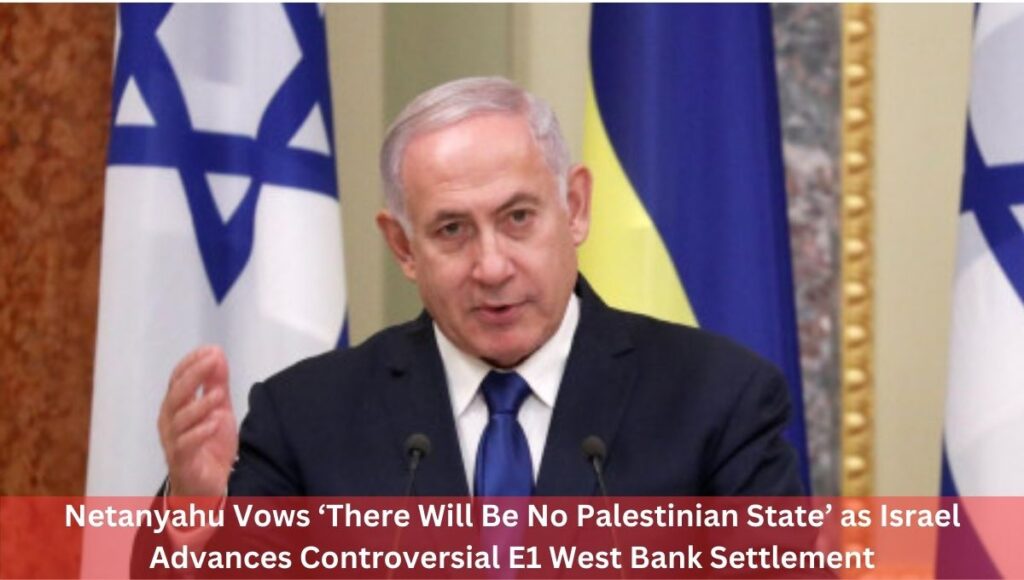
Netanyahu Vows ‘There Will Be No Palestinian State’ as Israel Advances Controversial E1 West Bank Settlement
“This Place Is Ours”: Netanyahu’s Defiant Message
At the signing ceremony, Netanyahu was unequivocal:
“There will never be a Palestinian state. This place is ours. We will safeguard our heritage, our land, and our security.”
He framed the expansion as both a fulfillment of his government’s promises and a guarantee of Israel’s permanent control over the strategically sensitive corridor east of Jerusalem.
Netanyahu further pledged to double Maale Adumim’s population through the construction of thousands of new housing units, a move that would cement Israeli dominance in the area.
The event, streamed live by the Prime Minister’s Office, featured nationalist coalition members, including Finance Minister Bezalel Smotrich, who has openly advocated for the annexation of the West Bank.
The E1 Settlement Project: A Long-Contested Plan
What Is the E1 Area?
The E1 zone (short for “East 1”) covers roughly 12 square kilometers (4.6 square miles) of land between Jerusalem and Maale Adumim. Israel has long sought to develop this area, but international opposition has kept the plan largely frozen since 2012.
The Current Plan
The newly signed agreement calls for the construction of 3,400 housing units, alongside major roads and infrastructure upgrades, with an estimated cost of nearly $1 billion.
Israeli NGO Peace Now, which tracks settlement expansion, warned last week that infrastructure work could begin within months, with actual housing construction starting within a year.
Why It’s So Controversial
If implemented, the project would:
- Bisect the West Bank, severing the north from the south.
- Isolate East Jerusalem from the rest of Palestinian territory.
- Make a contiguous Palestinian state geographically impossible.
As UN Secretary-General Antonio Guterres warned:
“The settlement would cleave the West Bank in two and pose an existential threat to a contiguous Palestinian state.”
International Law and Settlements
Global Consensus
According to the Fourth Geneva Convention, it is illegal for an occupying power to transfer its civilian population into occupied territory.
The UN Security Council has repeatedly reaffirmed that all Israeli settlements in the West Bank have no legal validity.
Israel’s Position
Israel disputes this interpretation, arguing that:
- The West Bank was not under recognized sovereignty before 1967, so the Geneva Convention does not apply.
- Israelis who move into settlements do so voluntarily, not through government “transfer.”
Nonetheless, the vast majority of the international community continues to view the settlements as illegal and a major obstacle to peace.
Global Response: Condemnation and Threats of Recognition
Western Allies Losing Patience
Several Western governments, already frustrated with Israel’s conduct in Gaza, have indicated that Netanyahu’s move could accelerate their recognition of Palestinian statehood.
- Britain and France have both said they may officially recognize Palestine at the upcoming UN General Assembly if Israel refuses a Gaza ceasefire.
- Belgium, Malta, and France have pledged recognition at the gathering.
- Germany announced support for a France-Saudi-backed “New York Declaration”, calling for Palestinian statehood and refugee rights.
The United Nations
In September 2024, the UN General Assembly demanded that Israel:
- End its presence in the West Bank.
- Halt all new settlement activity.
- Withdraw its settlers.
Earlier, in July 2024, the International Court of Justice (ICJ) ruled that Israel’s continued presence in occupied territory was unlawful and that it must “cease immediately” all settlement activity. Netanyahu dismissed the ICJ’s ruling as a “decision of lies.”
Regional Reaction
The Palestinian Authority strongly condemned the expansion. Presidential spokesperson Nabil Abu Rudeineh declared:
“A Palestinian state with East Jerusalem as its capital is inevitable. Netanyahu is pushing the entire region towards the abyss.”
Also Read: Hamas Rejects Disarmament Claims, Demands Palestinian Statehood First
Gaza War and Escalating Violence
The Gaza Context
Netanyahu’s settlement announcement comes amid Israel’s ongoing war in Gaza. Since October 2023, Israeli bombardments have killed over 64,000 Palestinians and wounded more than 163,000, according to health officials.
The war was triggered by Hamas’ October 7 attacks, which left around 1,200 Israelis dead and more than 250 hostages taken.
Recent Violence in Jerusalem and West Bank
- September 2025: Two Palestinian gunmen killed six people at a bus stop in Jerusalem’s Ramot Junction.
- Israeli forces responded by demolishing the suspects’ homes and arresting nearly 100 men in Tulkarem.
The escalating violence underscores how the settlement expansion is fueling instability not only in Gaza but also across the West Bank.
Netanyahu’s Qatar Strike and “September 11” Remarks
Just days before announcing the settlement project, Israel launched a strike in Doha, Qatar, targeting Hamas leaders.
The strike killed five people, including a Qatari security agent, but failed to eliminate the intended Hamas figures.
In his remarks, Netanyahu compared Hamas’ October 7 attacks to the September 11, 2001 attacks in the U.S.:
“We remember September 11. We also have a September 11… Yesterday, we acted along those lines. We went after the terrorist masterminds who committed the October 7 massacre.”
He warned Qatar and other nations sheltering Hamas leaders:
“You either expel them or bring them to justice. Because if you don’t, we will.”
The strike sparked backlash from Qatar and Western allies, with U.S. President Donald Trump saying he was “very unhappy about every aspect” of the operation.
Bezalel Smotrich and the Far-Right Agenda
Netanyahu’s coalition includes powerful far-right figures like Finance Minister Bezalel Smotrich, who recently declared:
“A Palestinian state is being erased from the table, not with slogans but with actions.”
Smotrich argues that settlements like E1 are key to ensuring that a Palestinian state “never materializes.”
Other coalition partners have openly pushed for annexing the West Bank outright, signaling a hard-right shift in Israeli politics.
Historical Context: Netanyahu vs. Palestinian Statehood
Netanyahu’s rejection of a Palestinian state is not new.
- In the 1990s, he opposed the Oslo Accords, which were designed to pave the way for Palestinian statehood.
- In 2001, he was caught on video boasting: “I de facto put an end to the Oslo Accords.”
- During his first term as PM in 1997, Netanyahu authorized the creation of the Har Homa settlement in East Jerusalem.
More than two decades later, his stance remains unchanged: no Palestinian state under his watch.
Also Read: Western bids to recognise a Palestinian state put Israel first
Implications for the Two-State Solution
The two-state solution envisions an independent Palestinian state in the West Bank, East Jerusalem, and Gaza, coexisting alongside Israel.
But by advancing the E1 project, Netanyahu’s government has effectively:
- Undermined territorial continuity for Palestine.
- Deepened international isolation.
- Risked long-term instability across the Middle East.
As Israeli NGO Peace Now warned:
“The E1 plan is deadly for the future of Israel and for any chance of achieving a peaceful two-state solution.”
Conclusion
Benjamin Netanyahu’s vow that “there will never be a Palestinian state”, coupled with the advancement of the E1 settlement project, represents one of the clearest rejections yet of the two-state solution.
For Palestinians, the expansion means further land loss, severed communities, and diminishing hopes of independence. For Israel, it risks deepening global isolation as key allies weigh recognition of Palestinian statehood. With violence continuing in Gaza and the West Bank, and with far-right ministers doubling down on annexationist rhetoric, the conflict shows no sign of de-escalating.
Instead, Netanyahu’s gamble on E1 may go down as the moment that pushed the decades-old Israeli-Palestinian conflict into an even more uncertain and volatile chapter.