
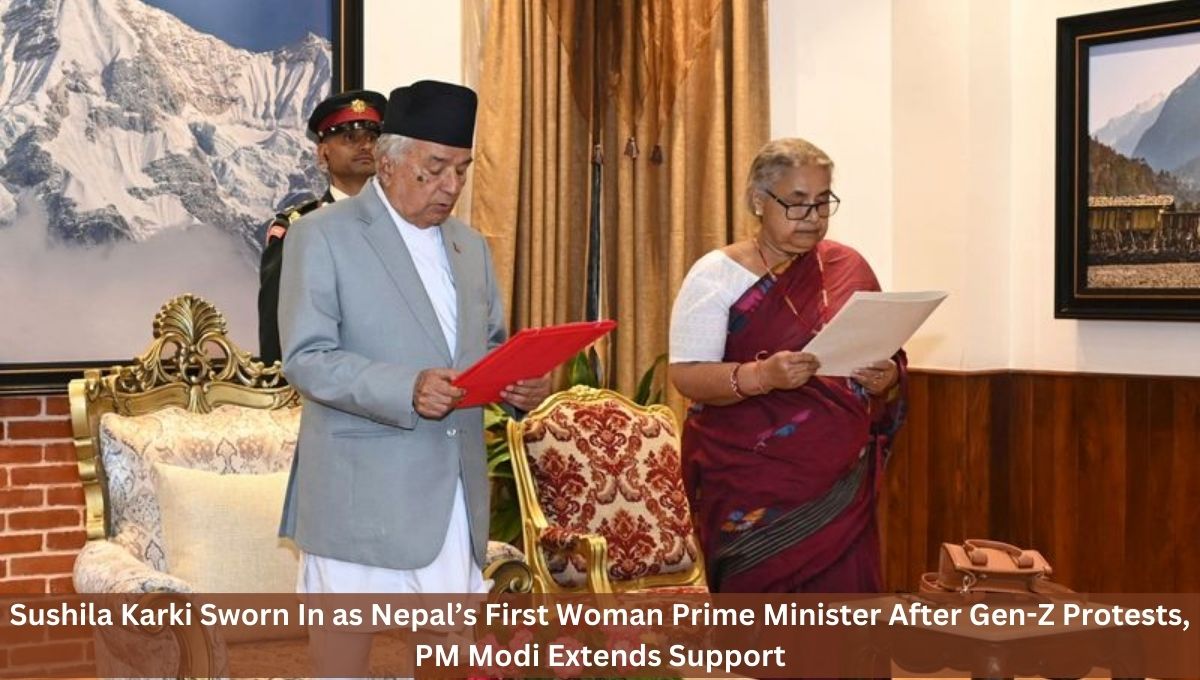
Historic moment for Nepal: Former Chief Justice Sushila Karki Sworn In as Nepal’s First Woman Prime Minister After Gen-Z Protests, PM Modi Extends Support. Nepal has entered a new political chapter with the swearing-in of Sushila Karki as the country’s first woman Prime Minister. At 73, Karki, a former chief justice known for her integrity and zero-tolerance stance on corruption, took the oath of office on September 12, 2025, ending days of political turmoil.
Her appointment comes after nationwide Gen-Z-led protests forced the resignation of Prime Minister KP Sharma Oli, whose government collapsed following an unpopular social media ban and allegations of corruption and authoritarianism.
The swearing-in ceremony, held at Sheetal Niwas in Kathmandu, was administered by President Ramchandra Paudel and attended by senior judges, top military officials, diplomats, and political leaders. Outside the presidential office, jubilant crowds of young protesters celebrated Karki’s rise, waving flags and chanting slogans of change. President Paudel congratulated her warmly: “Hearty congratulations, you will succeed to save the country.”
Sushila Karki Sworn In as Nepal’s First Woman Prime Minister After Gen-Z Protests, PM Modi Extends Support
PM Modi’s Message of Support
Prime Minister Narendra Modi was among the first world leaders to congratulate Karki. In a message shared online, he wrote:
“I extend my best wishes to Right Hon. Mrs. Sushila Karki on assuming office as the Prime Minister of the Interim Government of Nepal. India remains firmly committed to the peace, progress, and prosperity of the people of Nepal.”
India’s Ministry of External Affairs echoed this sentiment, emphasizing the shared democratic values and deep historical ties between the two nations. “As a close neighbour, a fellow democracy, and a long-term development partner, India will continue to work closely with Nepal for the well-being and prosperity of our two peoples and countries,” the statement read.
Karki herself acknowledged India’s importance, recalling her own years as a student in Varanasi’s Banaras Hindu University (BHU). In a TV interview, she smiled: “First, I will say namaskaar to Modi ji. I have a good impression about him. India has always helped Nepal.”
The Gen-Z Protests That Toppled Oli
The road to Karki’s appointment was paved by a wave of youth-led protests that began in early September. Sparked by the Oli government’s decision to ban social media platforms in an attempt to curb dissent, the protests quickly escalated into the largest civilian uprising in Nepal in decades.
- Over 51 people were killed, including protesters, police, and bystanders.
- More than 1,700 were injured, with hospitals in Kathmandu struggling to handle the influx.
- Government buildings, including parts of parliament, were torched, and the residence of KP Sharma Oli was attacked.
Despite curfews and army deployment, the protests continued. Youth leaders organized resistance through encrypted messaging platforms like Discord, ensuring coordination even in the face of internet restrictions.
Ultimately, Oli resigned on September 9, paving the way for President Paudel, the army leadership, and protest representatives to seek consensus on an interim leader.
From Chief Justice to Prime Minister
Sushila Karki’s rise is remarkable given her background. She is not a career politician but a respected jurist, best known for becoming Nepal’s first woman Chief Justice in 2016.
Her legal career was defined by a fearless stance against corruption:
- She upheld the conviction of Information and Communications Minister Jaya Prakash Prasad Gupta in a corruption case.
- She challenged political interference in judicial matters, including rulings against powerful figures.
- In 2017, she faced an impeachment motion filed by lawmakers from Nepali Congress and CPN (Maoist Centre). Though suspended briefly, the motion was withdrawn after public outcry and Supreme Court intervention.
This reputation for independence and integrity made her the consensus choice for interim Prime Minister—acceptable both to the Gen-Z protest leaders and traditional political elites.
Early Life and India Connection
Born in 1952 in eastern Nepal into a farming family, Karki was the eldest of seven children. Her family had ties with Bishweshwar Prasad Koirala, Nepal’s first democratically elected prime minister.
Her education laid the foundation for her later prominence:
- 1972 – Bachelor of Arts from Mahendra Morang Campus.
- 1975 – Master’s in Political Science from Banaras Hindu University (BHU), India.
- 1978 – Bachelor of Laws from Tribhuvan University, Kathmandu.
Her time in India left deep impressions. She often recalls her student life in Varanasi—studying near the Ganga, sleeping on hostel terraces in summer, and forging lifelong friendships.
It was during her BHU years that she met Durga Prasad Subedi, her future husband, who later played a controversial role in the 1973 Nepal Airlines hijacking.
The Hijacking Episode
On June 10, 1973, Subedi and associates hijacked a domestic Nepal Airlines flight carrying 4 million Nepalese rupees (around $400,000 at the time). The plane was forced to land in Forbesganj, Bihar, with passengers, including Bollywood actress Mala Sinha, unharmed.
The funds were handed to Girija Prasad Koirala, later Nepal’s prime minister, and used to buy arms for the Nepali Congress’s anti-monarchy struggle. Subedi was jailed in India for two years before returning to Nepal.
This dramatic episode became part of Karki’s family history, linking her personal story to Nepal’s political upheavals.
Dissolution of Parliament and Upcoming Elections
Just hours after Karki took oath, Nepal’s parliament was dissolved on her recommendation. President Paudel announced that general elections will be held on March 5, 2026, with the interim government tasked to restore order and ensure free polls.
Karki’s mandate includes:
- Maintaining law and order in the aftermath of violent protests.
- Holding fair elections within six months.
- Rebuilding public trust in governance.
- Coordinating with international partners, including India, for economic and political stability.
Comparisons with Bangladesh
Karki’s selection has drawn parallels with Muhammad Yunus in neighbouring Bangladesh, who was appointed to lead an interim government in 2024 after student uprisings ousted Sheikh Hasina. Both represent a shift toward non-traditional leaders trusted by young movements demanding accountability and reform.
Voices From the Streets
Despite the destruction caused during the protests, many demonstrators expressed relief at Karki’s appointment.
- “Yes, this is my house, my college, now my country will also operate with the love, sacrifice, and affection of the mother,” one young woman posted on Facebook.
- Injured protester Liza Adhikari told Nepali media: “We did not destroy government property, nor was our intention. Political cadres caused the arson.”
The Gen-Z leadership has warned politicians not to hijack their movement: “This is purely a civilian movement, so don’t try to play politics with this,” one activist said.
India-Nepal Relations Under Karki
India and Nepal share deep cultural, economic, and strategic ties. From open borders to religious affinities, the relationship is multifaceted but often marked by friction.
Karki acknowledged this complexity: “When there are utensils in a kitchen, they make some sound. It happens. But there is so much goodwill, love between the people of India and Nepal.”
Her words reflect a commitment to balancing national sovereignty with neighbourly cooperation. For India, her appointment provides an opportunity to strengthen goodwill at a moment of instability in Nepal.
Challenges Ahead
Despite the optimism, Karki faces daunting challenges:
- Political Fragility – Balancing the expectations of Gen-Z protesters with traditional parties.
- Economic Recovery – Addressing unemployment and rebuilding infrastructure damaged in unrest.
- Law and Order – Preventing further clashes as the country transitions toward elections.
- Regional Diplomacy – Managing relations with India and China while safeguarding Nepal’s independence.
Her interim government’s success—or failure—will shape Nepal’s political trajectory for years to come.
A New Chapter for Nepal
As Nepal prepares for elections in March 2026, Sushila Karki’s appointment as interim Prime Minister symbolizes both a historic breakthrough for women in leadership and the power of grassroots youth movements to reshape national politics.
For many Nepalis, her rise offers hope of a corruption-free, democratic future, though much depends on how she navigates the treacherous months ahead. India’s support, Gen-Z’s expectations, and Nepal’s turbulent history all converge on this critical moment.
Karki’s leadership will be tested—but her reputation as a fearless judge and reformer may be exactly what Nepal needs in its fragile transition.
Also Read: Japan is set to choose its fourth PM in five years – who could be next?
Related Posts:
- Nepal’s Gen Z Protests Push Sushila Karki and Kulman…

- Nepal Gen Z Protests Escalate: 112 Indian Tourists…

- 7 Shocking Developments in KP Sharma Oli Arrest Over…
- 10 Explosive Shifts: Nepal Votes in First Election…
- 9 Powerful Reasons Why Balen Shah’s Victory Could…

- Kathmandu Airport Reopens after Nepal Gen Z Protests…
