
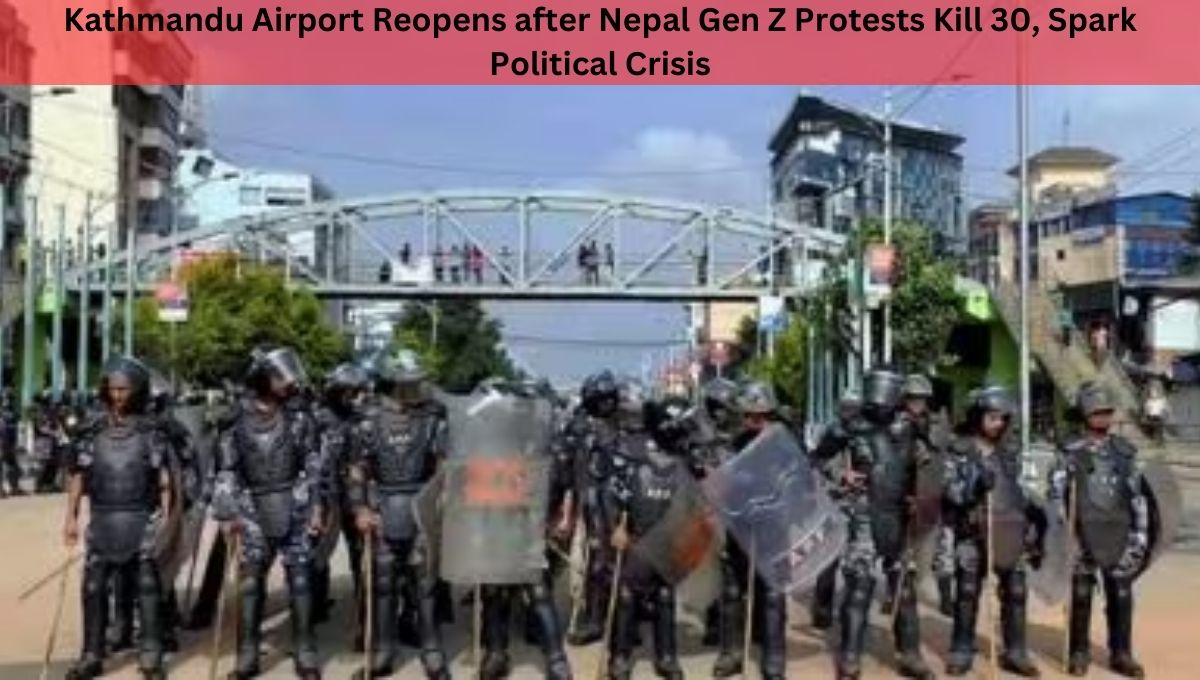
After 24 hours of closure, Kathmandu Airport Reopens after Nepal Gen Z Protests Kill 30, Spark Political Crisis. Kathmandu’s Tribhuvan International Airport reopened on Wednesday, just 24 hours after being shut down amid violent protests that rocked Nepal and led to the resignation of Prime Minister KP Sharma Oli. The protests, driven by Nepal’s youth-led “Gen Z” movement, left at least 30 people dead and over 1,000 injured, plunging the Himalayan nation into one of its worst crises in decades.
The reopening of the airport brings some relief for stranded passengers, including many Indian nationals, but the political turbulence shows no signs of easing as protesters demand sweeping reforms, an end to corruption, and greater accountability from the ruling class.
Kathmandu Airport Reopens after Nepal Gen Z Protests Kill 30, Spark Political Crisis
Kathmandu Airport Reopens After 24 Hours
The Civil Aviation Authority of Nepal (CAAN) announced the reopening of Tribhuvan International Airport, the country’s only international gateway, after an emergency meeting of the airport’s security committee.
“Flights suspended due to adverse circumstances would now be lifted, in accordance with the decision of the Tribhuvan International Airport Security Committee meeting,” the authority said in a statement.
Passengers were advised to contact airlines for updated schedules and carry proper identification before traveling.
During the unrest, Indian airlines Air India and IndiGo cancelled all flights to and from Kathmandu on September 9 and 10, citing safety concerns.
Dozens of Indians were left stranded as clashes between protesters and security forces escalated in Kathmandu and Pokhara.
Nepal Protests Turn Deadly: 30 Killed, Over 1,000 Injured
The protests, which began on September 8, 2025, over a controversial ban on social media platforms including Facebook, Instagram, YouTube, and X, quickly spiraled into a nationwide anti-government uprising.
Initially framed as a protest against censorship, the demonstrations expanded into a broad youth-led movement against corruption, nepotism, and lack of opportunities.
Security forces fired tear gas and rubber bullets, and in some cases live rounds, to disperse crowds. According to Nepal’s health ministry, the death toll has reached 30, while 1,033 people were injured, making it one of the deadliest civilian uprisings since the abolition of monarchy in 2008.
Leaders Attacked, Homes Set on Fire
The violent turn of events shocked the country. Protesters stormed and set fire to several government buildings, including Parliament, the Supreme Court, and the President’s office.
They also targeted the private homes of prominent leaders:
- Former Prime Minister Sher Bahadur Deuba and his wife, Foreign Minister Arzu Rana Deuba, were beaten by mobs. Videos showed both bleeding as supporters rushed them to safety.
- Former PM Jhala Nath Khanal’s wife, Rajyalaxmi Chitrakar, reportedly sustained severe burn injuries after their home was set ablaze in Dallu. Some reports said she succumbed to her injuries, though authorities have not confirmed.
- The private residence of KP Oli in Balkot was torched, along with properties belonging to President Ramchandra Paudel and other ministers.
- Deputy Prime Minister Bishnu Paudel was chased and assaulted by protesters.
The violence, which spread from Kathmandu to Pokhara, Birgunj, Butwal, and Nepalgunj, also destroyed businesses, including several hotels and even the Hilton in Kathmandu.
Gen Z Chooses Sushila Karki as Interim PM
With Prime Minister KP Sharma Oli resigning under pressure, the focus shifted to the question of leadership. In a historic development, protesters nominated former Chief Justice Sushila Karki as interim Prime Minister.
Karki, 73, was Nepal’s first female Chief Justice (2016–2017) and is known for her anti-corruption stance.
Speaking to Indian media, she said:
“I am humbled by the trust of Nepal’s youth. This is an unprecedented moment in our history. I urge all citizens to act with maturity and responsibility.”
Karki, an alumna of Banaras Hindu University (BHU), India, expressed her fondness for India and described herself as a “friend of India.” She recalled her days in Varanasi and expressed admiration for Prime Minister Narendra Modi, saying, “I greet Modi ji. I have a good impression of him.”
Her candidacy has also been endorsed by Kathmandu Mayor Balendra Shah (Balen), who himself is highly popular among youth but declined to accept an interim leadership role.
Who is Balendra Shah (Balen)?
Mayor Balendra Shah, popularly known as Balen, has emerged as another potential future leader.
- A civil engineer and rapper, he completed his M.Tech in Structural Engineering from Nitte Institute of Technology, Bengaluru, India (2016–2018).
- In 2022, he became Kathmandu’s first Independent mayor, riding a wave of youth support.
- During the crisis, he backed Sushila Karki’s nomination, urging protesters to focus on reforms and elections rather than anarchy.
His support highlights the generational shift in Nepal’s politics, where young leaders are challenging entrenched elites.
Anger Over Social Media Ban and Nepotism
The spark for the uprising was the ban on 26 major social media platforms, announced by the Oli government, citing cybersecurity and tax revenue concerns.
Though the ban was lifted after 19 deaths, the damage had been done. The Gen Z movement, largely mobilized online, accused leaders of corruption, nepotism, and indifference to public suffering.
The issue of “Nepo Babies” — the privileged children of politicians flaunting wealth online — further fueled resentment, as ordinary youths struggled with 20% unemployment and mass migration abroad for jobs.
India, China, and Global Leaders React
As the crisis deepened, world leaders appealed for calm:
- Prime Minister Narendra Modi urged Nepal’s citizens to maintain peace and assured assistance for stranded Indians.
- China expressed hope that “order and stability will be restored soon.”
- Former King Gyanendra condemned the violence but voiced support for the youth’s anti-corruption cause, hinting at pro-monarchy sentiments resurfacing.
Meanwhile, India’s Civil Aviation Ministry directed Air India and IndiGo to operate extra flights for evacuation once Kathmandu airport reopened.
Border Security Tightened in Uttar Pradesh
The unrest in Nepal triggered alarm in India, particularly in Uttar Pradesh, which shares a 600-km open border with Nepal.
The UP Police placed all seven border districts — Shravasti, Balrampur, Bahraich, Pilibhit, Lakhimpur Kheri, Siddharthnagar, and Maharajganj — on high alert.
- Patrolling was intensified by the Sashastra Seema Bal (SSB).
- Three emergency helpline numbers were launched to assist stranded Indians.
- Several escaped Nepali prisoners were caught crossing into India amid the chaos.
- Hundreds of Indian truckers were stranded at Sonouli and other border points due to curfews and mob violence.
Royal Massacre of 2001 Back in Spotlight
Amid the turmoil, memories of the 2001 Royal Palace Massacre, one of Nepal’s darkest moments, resurfaced.
On June 1, 2001, Crown Prince Dipendra killed King Birendra, Queen Aishwarya, and eight other royals before fatally shooting himself. Declared king while in a coma, Dipendra died three days later.
Former King Gyanendra, who took the throne afterward, has now resurfaced as a voice in the current unrest, calling for peace but indirectly benefiting from renewed pro-monarchy debates.
Conclusion: Nepal at a Crossroads
Nepal stands at a fragile crossroads. The Gen Z movement has proven its power, forcing out a sitting prime minister and shaping the choice of an interim leader.
But challenges remain enormous: restoring order, preventing further violence, rebuilding trust in governance, and meeting the aspirations of a restless youth population.
The reopening of Kathmandu Airport symbolizes a tentative return to normalcy, but the streets of Nepal — scarred by flames, blood, and chants for change — reveal a nation in deep transformation
Also Read: Worried Migrants Head Home from India as Nepal’s Gen Z Protests Spiral into Political Turmoil
Related Posts:
- Nepal Gen Z Protests Escalate: 112 Indian Tourists…

- 7 Shocking Developments in KP Sharma Oli Arrest Over…
- 9 Powerful Reasons Why Balen Shah’s Victory Could…

- Nepal’s Gen Z Protests Push Sushila Karki and Kulman…

- 10 Explosive Shifts: Nepal Votes in First Election…
- Sushila Karki Sworn In as Nepal’s First Woman Prime…
