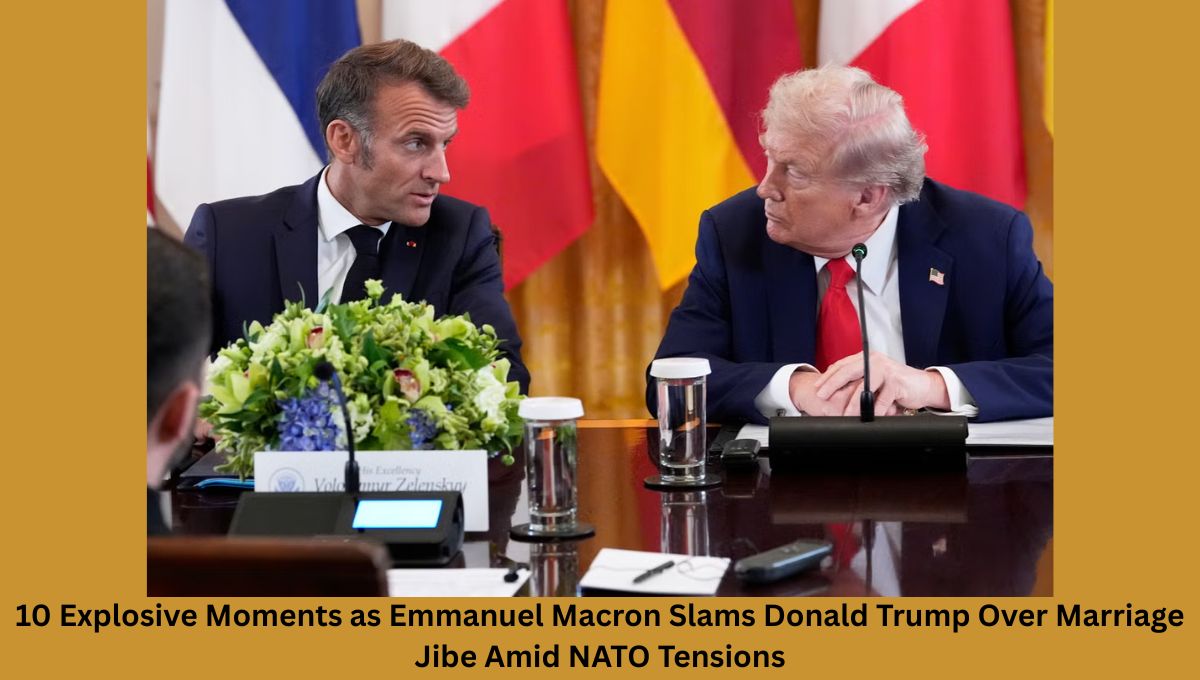
10 Explosive Moments as Emmanuel Macron Slams Donald Trump Over Marriage Jibe Amid NATO Tensions at private Washington lunch. Tensions between Emmanuel Macron and Donald Trump have escalated sharply after a series of controversial remarks by Trump that veered into personal territory. What began as disagreements over geopolitical strategy—particularly regarding the Iran conflict and NATO cooperation—has now evolved into a deeply personal and public war of words.
Macron’s response was measured yet firm. Speaking during an official visit to South Korea, he described Trump’s comments about his marriage as “neither elegant nor up to standard,” signaling both disapproval and a refusal to fully engage in personal attacks.
This episode highlights not just a clash of personalities, but a widening transatlantic divide over global security, diplomacy, and leadership norms.
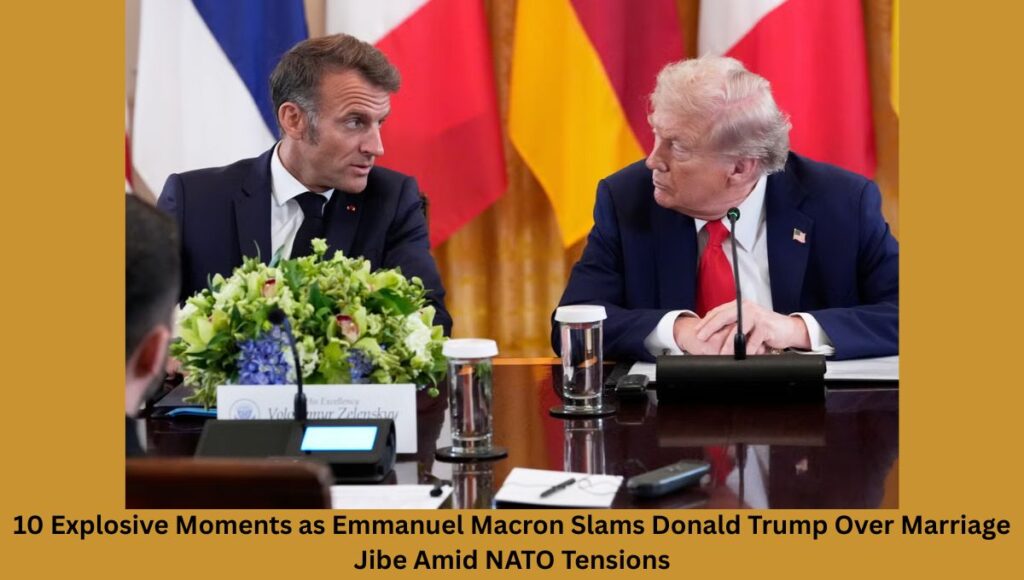
10 Explosive Moments as Emmanuel Macron Slams Donald Trump Over Marriage Jibe Amid NATO Tensions
What Exactly Did Trump Say?
The controversy stems from remarks made by Donald Trump during a private lunch in Washington, D.C., where he criticized NATO allies and mocked Macron personally.
Trump reportedly said:
- Macron’s wife “treats him extremely badly”
- He joked that Macron was “still recovering from the right to the jaw”
- He mimicked a French accent while recounting a conversation about military support
The remarks referenced a viral 2025 video involving Brigitte Macron, which appeared to show a playful moment that was later framed by some as controversial.
Macron had previously dismissed that footage as part of a disinformation campaign.
Trump’s comments were widely seen as crossing a diplomatic line—moving from policy criticism into personal mockery.
Macron’s Response: Measured but Firm
Responding to reporters, Emmanuel Macron chose not to escalate the rhetoric.
Instead, he delivered a restrained yet pointed critique:
- He called Trump’s remarks “not elegant”
- He said they were “not up to standard”
- He added that they “do not merit a response”
Despite this, Macron did not remain entirely silent.
He used the moment to emphasize a broader message:
“This is not a show. We are talking about war and peace.”
This statement underscores Macron’s attempt to redirect attention back to serious geopolitical issues, particularly the ongoing tensions in the Middle East.
The Iran Conflict: Core of the Dispute
At the heart of the disagreement lies the ongoing Iran conflict and the role of Western allies.
US Position
The United States, under Donald Trump, has taken an aggressive military stance, including:
- Strikes on Iranian-linked targets
- Calls for allied naval support in the Persian Gulf
- Pressure on NATO partners to contribute more actively
France’s Position
France, led by Emmanuel Macron, has taken a more cautious approach:
- Supporting regional defense deployments
- Avoiding direct participation in offensive operations
- Advocating for diplomacy and de-escalation
Macron has explicitly rejected military action to forcibly reopen the Strait of Hormuz, calling it “unrealistic” and dangerous.
NATO Under Fire
Another major flashpoint is Trump’s criticism of NATO.
During his remarks, Trump:
- Called NATO a “paper tiger”
- Questioned whether allies would support the US in a major conflict
- Suggested the alliance may not be reliable in a “big one”
These statements have alarmed European leaders, including Macron, who warned that:
“If you create doubt every day about your commitments, you hollow out its substance.”
This exchange reflects a deeper strategic divide over the future of NATO and collective defense.
France’s Strategic Position in the Middle East
Despite refusing direct involvement in US-led operations, France is not disengaged.
French Actions Include:
- Deploying jets and air defense systems in the Gulf
- Stationing naval assets near Cyprus
- Protecting allied nations in the region
However, France has drawn a clear line:
- No participation in offensive strikes
- No use of French airbases for US bombing missions
- Emphasis on diplomatic solutions
This approach places France closer to other European powers like Spain and Italy, which have also resisted deeper military involvement.
Political Backlash in France
Trump’s remarks triggered strong reactions across the French political spectrum.
Key Reactions:
- Yaël Braun-Pivet criticized the comments as inappropriate during a time of global crisis.
- Manuel Bompard called them “absolutely unacceptable,” despite being a critic of Macron.
What’s notable is the rare unity in France—both allies and opponents of Macron defended him against Trump’s personal attack.
Personal Attacks vs Diplomatic Norms
Traditionally, international diplomacy maintains a clear boundary between:
- Policy disagreements (acceptable)
- Personal attacks (generally avoided)
Trump’s remarks blurred this line, raising concerns about:
- The erosion of diplomatic decorum
- The personalization of international disputes
- The potential long-term impact on alliances
Macron’s restrained response can be seen as an attempt to preserve institutional norms despite provocation.
A History of Macron–Trump Relations
The relationship between Emmanuel Macron and Donald Trump has always been complex.
Early Phase:
- Warm public interactions
- Highly publicized handshakes symbolizing power dynamics
- Cooperation on certain global issues
Recent Phase:
- Increasing disagreements on trade, NATO, and foreign policy
- Public and private tensions becoming more visible
- Shift from strategic rivalry to personal friction
This latest episode marks a new low in their relationship.
Broader Implications for Global Politics
The Macron–Trump clash is not just a bilateral issue—it has wider implications.
Key Concerns:
- Transatlantic Unity
- Growing divide between the US and European allies
- Reduced coordination on global crises
- NATO’s Future
- Questions about collective defense commitments
- Potential weakening of alliance credibility
- Middle East Stability
- Diverging strategies on Iran
- Risk of prolonged conflict without unified approach
- Diplomatic Standards
- Increasing normalization of personal rhetoric in global politics
Macron’s Core Message: Focus on Peace
Despite the controversy, Emmanuel Macron has consistently emphasized:
- De-escalation in the Middle East
- The need for a ceasefire
- The importance of diplomatic engagement
His remarks reflect a broader European stance that prioritizes stability over military escalation.
Conclusion: More Than Just Words
The clash between Emmanuel Macron and Donald Trump is more than a personal dispute—it is a reflection of deeper geopolitical fractures.
Trump’s remarks may have sparked the controversy, but the underlying issues—NATO’s role, the Iran conflict, and transatlantic relations—are far more consequential.
Macron’s response, while restrained, signals a firm stance:
global leadership must rise above personal attacks, especially in times of crisis.
As tensions continue to unfold, the world will be watching closely—not just what leaders say, but how they act in shaping the future of international diplomacy.
Also Read: “Macron Mocked Over Viral ‘Face Shove’ by Wife Brigitte as Kremlin Joins in on Controversy”
Also Read: ‘Doesn’t Merit Response’: Emmanuel Macron On Trump’s Marriage Jibe
Related Posts:
- 5 Powerful Highlights as Trump Lands Second Nobel…

- Trump’s 2025 Gaza Peace Plan Signing and Historic…

- 7 Crucial Insights Into Trump and Xi’s High-Stakes…
- 9 Explosive Revelations as Trump Declares His Health…
- Trump's 3 Blunt Warnings to China and Russia Over…
- Trump Threatens Military Action in Nigeria Over…