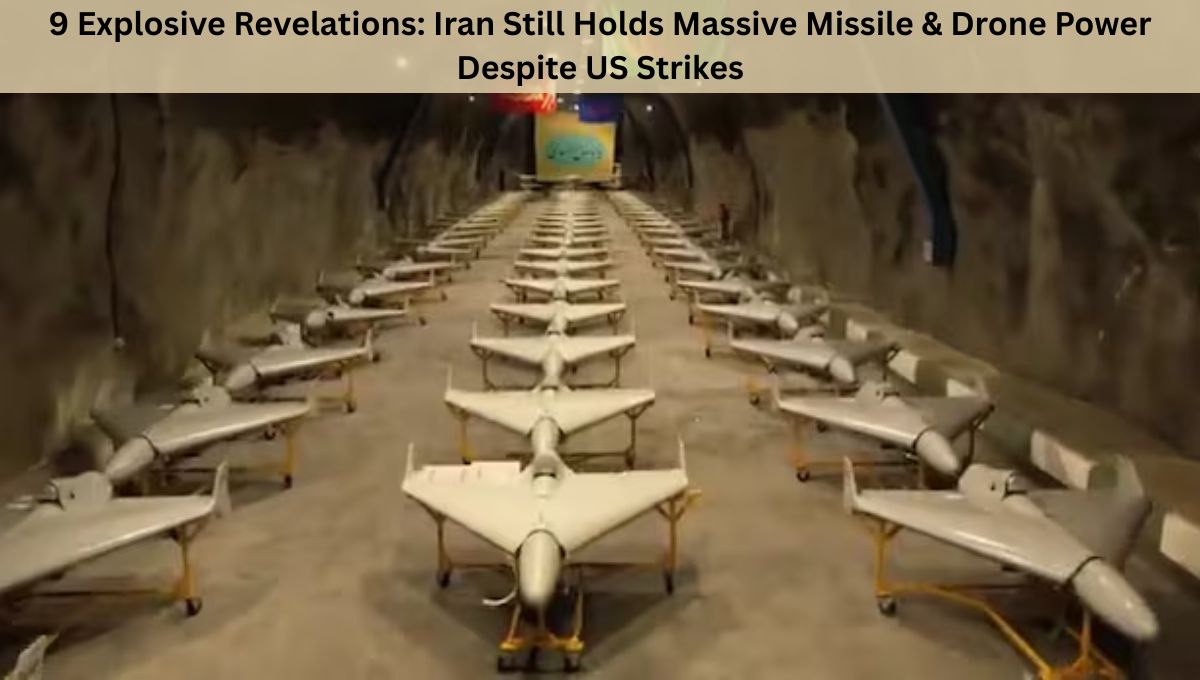
9 Explosive Revelations: Iran Still Holds Massive Missile & Drone Power Despite US Strikes, say’s US intelligence.A fresh intelligence assessment from the United States has cast serious doubt on claims that Iran’s military capabilities have been decisively crippled. Despite more than a month of relentless airstrikes by the United States and Israel, Tehran appears to retain a significant portion of its missile and drone arsenal—enough to continue posing a major threat across the Middle East.
While public statements from Donald Trump and senior officials have painted a picture of overwhelming success, classified intelligence reviewed by multiple sources suggests a far more complex and dangerous reality.
At the heart of this contradiction lies a critical question:
Has Iran truly been “decimated,” or is it simply adapting to a prolonged war?
9 Explosive Revelations: Iran Still Holds Massive Missile & Drone Power Despite US Strikes
The Intelligence Assessment: A More Nuanced Reality
Recent US intelligence findings indicate that roughly 50% of Iran’s missile launchers remain intact, along with thousands of one-way attack drones.
This suggests that, despite sustained bombardment, Iran’s offensive capabilities remain far from neutralized.
Officials familiar with the assessment emphasize that some launch systems may not be destroyed but merely rendered temporarily inaccessible, often buried under rubble or hidden deep within underground networks.
This distinction is crucial. A destroyed launcher is permanently removed from the battlefield. A buried one, however, can be restored and redeployed.
Missile Launchers: The Core of Iran’s Strike Capability
Missile launchers—not missiles themselves—are the backbone of Iran’s offensive strategy. Without them, even a large stockpile of missiles becomes ineffective.
Why Launchers Matter More Than Missiles
- Launchers determine how quickly and frequently missiles can be fired
- Mobile launchers allow “shoot-and-scoot” tactics
- Underground silos protect them from airstrikes
Iran has spent decades building a distributed and resilient launcher network, designed specifically to survive the kind of air campaign currently being conducted.
Underground Networks: A Strategic Advantage
Iran’s extensive system of tunnels and caves has proven to be one of its greatest defensive assets.
These facilities allow:
- Concealment of launchers
- Rapid redeployment
- Protection from surveillance and airstrikes
This strategy mirrors challenges faced by the US in tracking Houthi forces in Yemen—highlighting how asymmetric warfare continues to frustrate technologically superior militaries.
Drone Arsenal: The Silent Force Multiplier
Beyond missiles, Iran’s drone capabilities remain a major concern.
Scale of Remaining Drone Power
Intelligence estimates suggest:
- Around 50% of Iran’s drone arsenal is still operational
- Thousands of “kamikaze drones” remain available
- Production capabilities, though damaged, are not fully destroyed
Why Drones Are So Effective
Iranian drones are not just weapons—they are strategic tools:
- Low cost compared to missiles
- Difficult to detect and intercept
- Capable of overwhelming air defenses through swarm tactics
These drones have already demonstrated their effectiveness by targeting:
- Military bases
- Radar installations
- Commercial shipping
Cruise Missiles and the Strait of Hormuz
One of the most alarming aspects of the intelligence report is the survival of Iran’s coastal defense cruise missiles.
Strategic Importance of the Strait of Hormuz
Strait of Hormuz is one of the most critical chokepoints in the global energy system:
- Handles roughly 20% of global oil supply
- Essential for energy exports from Gulf countries
- Highly vulnerable to disruption
Iran’s Remaining Capability
The assessment indicates that many of Iran’s anti-ship missiles remain intact, largely because they have not been the primary target of US strikes.
This means Iran still has the ability to:
- Threaten commercial shipping
- Disrupt global oil markets
- Escalate the conflict beyond military targets
Contradiction with Public Statements
The intelligence findings stand in stark contrast to public remarks by Donald Trump, who has repeatedly claimed that Iran’s military has been “dramatically curtailed.”
What Officials Are Saying Publicly
- Missile and drone attacks are down by 90%
- Iran’s navy has been largely destroyed
- Weapons factories have been heavily damaged
What Intelligence Suggests
- Significant launch capacity remains
- Large stockpiles are still intact
- Operational flexibility persists
This gap highlights a common phenomenon in wartime:
the difference between political messaging and battlefield reality.
Decline in Attacks: A Misleading Indicator?
One of the key arguments made by US officials is that Iranian attacks have dropped sharply.
While this is true, analysts caution against misinterpreting the data.
Two Possible Explanations
- Capability Loss
Iran is unable to launch attacks at previous levels - Strategic Rationing
Iran is deliberately conserving resources for a longer conflict
Evidence increasingly points toward the second explanation.
Iran appears to be adopting a “strategic attrition” approach, carefully managing its remaining arsenal to sustain pressure over time.
While much of Iran’s conventional navy has been damaged, the Islamic Revolutionary Guard Corps (IRGC) Navy remains a significant force.
What Remains
- Hundreds to thousands of small boats
- Unmanned surface vessels
- Fast-attack craft
These assets are particularly effective in asymmetric naval warfare, especially in confined waters like the Strait of Hormuz.
Why This Matters
Even a weakened naval force can:
- Harass commercial shipping
- Lay naval mines
- Launch swarm attacks on larger vessels
Regional Escalation: Expanding Conflict Zones
The conflict is no longer confined to Iran.
Recent Developments
- Strikes reported in the UAE and Bahrain
- Attacks targeting industrial infrastructure
- Continued missile exchanges with Israel
Israel remains a primary target, but the conflict is increasingly spilling over into the broader Gulf region.
Global Economic Impact
The implications of Iran’s remaining capabilities extend far beyond the battlefield.
Energy Markets Under Pressure
Disruptions in the Strait of Hormuz could lead to:
- Sharp increases in oil prices
- Supply chain disruptions
- Inflationary pressures worldwide
Shipping and Trade Risks
- Increased insurance costs for shipping
- Rerouting of vessels
- Delays in global trade
War Duration: No Quick End in Sight
Despite optimistic timelines suggested by officials, intelligence sources indicate that the conflict is unlikely to end quickly.
Why a Rapid Resolution Is Unlikely
- Iran retains significant capabilities
- Underground infrastructure limits damage
- Asymmetric tactics prolong the conflict
One source bluntly described expectations of a quick victory as unrealistic, emphasizing the complexity of dismantling a deeply entrenched military system.
The Role of Proxies
Iran’s regional influence extends through its network of proxy groups.
Key Players
- Hezbollah in Lebanon
- Houthi forces in Yemen
- Various militias across Iraq and Syria
These groups allow Iran to project power indirectly, complicating efforts to contain the conflict.
Legal and Ethical Concerns
The conflict has also raised serious questions about international law.
Potential War Crimes Debate
Experts warn that targeting civilian infrastructure—such as:
- Power plants
- Water systems
- Medical facilities
could violate the Geneva Conventions.
Statements suggesting widespread destruction of civilian infrastructure have intensified these concerns.
Information Warfare and Perception
Another critical dimension is the battle over narrative.
Why Narratives Matter
- Influence public opinion
- Shape diplomatic outcomes
- Affect market reactions
History shows that military capability estimates are often inflated or minimized for strategic reasons.
Strategic Takeaways
1. Iran Is Weakened—but Not Defeated
The country has lost significant assets but retains enough capability to continue fighting.
2. Underground Infrastructure Is a Game-Changer
Tunnels and mobile systems make complete destruction extremely difficult.
3. Drones Are Redefining Warfare
Low-cost UAVs are proving highly effective against advanced defenses.
4. The Conflict Has Global Implications
Energy markets, shipping, and geopolitical stability are all at risk.
Conclusion: A Conflict Entering a Dangerous Phase
The latest intelligence assessment underscores a critical reality:
this war is far from over.
Despite weeks of intense bombardment, Iran retains substantial military capabilities, including missile launchers, drones, and naval assets.
These remaining forces are sufficient not only to sustain the conflict but also to escalate it in ways that could have far-reaching global consequences.
The gap between public claims and intelligence findings highlights the uncertainty surrounding the true state of the battlefield.
As the conflict evolves, one thing is clear:
underestimating Iran’s remaining capabilities could prove to be a costly mistake.
For now, the world watches as a high-stakes confrontation continues to unfold—one that could reshape the balance of power in the Middle East and beyond.
Also Read: 10 Explosive Developments in Iran War Talks as Pakistan Emerges Key Peace Broker
Also Read: Iran Is Firing Fewer Missiles. But Its Hit Rate Is Increasing. Why?
Related Posts:
- 3 Explosive Conditions Iran Sets to End War with US…

- 7 Powerful Facts About Ayatollah Ali Khamenei’s…

- 10 Explosive Warnings as Donald Trump Calls Iran…

- 5 Major Takeaways from the US Supreme Court's…

- 7 Heartbreaking Facts About Venezuela's Earthquake Disaster

- 9 Explosive Claims as Trump Says US Winning Iran War